Introduction:
Choosing the right marketing partner can directly affect how effectively your business attracts customers, generates leads, and converts opportunities into revenue. But when your marketing involves multiple channels, platforms, campaigns, and creative requirements, managing several disconnected providers can become difficult.
A full service marketing agency brings different marketing capabilities together under one coordinated strategy. Instead of hiring separate companies for search engine optimization, paid advertising, social media, content, branding, and website development, businesses can work with one partner to plan, manage, and improve their marketing activities.
However, not every agency that advertises itself as full-service offers the same capabilities. Some focus primarily on traditional advertising, while others specialize in digital channels, performance marketing, or integrated brand campaigns.
Understanding what a full-service marketing agency actually does, which services your business needs, and how to evaluate potential partners can help you make a more informed decision.
This guide explains the services, benefits, costs, and selection criteria businesses should consider when choosing a full-service marketing partner.
What Is a Full-Service Marketing Agency?
A full-service marketing agency provides multiple marketing services through one coordinated team or agency relationship. Its capabilities may include marketing strategy, branding, advertising, public relations, content creation, digital marketing, website development, campaign management, and performance measurement.
The main idea is integration. Rather than treating every marketing channel as a separate activity, a full-service agency connects them to support shared business objectives.
For example, a company launching a new service might need:
- Market and audience research to understand potential customers.
- Branding and creative development to establish a consistent message.
- Website and landing page development to communicate the offer.
- Search engine optimization to build long-term organic visibility.
- Google Ads and paid social campaigns to attract relevant prospects.
- Content marketing to answer customer questions and build trust.
- Conversion rate optimization to improve the percentage of visitors who take action.
- Analytics and reporting to evaluate campaign performance.
A full-service partner can coordinate these activities so that the website, advertising, content, and customer experience work toward the same goals.
The defining feature is not simply the number of services an agency lists. It is how effectively those services are planned, delivered, measured, and connected.
Full-Service Marketing Agency vs. Full-Service Digital Marketing Agency
A traditional full-service marketing agency may provide both online and offline marketing services. A full-service digital marketing agency generally focuses on digital channels, technology, online customer acquisition, and measurable website or campaign performance.
| Area |
Full-Service Marketing Agency |
Full-Service Digital Marketing Agency |
| Marketing strategy |
Yes |
Yes |
| Branding and creative |
Common |
Common |
| Traditional advertising |
May include |
Usually limited |
| Public relations |
May include |
Depends on agency |
| Search engine optimization |
May include |
Common |
| Google and paid social advertising |
May include |
Common |
| Social media marketing |
May include |
Common |
| Website development |
Depends on agency |
Common |
| Email marketing |
May include |
Common |
| Analytics and conversion tracking |
Varies |
Common |
| Conversion optimization |
Varies |
Common |
The right choice depends on your business model and customer acquisition strategy.
A company running television, print, event, and digital campaigns may need a broader traditional marketing partner. A business that primarily generates customers through Google, social media, websites, and online sales may benefit more from a full-service digital marketing agency.
Before hiring either type, confirm which services are delivered internally, which are handled through partners, and who is accountable for the overall strategy.
What Services Does a Full-Service Marketing Agency Offer?
A
full-service marketing agency can cover several stages of the customer journey, from building awareness to generating demand and converting prospects.
The exact service mix varies by provider. These are the major capabilities businesses commonly evaluate.
1. Marketing Strategy and Planning
Marketing should begin with a clear understanding of the business, its customers, competitive environment, and commercial objectives.
A marketing strategy establishes:
- Target audiences and customer segments.
- Products or services to prioritize.
- Market positioning and messaging.
- Customer acquisition channels.
- Marketing budget allocation.
- Campaign objectives and performance indicators.
- Short-term priorities and longer-term growth opportunities.
Without a strategy, businesses can end up spending across multiple channels without understanding how those activities contribute to their goals.
A capable agency should explain why it recommends specific channels, what each channel is expected to achieve, and how performance will be evaluated.
2. Search Engine Optimization (SEO)
Search engine optimization helps businesses improve their visibility in unpaid search results when potential customers look for relevant products, services, or information.
SEO commonly includes:
- Technical SEO and website health.
- Keyword and search-intent research.
- On-page optimization.
- Content strategy and development.
- Internal linking.
- Local SEO.
- Link acquisition and authority development.
- Search performance monitoring.
For businesses that depend on people discovering them through Google, SEO can support long-term organic customer acquisition.
A well-planned SEO campaign should focus on relevant search visibility, qualified website traffic, and business opportunities—not simply the number of keywords a website ranks for.
3. Google Ads and Paid Search Advertising
Google Ads allows businesses to reach people searching for products and services through paid placements across Google’s advertising network.
A full-service digital marketing agency may manage:
- Search campaigns.
- Display advertising.
- Shopping campaigns.
- YouTube advertising.
- Remarketing.
- Keyword and audience targeting.
- Conversion tracking.
- Budget and bidding optimization.
- Landing page performance.
Paid search can be particularly useful when a business wants to reach people who are actively searching for a solution.
However, campaign performance depends on more than advertising spend. Keyword relevance, offer quality, competition, landing page experience, conversion tracking, and sales follow-up all influence the outcome.
4. Social Media Marketing and Paid Social Advertising
Social media marketing helps businesses build an audience, communicate their value, distribute content, and generate demand.
Depending on the target audience and business model, an agency may work across platforms such as Facebook, Instagram, LinkedIn, TikTok, and other relevant networks.
Services can include:
- Social media strategy.
- Content planning and publishing.
- Creative design.
- Short-form video content.
- Community engagement.
- Paid social campaigns.
- Audience targeting.
- Retargeting and campaign optimization.
Organic social media and paid advertising serve different purposes. Organic content supports ongoing communication and brand development, while paid campaigns can extend reach and target specific audience segments.
Businesses should select platforms based on where their customers spend time and how those platforms support their buying journey.
5. Content Marketing
Content marketing involves creating and distributing useful information that helps potential customers understand a problem, evaluate solutions, and make purchasing decisions.
Common content formats include:
- Blog articles and educational guides.
- Website service pages.
- Industry-specific landing pages.
- Case studies and customer stories.
- Downloadable resources.
- Email content.
- Video scripts and social media content.
Effective content should serve a defined audience and search intent. An article intended to educate someone researching a problem needs a different approach from a landing page targeting someone ready to request a quote.
A strong content strategy connects topics to the services a business sells and the questions customers ask before making a decision.
6. Website Development and Landing Page Design
A business website is often where potential customers evaluate a company before contacting its sales team or making a purchase.
Website development and landing page services may include:
- Custom website development.
- CMS-based website development.
- Website redesigns.
- Service and industry pages.
- E-commerce functionality.
- Responsive design.
- Website speed and technical improvements.
- Landing page design.
- Contact and lead-generation forms.
A website should make it easy for visitors to understand what the business offers, why it is relevant, and what action to take next.
For advertising campaigns, landing pages should match the message and offer in the advertisement. Sending paid traffic to an unrelated or confusing page can reduce the effectiveness of an otherwise well-targeted campaign.
7. Conversion Rate Optimization (CRO)
Generating website traffic is only part of the marketing process. Businesses also need to understand whether visitors are taking meaningful actions.
Conversion rate optimization focuses on identifying and reducing obstacles that prevent visitors from completing desired actions.
A CRO process may examine:
- Landing page messaging.
- Calls to action.
- Form length and usability.
- Page layout and navigation.
- Mobile experience.
- Page loading performance.
- Trust signals and supporting information.
- User behavior and conversion data.
For example, if a business receives relevant traffic from Google Ads but very few visitors submit inquiries, the problem may involve the offer, landing page, form, pricing information, or customer experience.
CRO helps businesses investigate these issues instead of automatically increasing advertising budgets.
8. Branding and Creative Design
Branding helps businesses communicate a recognizable identity and establish a consistent market position.
A branding and creative team may work on:
- Brand positioning.
- Visual identity.
- Logo and brand guidelines.
- Messaging and tone of voice.
- Advertising creatives.
- Social media graphics.
- Marketing materials.
- Campaign concepts.
Consistent branding can make it easier for customers to recognize a business across its website, advertisements, social profiles, and other customer touchpoints.
9. Email Marketing and Marketing Automation
Email marketing gives businesses a direct way to communicate with subscribers, leads, and existing customers.
Depending on the business, campaigns may include:
- Welcome sequences.
- Lead-nurturing emails.
- Promotional campaigns.
- Product announcements.
- Customer retention campaigns.
- Follow-up messages.
- Re-engagement sequences.
Marketing automation can connect these communications to customer actions. For example, someone who downloads a guide may receive a relevant follow-up sequence, while an existing customer may receive different information.
Automation should improve communication and follow-up—not create unnecessary messages or replace a useful customer experience.
10. Analytics, Reporting, and Performance Measurement
A marketing agency should be able to explain what is happening across campaigns and whether the work is contributing to business objectives.
Depending on the engagement, measurement may include:
- Website traffic and engagement.
- Organic search performance.
- Advertising spend.
- Cost per click.
- Cost per lead.
- Lead quality.
- Conversion rates.
- Customer acquisition cost.
- Return on advertising spend.
- Sales pipeline and revenue attribution.
Not every metric is equally important for every business. A local service company may prioritize qualified calls and booked appointments, while an e-commerce business may focus on purchases, average order value, and contribution margin.
The reporting system should reflect the way the business actually makes money.
How Do Full-Service Marketing Services Work Together?
The biggest advantage of an integrated marketing approach is that different channels can support one another.
Consider a U.S.-based home services company that wants to generate more qualified customer inquiries.
A coordinated marketing program might work like this:
- Strategy: Identify the company’s most profitable services, target locations, and ideal customers.
- Website: Build clear service pages and landing pages that explain the offer and make it easy to contact the business.
- SEO: Improve organic visibility for relevant service and location searches.
- Google Ads: Reach people actively searching for the company’s services.
- Social media: Build brand familiarity and support local awareness.
- Conversion optimization: Review calls, forms, and landing page behavior to identify barriers to conversion.
- Measurement: Track qualified inquiries, booked jobs, campaign costs, and revenue where data is available.
The channels have different roles, but they contribute to a shared acquisition process.
This is what separates an integrated marketing program from a collection of unrelated services.
Benefits of Hiring a Full-Service Marketing Agency
Working with one agency for multiple marketing functions can offer several advantages. The value depends on the agency’s capabilities, communication, processes, and ability to connect its work to business goals.
One Coordinated Marketing Strategy
When multiple providers work independently, they may use different messaging, priorities, reporting methods, and campaign assumptions.
A coordinated agency relationship can make it easier to align SEO, paid advertising, content, creative, and website improvements around common objectives.
Access to Multiple Areas of Expertise
Businesses may need specialists in search, advertising, design, content, development, and analytics.
A full-service agency can provide access to several disciplines without requiring the business to hire every specialist full-time.
The important question is whether the agency has genuine capability in the services it promises.
More Consistent Brand Messaging
Customers may interact with a business through its website, social media, search listings, advertisements, and email campaigns.
A coordinated approach helps keep messaging, visual identity, and offers consistent across these touchpoints.
Better Visibility Across Marketing Performance
When campaigns are measured through a connected reporting process, businesses can better understand how different channels contribute to traffic, leads, and sales.
This does not automatically guarantee perfect attribution. Tracking limitations, long sales cycles, offline conversions, and customer journeys across multiple devices can make measurement difficult.
A reliable agency should explain these limitations rather than presenting every conversion as unquestionably attributable to one channel.
Less Vendor Coordination
Managing multiple agencies and freelancers can create additional communication, approval, and project-management responsibilities.
A single primary partner may simplify coordination, particularly when several services need to be delivered as part of one campaign.
However, one agency is not automatically better than multiple specialists. The decision depends on the complexity of the business and the quality of the available providers.
A Marketing Program That Can Adapt
Business priorities change. A company may need to focus on lead generation this quarter, improve website conversion next quarter, or expand into another market later.
An agency that understands the broader strategy can help adjust channel priorities as the business develops.
Who Should Hire a Full-Service Marketing Agency?
A
full-service marketing partner may be useful for businesses that need several marketing capabilities but do not want to manage every function internally.
Small and Medium-Sized Businesses
SMBs often have limited internal marketing resources. A suitable agency can provide access to strategic planning, campaign management, content, and creative support.
The service mix should reflect the company’s budget and immediate growth priorities.
Startups and Growing Companies
Startups may need to establish positioning, launch a website, build initial awareness, and test customer acquisition channels.
A coordinated agency can help prioritize these activities and avoid investing in channels before the business has a clear offer or target audience.
E-Commerce Businesses
E-commerce brands often need a combination of paid advertising, SEO, product content, social media, email marketing, landing page improvements, and conversion optimization.
Because online sales can be measured at several stages, these businesses may benefit from a partner that understands the relationship between advertising costs, customer acquisition, conversion rates, and order value.
B2B Companies
B2B businesses often have longer sales cycles and multiple decision-makers. Their marketing may require SEO, thought leadership, paid campaigns, landing pages, lead nurturing, and sales alignment.
A suitable agency should understand the difference between generating a form submission and generating a qualified sales opportunity.
Local and Multi-Location Businesses
Local businesses may need location-specific SEO, Google Business Profile optimization, paid search, review management, website improvements, and lead tracking.
Companies operating in multiple cities may also need consistent branding and a structured approach to local landing pages and campaign management.
How Much Does a Full-Service Marketing Agency Cost?
There is no single standard price for hiring a full-service marketing agency. Costs depend on the scope of work, number of services, campaign complexity, advertising budget, business size, and level of strategic support.
Common pricing arrangements include:
| Pricing model |
How it works |
Often suitable for |
| Monthly retainer |
A recurring fee for an agreed scope of services |
Ongoing marketing management |
| Project-based pricing |
A fixed price for a defined deliverable |
Website development, branding, or audits |
| Hourly consulting |
Payment for a defined amount of expert time |
Strategy, reviews, and specialist advice |
| Performance-based pricing |
Fees linked to agreed performance conditions |
Selected campaigns with clearly defined measurement |
When comparing proposals, separate the agency's management fee from the actual advertising spend. A Google Ads management fee, for example, is not the same as the budget paid to Google.
Before signing an agreement, clarify:
- Which services are included?
- What deliverables will be provided?
- Who creates and approves campaign content?
- Is advertising spend billed separately?
- Who owns the advertising accounts and website assets?
- What reporting will be provided?
- How are additional requests priced?
- What is the contract length and cancellation policy?
- How will success be measured?
The lowest proposal is not necessarily the best value. Compare the actual scope, expertise, communication, measurement, and expected business contribution.
Full-Service Marketing Agency vs. In-House Marketing Team
Businesses often compare outsourcing with building an internal marketing department.
Neither approach is automatically right for every company.
| Factor |
Full-Service Agency |
In-House Team |
| Specialist access |
Multiple disciplines may be available through one provider |
Depends on hiring and team structure |
| Management |
Agency manages its agreed scope |
Business manages the team |
| Internal knowledge |
Requires onboarding and ongoing communication |
Knowledge stays within the company |
| Flexibility |
Scope may be adjusted through an agreement |
Priorities can be changed internally |
| Cost structure |
Agency fees and additional costs |
Salaries, benefits, tools, and management |
| Control |
Shared through agreed processes and access |
Direct day-to-day oversight |
Some businesses use a hybrid model: an internal marketing manager owns the strategy and customer knowledge, while an external agency handles specialist execution.
The best structure depends on the workload, the expertise required, the company’s resources, and how closely marketing needs to work with sales or operations.
How to Choose the Right Full-Service Marketing Agency
Choosing an agency requires more than reviewing a service list or comparing prices. The provider should understand your business, explain its approach, and show how it will manage the work.
Use the following checklist when evaluating potential partners.
1. Define Your Business Goals First
Before contacting agencies, identify what you want marketing to achieve.
Examples include:
- Increasing qualified leads.
- Growing online sales.
- Improving organic search visibility.
- Reducing customer acquisition costs.
- Expanding into new markets.
- Improving website conversion rates.
- Building awareness for a new product or service.
Clear goals make it easier to compare proposals and reject services that do not support your priorities.
2. Check Relevant Industry Experience
Ask whether the agency has worked with businesses similar to yours in terms of industry, audience, business model, sales cycle, or marketing objectives.
Relevant experience doesn't guarantee success, but it can help the agency understand the market and spot potential challenges.
Request examples of actual work and ask what the agency was responsible for.
3. Evaluate Its Real Service Capabilities
Ask who will deliver each service and how the agency manages the work.
A provider may list SEO, paid media, web development, and branding, but its actual expertise may be concentrated in only one or two areas.
Find out whether an internal team, freelancers, or external partners complete the work. None of these arrangements is automatically wrong, but the delivery model should be transparent.
4. Understand the Strategy Behind the Proposal
A proposal should explain more than the number of posts, backlinks, advertisements, or articles included.
It should identify:
- The business problem being addressed.
- The audience being targeted.
- The recommended channels.
- The reason for selecting those channels.
- The expected deliverables.
- The measurement approach.
- The priorities for the initial period.
The agency should be able to explain its decisions in language you understand.
5. Review Reporting and Measurement
Ask what you will receive in monthly or campaign reports.
Look for meaningful information about qualified leads, conversion activity, campaign costs, organic performance, and revenue where reliable tracking is available.
Be cautious when an agency reports only impressions, followers, clicks, or rankings without explaining how those metrics relate to your objectives.
6. Confirm Account and Asset Ownership
Your business should understand who controls important marketing assets.
Discuss ownership and access for:
- Website and domain.
- Google Analytics and Search Console.
- Google Ads accounts.
- Meta Business assets.
- Social media accounts.
- Creative files.
- Customer and lead data.
Make sure the agreement explains access, ownership, and what happens when the relationship ends.
7. Understand Communication and Accountability
Find out who manages your account, how often meetings take place, how approvals work, and who is responsible for resolving problems.
A good working relationship requires clear expectations on both sides.
8. Be Careful With Guaranteed Results
No agency can responsibly guarantee a specific Google ranking, number of leads, or return on advertising spend in every market and situation.
Performance depends on competition, budget, offer quality, customer demand, website experience, sales follow-up, and many other factors.
Look for a provider that explains its assumptions, measurement methods, and limitations.
Why Consider Adscular Agency?
Adscular Agency provides digital marketing and growth services for businesses looking to strengthen their online presence, reach relevant audiences, and improve customer acquisition.
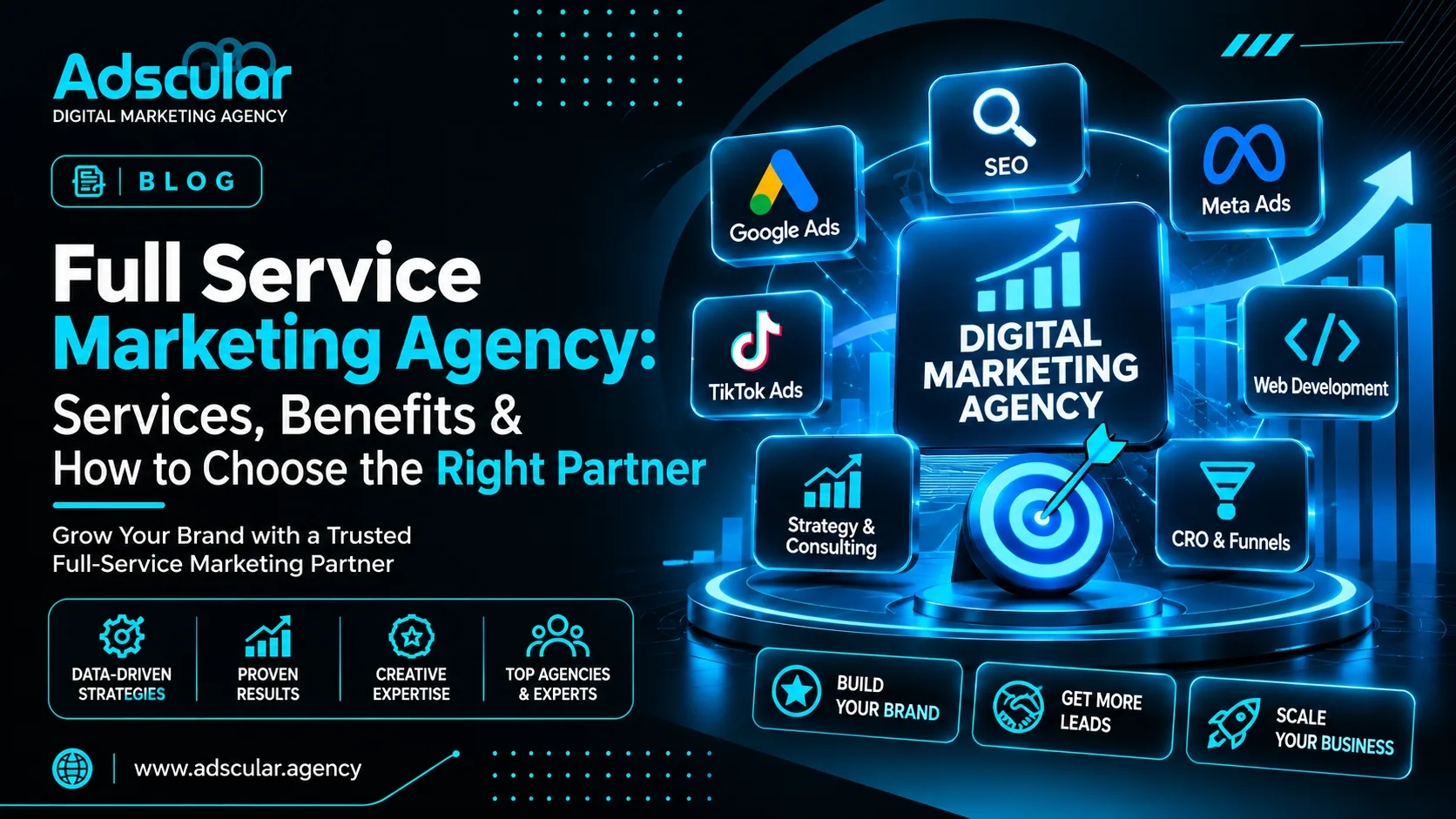
Its service capabilities include:
- SEO: Search engine optimization to improve relevant organic visibility.
- Google Ads: Paid search campaign management and optimization.
- Meta Ads: Facebook and Instagram advertising.
- Social Media Marketing: Social content and audience development.
- Website Development: Custom and CMS-based website development.
- Landing Page Design: Campaign-focused pages designed around clear user actions.
- Conversion Rate Optimization: Improving the website experience and conversion process.
- Branding and Creative Design: Visual identity and marketing creative.
- Lead Generation and Funnel Building: Structuring campaigns and customer journeys around lead acquisition.
- Marketing Strategy Consulting: Planning marketing priorities around business goals.
The right combination depends on your industry, current marketing performance, budget, and growth objectives. Not every business needs every service at the same time.
If you are evaluating a digital marketing partner, start with the business outcome you want to improve. From there, you can determine the right channel mix and scope of work.
Frequently Asked Questions About Full-Service Marketing Agencies
What does a full-service marketing agency do?
A full-service marketing agency provides multiple marketing capabilities through one coordinated provider. Depending on its offering, services may include strategy, branding, advertising, SEO, content marketing, social media, website development, email marketing, and campaign measurement.
What is the difference between a marketing agency and a full-service marketing agency?
A marketing agency may specialize in one area, such as SEO, paid advertising, branding, or social media. A full-service marketing agency offers several marketing disciplines and coordinates them under a broader strategy.
What is a full-service digital marketing agency?
A full-service digital marketing agency focuses on online marketing channels and activities. These may include SEO, paid search, social media advertising, content, email marketing, website development, conversion optimization, and digital analytics.
Is hiring a full-service marketing agency worth it?
It can be worthwhile when a business needs multiple marketing capabilities and values having one coordinated partner. The decision depends on the agency’s expertise, the quality of its work, the scope of services, and whether the investment supports business objectives.
What services should a full-service marketing agency include?
There is no universal service package. Common capabilities include marketing strategy, SEO, paid advertising, social media, content, branding, website development, email marketing, conversion optimization, and reporting. Businesses should choose services based on their needs rather than buying every available service.
How much does a full-service marketing agency charge?
Pricing varies by agency, service scope, campaign complexity, business size, and required expertise. Agencies may charge monthly retainers, project fees, hourly consulting rates, or agreed performance-based fees. Advertising spend is often separate from the agency’s management fee.
Is a full-service marketing agency better than hiring multiple specialists?
It depends on the business. One agency may simplify communication and coordinate campaigns, while multiple specialists may provide deeper expertise in specific channels. Evaluate delivery quality, accountability, coordination, and total cost before deciding.
How long does it take to see results from a full-service marketing agency?
Timelines depend on the channels and objectives involved. Paid campaigns may generate early activity after launch, while SEO and content marketing typically require sustained work before meaningful organic improvements become visible. Website development, tracking, and conversion improvements also have their own timelines.
Can a full-service marketing agency work with a small business?
Yes. Some agencies work with small businesses and offer a focused combination of services. The scope should match the available budget, business priorities, and capacity to handle new leads or sales.
What should I ask before hiring a full-service marketing agency?
Ask about relevant experience, service delivery, account ownership, pricing, reporting, communication, campaign strategy, contract terms, and how success will be measured. Request a clear proposal that connects the recommended work to your business objectives.
Final Thoughts
A full-service marketing agency can help businesses coordinate different marketing activities through one strategic relationship. But the value does not come from having the longest service list. It comes from choosing the right capabilities, connecting them to business goals, and measuring whether the work is producing meaningful progress.
Before selecting an agency, evaluate its expertise, delivery process, transparency, communication, and understanding of your customers. Start with your most important business objective, then build a marketing plan around the channels and services that can realistically support it.
For businesses looking for a digital marketing partner,
Adscular Agency can be a starting point for discussing a strategy based on their marketing requirements and growth priorities.