Facebook Ad Campaign Cost: What You'll Actually Pay in 2026
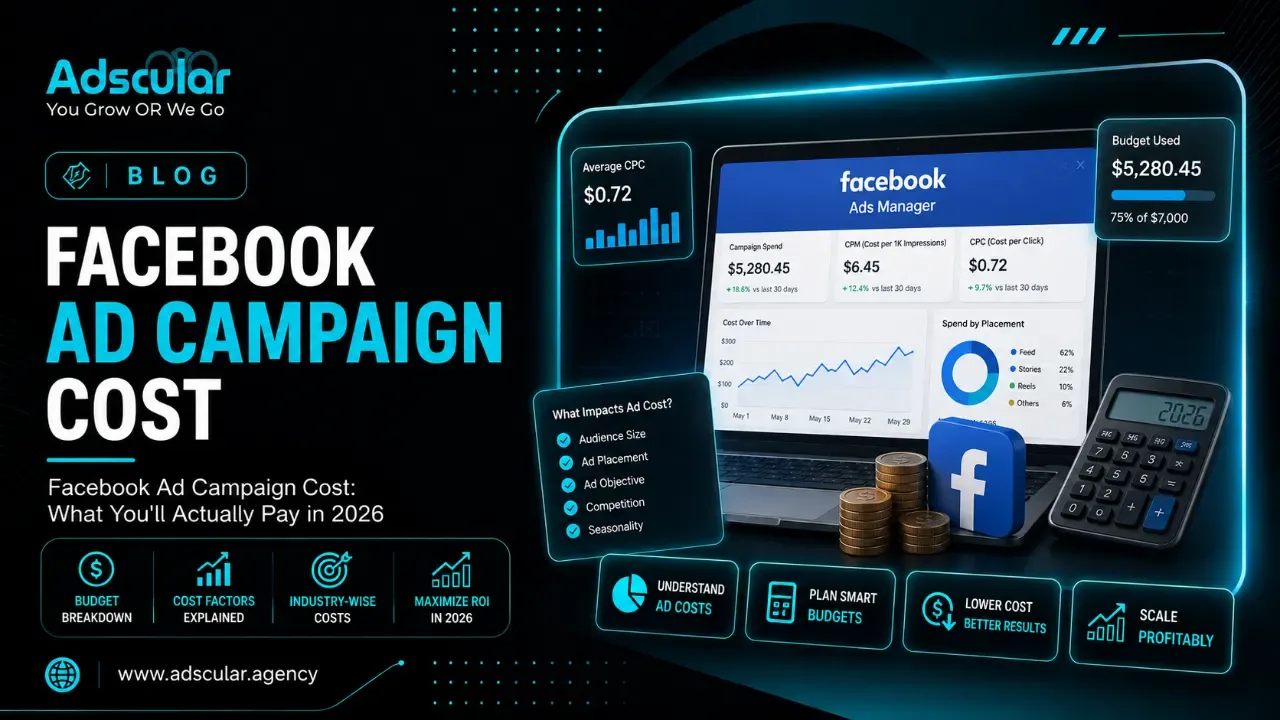
How Much Should You Really Spend on Facebook Ads in 2026?
Written by the Adscular Agency growth team | June 20, 2026 | 7 min read
Introduction:
Quick Answer: Most businesses pay between $0.70 and $1.92 per click on Facebook, $5 to $16 per 1,000 impressions, and roughly $20 to $35 per lead, though your exact cost depends heavily on your industry, objective, and audience competitiveness. A realistic starting budget for testing is $1,000 to $2,000 per month — anything lower and you won't generate enough data for Meta's algorithm to optimize properly.
How much does a Facebook ad campaign cost?
Budget $20 to $50 per day minimum to test a new campaign, and expect to spend that for at least 7 to 14 days before drawing conclusions. Below that, you're not really testing — you're guessing with extra steps.
Why Facebook ad campaign cost matters more than the number itself
The number on its own tells you almost nothing. A $1,200/month account producing $40 leads for a $15,000 average sale is a great deal. The same $1,200 producing $40 leads for a $200 product is a losing proposition. At Adscular Agency, a US-based performance marketing agency running Meta Ads, Google Ads, and full-funnel lead generation for clients in healthcare, legal, SaaS, e-commerce, and home services, the question we actually get isn't "how much do Facebook ads cost" — it's "how much should I be spending to hit my numbers." Those are different questions, and most cost guides only answer the first one.
What determines your Facebook ad campaign cost
Three things drive your price in the Meta auction: how much competition exists for your audience, how relevant Meta judges your ad to be, and your estimated action rate. Win on relevance and you pay less than a competitor with a bigger budget and a worse ad.
How does campaign objectives affect cost?
Awareness campaigns get the cheapest CPMs because Meta optimizes purely for reach, with little regard for whether anyone acts on what they see. Conversion campaigns cost more per impression because Meta is working harder to find people likely to actually buy, book, or fill out a form — and that targeting precision isn't free.
How does industry affect cost?
This is where the averages stop being useful and the range becomes the whole story. WordStream's benchmark data puts average cost-per-lead across all industries around $20-$28, but that masks a massive spread — restaurants and food brands can land leads for $3-4, while dentists and other high-ticket local services routinely pay $50-$77 per lead. If you're in a competitive, high-LTV niche, comparing yourself to a "global average" will just make you think something's broken when nothing is.
Facebook ad cost by metric: a quick reference
|
Metric |
Typical Range |
What It Means |
|
CPC (cost per click) |
$0.70 – $1.92 |
What you pay per click; varies heavily by objective |
|
CPM (cost per 1,000 impressions) |
$5 – $16 |
Cheapest for awareness, rises for retargeting and competitive niches |
|
CPL (cost per lead) |
$3 – $77 |
Widest range of any metric — almost entirely industry-driven |
|
CPA (cost per action/conversion) |
$8 – $55 |
Depends on funnel stage and how "expensive" the action is to earn |
Treat this table as a sanity check, not a target. If your numbers fall outside these ranges, that's not automatically bad — it depends entirely on what the result is worth to your business.
How to set your own Facebook ad campaign budget
-
Calculate your target cost per acquisition.
Take your average customer value and your acceptable marketing spend percentage, and work backward to a number you can actually afford to pay per lead or sale.
-
Multiply by your expected conversion rate.
If your landing page converts at 10% and you need 10 customers, budget for 100 leads at your target CPL.
-
Add 20% for creative testing.
You won't know your winning ad on day one — build testing cost into the plan instead of treating it as a surprise.
-
Run a minimum 7-14 day learning phase before judging results.
Pulling the plug on day 3 because costs look high is the single most common reason businesses conclude "Facebook ads don't work" when the algorithm never finished learning.
-
Scale in 20% increments, not by doubling overnight.
A sudden budget jump resets Meta's learning phase and often spikes your costs right when you thought you'd found a winner.
What a poorly managed account actually costs you
Here's the part most pricing guides skip entirely: the real cost of Facebook ads isn't the platform spend, it's the spend wasted on campaigns nobody's actively managing. An account left on autopilot with stale creative and no audience refinement routinely runs 30-40% above what the same budget would deliver under active optimization — that's not a guess, it's what shows up every time we audit a new account that's been running unmanaged for more than a couple months. If you're trying to understand how this compares to running ads on Google instead, our breakdown of Google Ads vs. Meta Ads for lead generation covers where each platform actually wins.
Frequently asked questions
What's a good Facebook ad budget for a small business?
Start with $1,000-$1,500 per month if you're testing for the first time. That's enough to run 3-5 creative variants at a meaningful daily spend without exhausting your budget before the algorithm has learned your audience.
Why did my Facebook ad costs suddenly increase?
Usually one of three things: rising competition in your auction (common in Q4), ad fatigue from running the same creative too long, or a recent budget change that reset your campaign's learning phase. Refresh creative every 4-6 weeks to stay ahead of fatigue before it shows up in your costs.
Is Facebook advertising cheaper than Google Ads?
Generally yes on a per-click basis — Facebook's average CPC tends to run lower than Google's. But Facebook targets based on interest and behavior rather than active search intent, so the people clicking aren't always as close to a buying decision as a Google searcher already typing your service into the search bar.
How much should I spend per day to test a new campaign?
$20-$50 per day is the realistic floor for gathering usable data within two weeks. Anything under $5/day technically runs, but won't generate enough signal for Meta's algorithm to optimize delivery in any meaningful way.
Do Facebook ad costs vary by season?
Yes, significantly. Q4 CPMs run roughly 15% higher than Q3 due to holiday-season competition. If your budget is tight, running awareness campaigns in Q1 — when costs typically bottom out — stretches your dollars further.
The bottom line
Facebook ad campaign cost isn't a fixed number — it's a range shaped by your industry, your objective, and how actively your account gets managed. Use the benchmarks here as a starting reference point, then build your real budget backward from what a customer is actually worth to your business.
If you want a performance marketing system that actually generates leads — not just impressions — get your free revenue growth audit. We'll show you exactly where your traffic is leaking and what it would take to fix it.
Want to go deeper? Read our full guide: Google Ads vs. Meta Ads for Lead Generation