
Local SEO for Service Businesses: How to Dominate Local Search and Turn Rankings Into Revenue (2026)
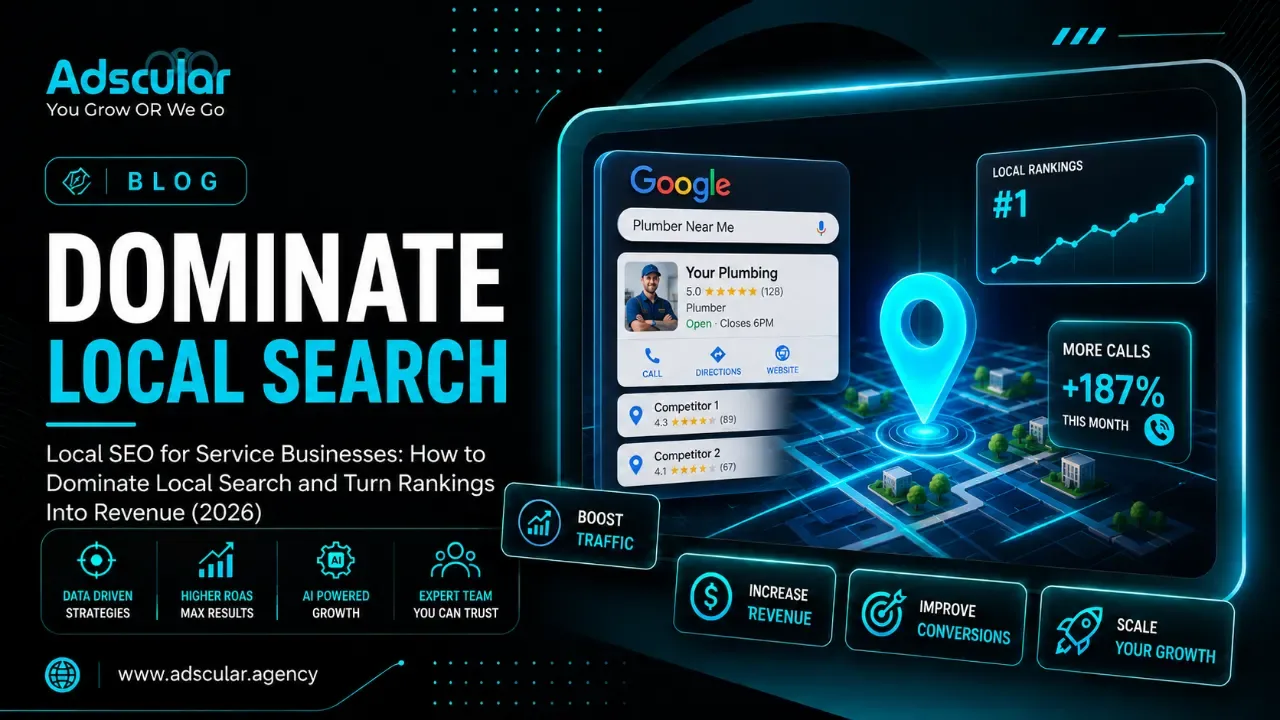
How Local SEO Turns Nearby Searches Into Revenue
Written by the Adscular Agency growth team | June 24, 2026 | 8 min read
Introduction:
Quick Answer: Local SEO for service businesses is the practice of optimizing your online presence so that nearby customers find you — not your competitor — when they search for what you offer. For a law firm, an HVAC company, a healthcare clinic, or any business that earns revenue from local customers, appearing in Google's top three local results isn't a marketing goal. It's a revenue lever.
At Adscular Agency, we build SEO systems for service businesses across healthcare, legal, home services, real estate, and B2B — and the pattern is consistent: businesses that control local search own their local market. The ones that don't are subsidizing their competitors.
What Is Local SEO and Why Does It Matter?
Local SEO is how you get your business into Google's Map Pack — the three listings that appear before any organic results when someone searches for a service near them. According to Google's own data, 76% of people who run a nearby search on their phone visit a business within 24 hours. That's not traffic. That's the intent.
The problem: only 35% of small-to-medium businesses have a Google Business Profile, and 56% of those who do haven't optimized it (SMB Marketing Report 2025). That gap is your opportunity.
Why Local SEO Hits Different for Service Businesses
Product companies can sell anywhere. You can't. If you run an HVAC company in Austin, a dental practice in Miami, or a law firm in Chicago, your revenue depends on people within a specific radius finding you before they find someone else.
Local lead generation through search is the highest-intent channel available to service businesses. The person searching "emergency plumber near me" is not browsing. They're ready to pay right now. Paid ads can capture that moment, but SEO vs. Google Ads for local lead generation shows a clear long-term advantage: local organic rankings compound over time while ad costs climb.
Here's what the data says about the local search opportunity in 2026:
- 46% of all Google searches carry local intent (Google)
- 75% of small businesses report local SEO generates more leads than paid advertising (BrightLocal)
- Local SEO produces leads at 61% lower cost than outbound marketing (HubSpot)
- 87% of consumers read online reviews before choosing a local business (BrightLocal 2026)
The businesses winning on local search aren't doing anything magical. They're executing a system consistently.
How Google's Local Algorithm Actually Works
Google evaluates three factors when ranking businesses in the Map Pack. Understanding them tells you exactly where to invest your time.
Proximity — The Factor You Can't Control (But Can Work Around)
Proximity accounts for roughly 55% of local ranking decisions (Whitespark 2026 Local Search Ranking Factors). Google favors businesses geographically close to the searcher. You can't move your office. But you can ensure Google clearly understands your service area, and you can build location-specific pages that capture searches across the cities you serve — not just the one where you're headquartered.
Relevance — The Factor Most Businesses Get Wrong
Relevance is how clearly Google understands what your business does. Vague GBP descriptions, wrong primary categories, and generic service pages all damage relevance. Google doesn't give you the benefit of the doubt. If your profile says "full-service company" and a searcher types "roof repair Dallas," Google needs an explicit match to rank you. The primary GBP category alone is the #1 individual ranking factor inside the 32% GBP signal weight (BrightLocal/Whitespark 2026).
Prominence — Where Effort Pays Off
Prominence is how well-known and trusted your business appears across the web: review volume, review recency, citation consistency, backlinks, and engagement signals. Review signals grew from 16% to 20% of local pack ranking weight between 2023 and 2026 — the largest increase of any factor category (Whitespark). A fully optimized GBP with steady reviews and complete citations is the closest thing to a compound interest account in local marketing.
The Local SEO Priority Stack: Where to Focus First
Most service businesses try to do everything at once and see results from nothing. Execute in this order:
1- Google Business Profile
Your single highest-leverage asset. GBP signals account for 32% of Map Pack ranking weight. Fix this first.
2- On-page service and location pages
Dedicated pages for each core service and each city you serve. On-page signals drive 19% of local rankings and 24% of AI search visibility.
3- NAP consistency
Your Name, Address, and Phone number must match exactly across every directory, citation, and your website.
4- Review velocity
A system for consistently earning reviews, not a one-time push.
5- Local content
Blog posts, FAQs, and location-specific content that builds topical authority over time.
Skip step one and steps two through five don't matter enough to move the needle.
Google Business Profile: The Asset That Wins the Map Pack
Your GBP is where Google collects signals about your business. A weak profile means weak local rankings — regardless of how good your website is.
What to optimize immediately:
- Primary category
Choose the most specific category that describes your core service. "HVAC Contractor" beats "Contractor." "Personal Injury Attorney" beats "Law Firm." Primary category selection improves Map Pack visibility by an average of 31% (Sterling Sky).
- Service areas
List cities and zip codes, not a radius. Your service area settings, your location pages, and your on-site copy need to tell Google the same geographic story.
- Business hours
Being listed as open at the time of search is now a top-5 individual ranking factor. If you offer emergency or after-hours service, list it.
- Photos
Fresh photos correlate with 45% more direction requests and 31% more clicks (Google data). Upload real job photos, team photos, and location images 2–3 times per week.
- Booking link
A direct booking or contact link on your GBP converts profile impressions into actions without the searcher having to navigate anywhere.
GBP Mistakes That Kill Your Map Pack Rankings
- Keyword-stuffing your business name (e.g., "Bob's Plumbing — Best Plumber Dallas 24/7"). Google's 2025 spam updates now filter these profiles more aggressively.
- Setting your service area as a radius instead of defined cities or zip codes.
- Letting review recency go stale. BrightLocal's 2026 Consumer Review Survey found 74% of consumers only trust reviews from the last three months. A burst of 40 reviews last year and nothing this quarter is actively hurting you.
On-Page Optimization: Service Pages and Location Pages That Rank
Your website is the proof that backs up what your GBP claims. If they conflict, Google defaults to skepticism — and you lose rankings.
For service pages:
Each core service needs its own dedicated page. "Roofing Services" is not a page. "Roof Replacement in Dallas" is. The more specific the page, the more precisely it matches the search query. For a law firm, that means separate pages for each practice area in each target city. For an HVAC company, separate pages for installation, repair, and maintenance.
For location pages:
If you serve multiple cities, build a dedicated page for each market where you have meaningful business volume. Each page needs:
- Unique intro paragraph with local context (not a city-name swap)
- Service-specific details for that location
- Real testimonials or job examples from that area
- A map embed and local phone number
- A clear conversion path (call, form, or booking link)
Copy-paste location pages with only the city name changed are classified as thin content and damage rankings. Three strong location pages outperform twenty weak ones.
NAP Consistency: The Invisible Signal Most Businesses Ignore
NAP stands for Name, Address, and Phone Number. Google cross-references your business data across dozens of directories to determine whether your business is legitimate. Inconsistencies erode that confidence — and therefore, your rankings.
NAP inconsistencies across three or more citation sources exclude businesses from Google AI Mode local answers 74% of the time (Semrush 2026). That's not a soft penalty. That's invisibility.
Quick audit process:
- Search your business name + phone number on Google
- Check the top 10 results for any variation in your NAP data
- Fix the four highest-priority directories first: Google, Yelp, Apple Maps, Bing Places
- Then fix industry-specific directories: Healthgrades (healthcare), Avvo and Justia (legal), Angi and Thumbtack (home services)
Use the exact same business name, address format, and phone number everywhere. "Suite 400" and "Ste. 400" are different to a citation audit tool — and to Google.
Reviews: The Revenue Signal Google Watches in Real Time
Reviews affect both where you rank and whether someone calls you after they find you. Both matter to revenue.
The review system that works:
- Ask within 24 hours of service completion — this is when satisfaction is highest
- Send a direct link to your Google review page (not your general listing)
- Aim for 1–2 new reviews per week minimum — recency matters more than total count
- Respond to every review, positive and negative, within 48 hours
GBPs with 50+ reviews win 4.4x more clicks than those with under 5 reviews. Profiles crossing 100 reviews saw 31% year-over-year lead volume growth (Visionary Marketing GBP Crawl 2026, n=180,000).
On responding to negative reviews: Acknowledge the issue, offer resolution, and take the conversation offline. Never argue publicly. Never use keywords in your response to a negative review — it reads as spammy to both potential customers and Google's algorithm. 89% of consumers read how businesses respond to reviews (BrightLocal 2025). Your response is marketing.
Local SEO in the AI Search Era: What Changed in 2026
AI did not replace local search. It raised the standard for it.
Google AI Overviews now appear in 40–68% of local business queries depending on the vertical (Sterling Sky / Local Falcon 2026). ChatGPT and Perplexity are used by 45% of consumers for local recommendations (BrightLocal 2026). These systems don't just pull your GBP data — they synthesize information from your website, reviews, third-party citations, and structured data.
The critical shift: for AI search visibility, on-page content is the dominant factor at 24% — surpassing GBP signals, which drop to 12% (Whitespark 2026). A business that has only optimized its GBP and neglected its website is now invisible to roughly half of local queries that run through AI systems.
What this means for your strategy:
- Your website needs detailed service pages that answer the questions AI systems pull answers from
- FAQ sections in conversational language feed directly into AI-generated answers
- Structured data (LocalBusiness schema, FAQPage schema) makes your content machine-readable for both Google and AI engines
- Your GBP, website, and reviews need to tell a consistent story — conflicting signals get filtered before the user even sees you
The businesses that win in 2026 aren't choosing between GBP optimization and website content. They're doing both.
Local SEO by Industry: What's Different for Your Type of Service Business
Local SEO principles are universal. The execution differs by industry.
Healthcare providers:
Healthgrades, Zocdoc, and WebMD are high-authority citation sources that Google weighs heavily. Patient reviews are critical but HIPAA compliance means responses need to be carefully worded — never confirm that someone was a patient. E-E-A-T signals (credentials, certifications, published expertise) carry higher weight in healthcare than almost any other vertical.
Law firms:
Avvo and Justia are the two non-negotiable citation sources for legal. Each practice area in each city should have its own page — "divorce attorney Houston" and "child custody lawyer Houston" are different search intents and different pages. Bar credentials and case results (where ethically permissible) are your E-E-A-T proof.
Home service businesses (HVAC, plumbing, roofing, electrical):
Google Local Service Ads and local organic rankings compound each other. Angi, Thumbtack, and HomeAdvisor are citation sources that also generate direct leads. Before/after job photos on GBP are among the most effective trust signals in this category.
B2B service companies:
Local search volume is lower but buying intent is significantly higher. A B2B firm doesn't need 500 monthly local searches to generate revenue from local SEO — 50 high-intent searches for the right keywords can justify the entire investment. Location pages targeting the city your headquarters serves are the starting point. For a deeper look at B2B lead generation as a whole, see our guide on B2B lead generation strategies.
Real estate:
Neighborhood-level content outperforms city-level content. "Homes for sale in River Oaks Houston" captures more qualified intent than "Houston real estate." Schema markup for listings and local area pages build topical authority faster than generalist content.
How Long Does Local SEO Take to Show Results?
Local SEO results compound over time — they don't spike and drop like paid ads.
|
Timeframe |
What to Expect |
|
2–4 weeks |
GBP optimizations begin influencing Map Pack position |
|
4–8 weeks |
Improved visibility for brand searches and low-competition terms |
|
2–4 months |
Service and location page rankings start shifting for mid-competition keywords |
|
3–6 months |
Review compounding and citation cleanup produce measurable ranking improvements |
|
6–12 months |
Authority builds, competitive keywords enter page one range |
The timeline is longer in competitive markets — personal injury law in Los Angeles or HVAC in Houston will take 9–12 months for high-competition terms. The investment logic holds regardless: unlike paid traffic, the rankings and authority you build don't disappear when the budget stops. For a more detailed breakdown of the full SEO timeline, read how long SEO takes — the honest timeline.
Common Local SEO Mistakes That Are Costing You Leads Right Now
-
Keyword-stuffed business names
"ABC Plumbing | Best Plumber Dallas | Emergency Service 24/7" violates Google's guidelines and triggers spam filters. Use your legal business name.
-
No review velocity
Getting 20 reviews in January and zero for the next eight months hurts recency signals. Consistency beats volume.
-
Generic service pages
A single "Services" page trying to rank for 12 different keywords ranks for none of them.
-
Inconsistent NAP across directories
Fixing citations is tedious. Ignoring them costs rankings.
-
GBP linked to your homepage
Link your GBP to a city-specific landing page, not the homepage. The relevance signal is significantly stronger.
-
Ignoring behavioral signals
No click-to-call button on mobile, slow site load times, and broken booking paths tell Google your business doesn't convert users. That hurts rankings.
Frequently Asked Questions
What is local SEO for service businesses?
Local SEO for service businesses is the process of optimizing your Google Business Profile, website, citations, and review presence so your business appears in Google's local results when nearby customers search for services you offer. Unlike national SEO, local SEO focuses on geographic relevance and is the primary driver of inbound leads for businesses that serve a defined service area.
How is local SEO different from regular SEO?
Regular SEO targets rankings across a broad geographic area. Local SEO targets the Map Pack and location-specific organic results for a defined radius or set of cities. Local SEO factors — GBP signals, review quantity and recency, NAP consistency — are distinct from standard organic ranking factors, though both require strong on-page content and a technically sound website.
Is local SEO worth it for small service businesses?
Yes — especially for small businesses. Google's local algorithm rewards relevance and trust signals, not budget. A well-optimized GBP, consistent reviews, and accurate citations can put a small business ahead of larger competitors in local results. BrightLocal data shows 75% of small businesses report local SEO generates more leads than paid advertising.
How do I rank higher in the Google Map Pack?
The three controllable factors are: (1) GBP signals — complete and accurate profile with the right primary category, (2) review signals — consistent velocity of new reviews with responses, and (3) on-page signals — service and location pages that clearly match the searches you want to rank for. Proximity is the largest factor but cannot be controlled.
Does local SEO work for B2B service companies?
Yes. Local search volume for B2B services is lower than B2C, but intent is significantly higher. A firm targeting "commercial HVAC service Chicago" or "B2B marketing agency Austin" faces less competition than consumer service terms and captures buyers who are closer to a purchase decision. Location pages, GBP optimization, and review signals all apply.
How does AI search affect local SEO in 2026?
AI Overviews appear in 40–68% of local business queries in 2026. For AI search visibility, on-page content is now the top-weighted factor at 24% — above GBP signals. Businesses that only optimize their GBP miss the majority of local queries processed through AI. A complete strategy requires strong website content, structured data, and consistent trust signals across GBP, reviews, and citations.
The Bottom Line
Local SEO for service businesses is not about gaming an algorithm. It's about building a system where your business is the obvious, credible answer when a nearby buyer searches for what you do. Google's Map Pack, AI Overviews, and local organic results all use the same underlying signals: relevance, trust, and consistency.
The businesses that dominate local search in 2026 have a fully optimized GBP, location-specific pages, clean citation data, and a steady review cadence. That's not a complex system. It's a disciplined one.
Want to know exactly where your local SEO is leaking leads?
At Adscular Agency, we audit service businesses' local presence — GBP, citations, on-page structure, and review signals — and show you specifically what's keeping competitors above you. No sales pitch. Just the data and the fix.
Get Your Free Local SEO Audit →
Want to go deeper on the SEO investment decision? Read our full breakdown: SEO vs. Google Ads — Which Drives More Leads for Service Businesses