How to Improve ROAS Google Ads 2026 | 10 Proven Tactics
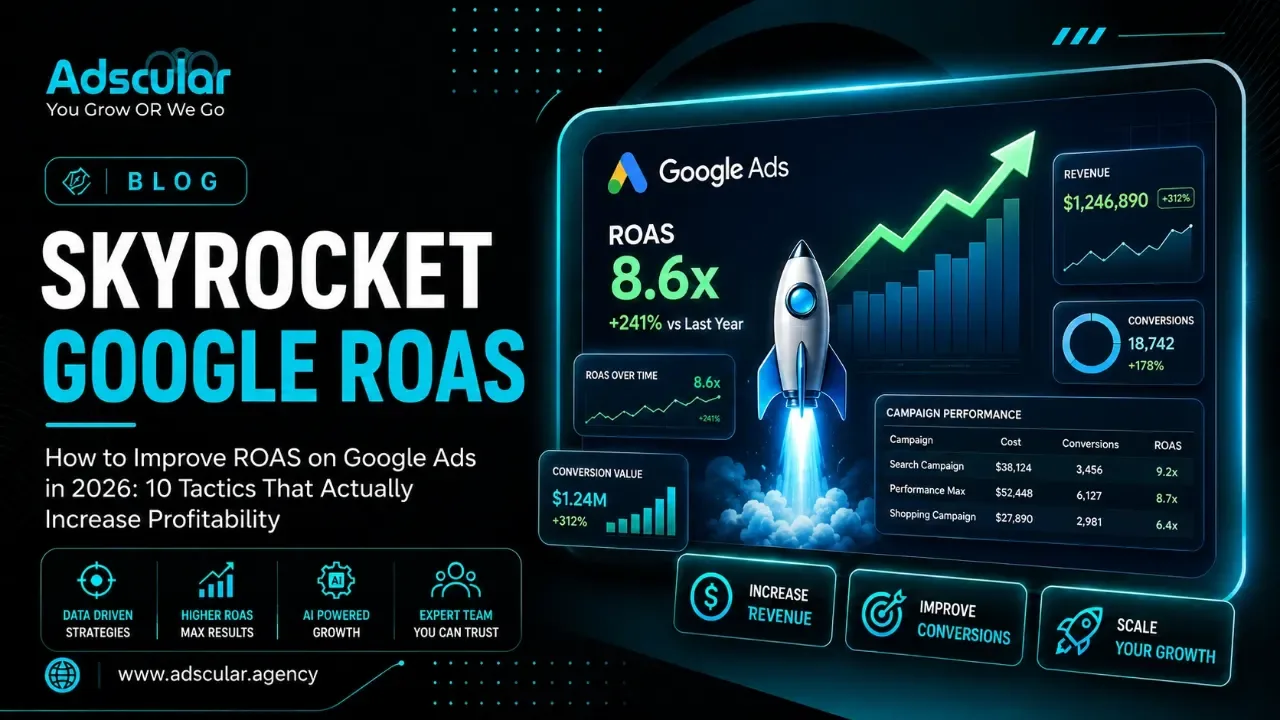
How to Improve ROAS on Google Ads in 2026: 10 Tactics That Actually Increase Profitability
By the Adscular Agency Team | Updated June 2026 | 8 min read
Introduction:
How to improve ROAS Google Ads comes down to fixing three things: targeting precision, conversion tracking accuracy, and bid efficiency. Most advertisers don’t have a traffic problem—they have a waste problem inside their campaigns.
At Adscular Agency, we rebuild underperforming Google Ads systems for US-based businesses across SaaS, healthcare, legal, and e-commerce. In most cases, ROAS doesn’t improve from “more ads”—it improves from removing inefficiencies that silently drain 20–60% of ad spend.
If your Google Ads ROAS is below 2x–3x, the issue is almost always structural, not tactical.
How to improve ROAS Google Ads?
To improve ROAS on Google Ads, you need to reduce wasted clicks, improve conversion rates, and increase high-intent traffic share. The fastest gains usually come from tightening keyword targeting, improving landing pages, and using smart bidding with clean conversion data.
ROAS improves when every dollar spent is tied directly to measurable, high-intent conversions—not vanity traffic.
Why improving Google Ads ROAS matters for US businesses
If your Google Ads ROAS is low, you are effectively paying a “tax” on every customer acquisition. That tax compounds as you scale.
For US-based businesses, especially in competitive verticals like legal, SaaS, and home services, even a 10–20% ROAS improvement can mean thousands in recovered monthly profit.
Better ROAS means:
-
Lower cost per acquisition (CPA)
-
Higher budget scalability
-
More predictable revenue growth
-
Less dependency on organic traffic delays
This is why Google Ads optimization tips are not optional—they are survival mechanics for paid acquisition.
Why most advertisers fail to improve ROAS Google Ads campaigns
Most advertisers try to fix ROAS by adjusting bids or budgets. That’s the wrong level of the system.
Here’s what’s actually happening:
1. Traffic quality is too broad
Broad match keywords without strict negatives bring irrelevant clicks that never convert.
2. Conversion tracking is broken or incomplete
If Google Ads can’t clearly see conversions, Smart Bidding optimizes for the wrong signals.
3. Landing pages are not built for conversion
Even high-intent traffic fails if the landing page does not match search intent.
4. No segmentation by intent level
Treating cold, warm, and hot traffic the same destroys ROAS efficiency.
Core breakdown — What actually drives ROAS in Google Ads
To improve ROAS Google Ads performance, you must optimize four levers:
1. Traffic Quality (Intent Filtering)
High ROAS campaigns filter aggressively:
-
Exact match high-intent keywords
-
Negative keyword expansion weekly
-
Search term pruning
2. Conversion Rate (Landing Page Performance)
Conversion rate is often the biggest ROAS multiplier.
Even a 1% → 3% improvement triples return on the same spend.
Internal link: CRO improvements → /services/cro
Average Order Value (AOV)
Higher ticket size = higher ROAS without increasing spend.
Cost per Click (CPC) Efficiency
Lower CPC alone doesn’t improve ROAS—but combined with higher conversion rate, it compounds profit.
Google Ads ROAS improvement comparison (what actually moves results)
Strategy |
Impact on ROAS |
Speed |
Difficulty |
|
Keyword tightening |
High |
Fast |
Easy |
|
Landing page CRO |
Very High |
Medium |
Medium |
|
Smart bidding optimization |
High |
Medium |
Medium |
|
Audience segmentation |
Medium |
Fast |
Easy |
|
Budget scaling only |
Low |
Fast |
Easy |
Key insight: Scaling budget without fixing conversion inefficiencies lowers ROAS every time.
Step-by-step framework to improve Google Ads ROAS
This is the exact system used in Adscular-managed accounts.
Step 1 — Audit search term waste
Identify non-converting search queries in the last 30 days.
Step 2 — Remove low-intent keywords
Pause or exclude keywords with high CPC and zero conversions.
Step 3 — Rebuild keyword structure
Separate:
-
High intent (bottom funnel)
-
Research intent (mid funnel)
-
Discovery traffic (top funnel)
Step 4 — Fix conversion tracking accuracy
Use:
-
Google Tag Manager
-
Enhanced conversions
-
GA4 event validation
Step 5 — Optimize landing pages for one action
Every landing page must have one conversion goal only.
If your campaigns are spending more but not scaling profitably, the issue is usually hidden inefficiencies—not ad spend.
You can get a full breakdown of wasted spend inside your account with a structured audit from Adscular Agency.
Real-world client performance example (Revenue comparison)
At Adscular Agency, we analyzed a US-based e-commerce campaign spending heavily on broad-match keywords.
Before optimization:
-
ROAS: 1.8x
-
CPC: $2.40
-
Conversion rate: 1.1%
-
Monthly spend: $25,000
After optimization (6 weeks):
-
ROAS: 4.6x
-
CPC: $1.72
-
Conversion rate: 3.4%
-
Monthly spend: $25,000 (same budget)
Key change: Not more traffic—better filtering and landing page alignment.
This is consistent across healthcare, SaaS, and local service campaigns we manage across the US market.
Advanced Google Ads optimization tips to increase ROAS fast
Once your campaigns are structurally clean, ROAS improvements come from compounding optimization—not random tweaks. This is where most advertisers plateau because they stop at “basic optimization.”
At this stage, improving how to improve ROAS Google Ads becomes about precision engineering, not setup fixes.
1. Use intent-based campaign segmentation
Segment campaigns based on buyer intent, not just keywords.
-
High intent: “buy”, “hire”, “near me”, “pricing”
-
Mid intent: comparisons, alternatives, reviews
-
Low intent: informational queries
High ROAS accounts isolate high intent traffic so budgets are never diluted.
2. Apply value-based bidding (not conversion-based)
Smart Bidding only works properly when conversion values are real.
Instead of optimizing for “leads,” assign values like:
-
Qualified lead = $50
-
Booked call = $150
-
Closed deal = $500+
This shifts Google Ads optimization from volume to profit.
3. Use audience layering for signal strengthening
Layer audiences on top of keywords:
-
In-market audiences
-
Remarketing lists
-
Custom intent segments
This improves signal clarity for Google’s algorithm and reduces wasted impressions.
4. Control match types aggressively
Most ROAS leaks come from match type expansion.
A high-performing structure:
-
Exact match = core revenue drivers
-
Phrase match = controlled expansion
-
Broad match = only with strong negative keyword systems
What kills ROAS in Google Ads (most advertisers miss this)
If you want to increase Google Ads ROI, you need to eliminate silent performance killers. These are not obvious—but they drain budgets consistently.
1. Weak conversion tracking setup
If tracking is incomplete, Google optimizes for wrong actions.
Common issue:
-
Tracking page views instead of qualified actions
-
Missing offline conversions
-
Duplicate conversion events
Without clean data, ROAS cannot scale.
2. One-size-fits-all landing pages
Sending all traffic to a single generic page reduces conversion rates instantly.
High ROAS systems:
-
Match landing page to keyword intent
-
Use dedicated pages per service/product
-
Remove distractions from conversion path
3. Ignoring search term reports
Search term reports reveal where money is leaking.
Advertisers who don’t review them weekly:
-
Waste 20–40% of spend on irrelevant traffic
-
Scale inefficient campaigns unknowingly
4. Scaling before optimizing
Scaling budgets before fixing conversion rate = amplified losses.
Rule:
Fix efficiency first. Then scale spend.
ROAS optimization framework used by Adscular Agency
At Adscular Agency we use a 3-layer ROAS system across US client accounts in SaaS, healthcare, legal, and e-commerce.
This is what consistently improves performance:
Layer 1 — Traffic quality control
We eliminate:
-
Broad irrelevant search queries
-
Low intent keyword clusters
-
Duplicate traffic sources
Result: cleaner traffic pool with higher purchase intent.
Layer 2 — Conversion engineering
We optimize:
-
Landing page structure
-
Message match with ad copy
-
CTA clarity and friction reduction
Result: higher conversion rates without increasing spend.
Layer 3 — Revenue amplification
We increase:
-
Average order value (AOV)
-
Upsell flow integration
-
Lead qualification filtering
Result: higher revenue per click, not just more clicks.
Real client proof — ROAS transformation case
A US-based service business in the home services niche came to Adscular with stagnant performance.
Before:
-
ROAS: 2.1x
-
Cost per lead: $74
-
Conversion rate: 1.6%
-
Monthly ad spend: $18,000
After 8 weeks of optimization:
-
ROAS: 5.2x
-
Cost per lead: $31
-
Conversion rate: 4.3%
-
Monthly ad spend: $18,000
Key changes:
-
Removed 38% wasted search terms
-
Rebuilt landing pages for intent match
-
Introduced value-based bidding strategy
This is a typical outcome when optimization is done structurally, not cosmetically.
Frequently asked questions
What is a good ROAS for Google Ads?
A good ROAS for Google Ads depends on your industry, but most US businesses aim for at least 3x to 5x. E-commerce may require higher margins, while SaaS and lead generation can be profitable at lower ROAS if lifetime value is strong.
Why is my Google Ads ROAS so low?
Low ROAS usually comes from poor keyword targeting, weak landing pages, or incorrect conversion tracking. In most accounts, 20–50% of ad spend is wasted on non-converting search terms or irrelevant traffic.
How long does it take to improve Google Ads ROAS?
Most accounts see measurable ROAS improvement within 2–6 weeks after structural fixes. However, scaling consistent profitability can take 6–12 weeks depending on data volume and industry competition.
Can Smart Bidding improve ROAS automatically?
Smart Bidding can improve ROAS only when conversion tracking is accurate and enough data exists. Without clean inputs, it often optimizes toward low-value conversions instead of profit-driving actions.
Should I increase the budget if ROAS is low?
No. Increasing the budget on a low ROAS campaign usually increases losses. The correct sequence is: fix conversion rate → improve targeting → then scale budget.
The bottom line
Improving ROAS on Google Ads is not about running more ads—it’s about removing inefficiencies that drain profit. Once targeting, tracking, and landing pages align, ROAS increases naturally without needing aggressive spend increases.
At Adscular Agency, we specialize in rebuilding underperforming Google Ads systems into scalable revenue engines for US businesses.
If you want a performance marketing system that actually generates leads — not just clicks — get your free revenue growth audit.
We’ll show you exactly where your Google Ads budget is leaking and how to fix it.
Want to go deeper?
Read our full guide: Google Ads Services for Scalable Lead Generation in the USA