

Performance Marketing KPIs: 12 Metrics That Drive Revenue
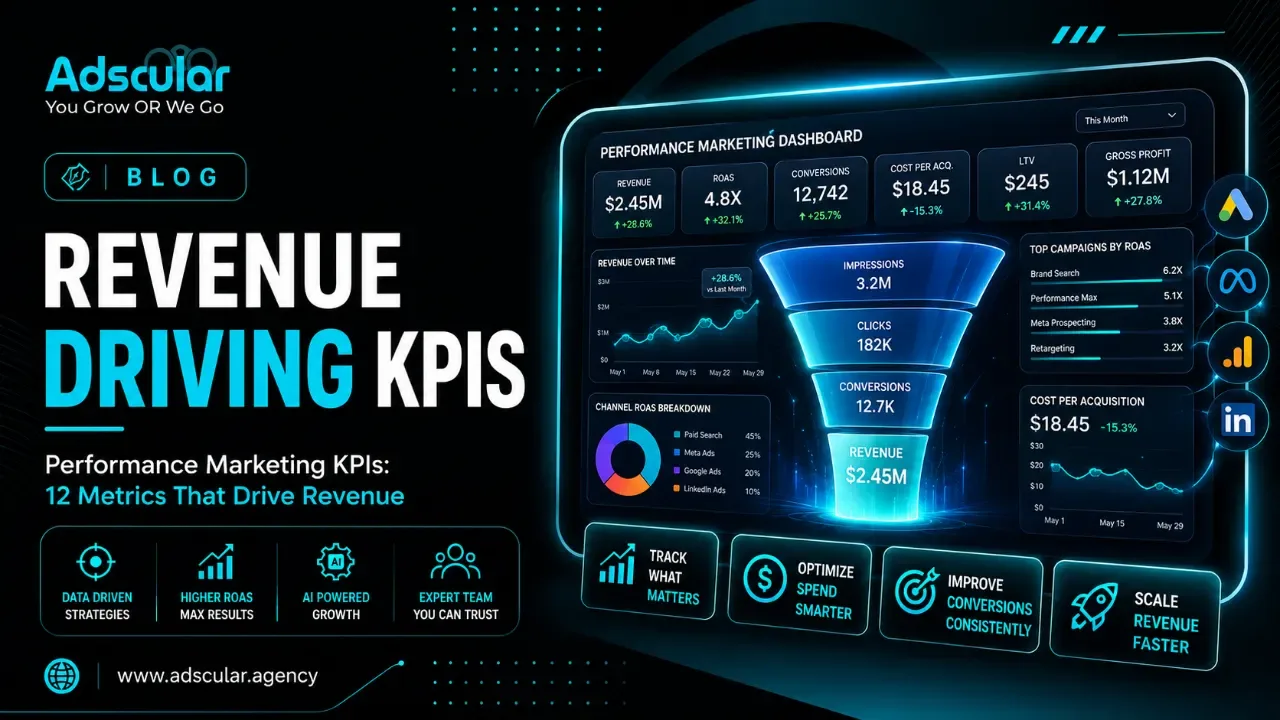
12 Performance Marketing KPIs That Predict Revenue for US Businesses
By the Adscular Agency Team | Updated June 19, 2026 | 9 min read
Introduction:
Quick Answer: Performance marketing KPIs show which marketing activities generate profitable growth by measuring acquisition cost, conversion efficiency, customer value, and return on investment. The most important KPIs include CAC, ROAS, CPL, LTV, conversion rate, and pipeline revenue because these metrics connect campaigns directly to business outcomes.
At Adscular Agency, we build full-funnel revenue systems for healthcare providers, law firms, SaaS companies, e-commerce brands, home service companies, real estate businesses, and B2B organizations across the US. Our performance marketing approach focuses on measurable revenue impact — not surface-level metrics that look impressive but fail to increase profit.
Based on campaigns we have managed across multiple industries, the biggest growth problems usually come from tracking the wrong numbers. A company can generate thousands of clicks and still lose money if customer acquisition cost rises, lead quality drops, or lifetime value stays low.
The right performance marketing KPIs tell you where your funnel makes money, where revenue leaks happen, and what needs optimization next.
For a complete view of how paid campaigns fit into a broader growth system, explore our Performance Marketing pillar resources.
What are performance marketing KPIs?
Performance marketing KPIs are measurable indicators that show whether marketing campaigns are producing profitable business results. The strongest KPIs track the entire customer journey — from lead generation and acquisition cost to conversion rate, revenue, and customer lifetime value.
A performance marketing KPI is useful only when it helps answer one question:
“Are we spending money to create profitable growth?”
For example:
-
High impressions do not guarantee revenue.
-
Low CPC does not guarantee qualified customers.
-
More leads do not guarantee profitability.
Revenue-focused teams prioritize KPIs such as:
KPI |
What It Measures |
Why It Matters |
|
CAC |
Customer acquisition cost |
Shows how much you pay to acquire customers |
|
ROAS |
Return on ad spend |
Shows revenue generated from advertising |
|
CPL |
Cost per lead |
Measures lead generation efficiency |
|
LTV |
Lifetime value |
Shows long-term customer profitability |
|
Conversion Rate |
Funnel efficiency |
Identifies website and landing page issues |
|
Pipeline Revenue |
Sales impact |
Connects marketing to business growth |
The best performance marketing KPI strategy does not track everything. It tracks the numbers that influence decisions.
Why do performance marketing KPIs matter for US business owners?
Performance marketing KPIs matter because they replace assumptions with financial clarity. Business owners can see exactly which campaigns create customers, which channels waste budget, and where optimization creates the highest return.
Marketing budgets are no longer judged by activity.
They are judged by outcomes.
A healthcare practice does not need more impressions. It needs profitable patient acquisition.
A law firm does not need more clicks. It needs qualified consultations.
A SaaS company does not need cheaper traffic. It needs customers whose subscription value exceeds acquisition cost.
This is why revenue-focused companies measure:
-
acquisition efficiency
-
customer profitability
-
sales pipeline contribution
-
retention value
-
campaign scalability
Platforms like Google Ads, Google Analytics, and HubSpot provide valuable reporting data, but the business strategy comes from understanding which numbers actually drive growth.
A useful KPI framework connects marketing data with sales and financial outcomes.
Which performance marketing KPIs should you track first?
You should track performance marketing KPIs based on your business goal, not based on what an advertising dashboard shows first. Revenue-focused companies usually start with four core metrics: CAC, ROAS, CPL, and LTV.
These four KPIs answer the most important growth questions:
Business Question |
KPI Answer |
|
How much does it cost to get a customer? |
CAC |
|
Are ads generating profitable revenue? |
ROAS |
|
How efficiently are we generating leads? |
CPL |
|
How valuable is each customer over time? |
LTV |
A business that understands these four numbers can make smarter decisions about:
-
increasing ad spend
-
improving landing pages
-
changing targeting
-
adjusting offers
-
fixing sales processes
What is CAC in performance marketing?
Customer Acquisition Cost (CAC) measures the total amount a business spends to acquire one new customer.
Formula:
CAC = Total Marketing + Sales Costs ÷ Number of New Customers
Example:
A SaaS company spends $20,000 on marketing and sales in one month and gains 100 customers.
CAC:
$20,000 ÷ 100 = $200 per customer
CAC tells you whether customer growth is financially sustainable.
A lower CAC is not always better. A company can spend more to acquire customers if those customers generate higher lifetime value.
For example:
-
Business A spends $100 to acquire a customer worth $150.
-
Business B spends $300 to acquire a customer worth $2,000.
Business B has a healthier growth model.
Standalone insight: A profitable marketing strategy does not aim for the lowest acquisition cost; it aims for the highest profitable customer value ratio.
What is ROAS in performance marketing?
Return on Ad Spend (ROAS) measures how much revenue advertising generates for every dollar spent.
Formula:
ROAS = Revenue Generated From Ads ÷ Advertising Cost
Example:
A company spends $5,000 on Meta Ads and generates $25,000 in sales.
ROAS:
$25,000 ÷ $5,000 = 5x ROAS
A 5x ROAS means every $1 in advertising generates $5 in revenue.
However, ROAS alone does not show profit.
A campaign can have strong ROAS but still lose money if:
-
product margins are low
-
fulfillment costs are high
-
customer retention is poor
This is why ROAS must be analyzed with CAC and LTV.
What is CPL in performance marketing?
Cost Per Lead (CPL) measures how much your business spends to generate one potential customer inquiry, signup, consultation request, or contact form submission.
Formula:
CPL = Total Lead Generation Cost ÷ Number of Leads Generated
Example:
A dental clinic spends $3,000 on Google Ads and receives 150 consultation requests.
CPL:
$3,000 ÷ 150 = $20 per lead
CPL helps you understand lead generation efficiency, but a cheap lead does not always create revenue.
A $10 lead that never books an appointment is less valuable than a $75 lead that becomes a $5,000 customer.
For service businesses, CPL should always be analyzed with:
-
lead quality
-
appointment rate
-
close rate
-
customer value
Standalone insight: The best performance marketing campaigns do not generate the cheapest leads; they generate the most profitable customers at a scalable cost.
What is LTV in performance marketing?
Customer Lifetime Value (LTV) estimates how much revenue a customer generates throughout their relationship with your business.
Formula:
LTV = Average Customer Value × Purchase Frequency × Customer Lifespan
Example:
A SaaS company has:
-
Average monthly subscription: $200
-
Average customer retention: 24 months
LTV:
$200 × 24 = $4,800
If the company spends $800 to acquire that customer, the acquisition model is healthy.
A strong business usually aims for an LTV:CAC ratio of around 3:1 or higher.
Metric |
Weak Signal |
Healthy Signal |
|
CAC |
Increasing without revenue growth |
Stable or decreasing |
|
ROAS |
High but low profit margin |
High with profitable margins |
|
CPL |
Cheap but poor quality |
Predictable qualified leads |
|
LTV |
Low retention |
Strong repeat value |
12 Performance Marketing KPIs That Predict Revenue
The four KPIs above create the foundation, but profitable growth requires a complete measurement system.
Here are the 12 performance marketing KPIs that help businesses understand the entire revenue funnel.
1. Customer Acquisition Cost (CAC)
CAC shows the true cost of acquiring customers.
Track CAC by:
-
advertising channel
-
campaign
-
audience segment
-
sales source
A Facebook campaign with a $50 CAC may outperform a Google campaign with a $150 CAC — unless the Google customers generate higher revenue.
2. Return on Ad Spend (ROAS)
ROAS shows whether paid advertising creates measurable revenue.
Track ROAS across:
-
Meta Ads
-
Google Ads
-
LinkedIn Ads
-
YouTube campaigns
-
retargeting campaigns
A strong ROAS benchmark depends on industry.
Examples:
Industry |
Common ROAS Focus |
|
E-commerce |
Product margin and repeat purchases |
|
SaaS |
Subscription value and retention |
|
Healthcare |
Patient acquisition cost |
|
Legal |
Case value and consultation quality |
|
Home Services |
Booking rate and job profitability |
3. Cost Per Lead (CPL)
CPL measures lead generation efficiency.
A declining CPL can indicate:
-
better targeting
-
stronger creative
-
improved landing pages
But CPL alone should never determine campaign success.
A campaign generating 20 high-intent leads at $100 CPL can outperform a campaign producing 200 weak leads at $20 CPL.
4. Customer Lifetime Value (LTV)
LTV determines how aggressively you can invest in acquisition.
Businesses with higher LTV can:
-
spend more on ads
-
compete harder
-
scale faster
For example:
A subscription software company with $10,000 customer lifetime value can justify higher acquisition costs than a one-time purchase business.
5. Conversion Rate (CVR)
Conversion Rate measures the percentage of visitors who complete a desired action.
Formula:
CVR = Conversions ÷ Total Visitors × 100
Conversions may include:
-
purchases
-
booked calls
-
demo requests
-
consultation forms
-
downloads
A landing page receiving 10,000 visitors but only 100 leads has a 1% conversion rate.
Improving conversion rate from 1% to 3% can triple lead volume without increasing ad spend.
This is where conversion optimization becomes critical.
Adscular Agency helps businesses improve funnel performance through data-driven CRO and revenue optimization services.
6. Cost Per Acquisition (CPA)
CPA measures the cost of generating a specific customer action.
Unlike CPL, CPA focuses on completed outcomes:
-
purchases
-
booked appointments
-
subscriptions
-
signed contracts
Example:
A real estate company spends $10,000 and generates 20 signed client agreements.
CPA:
$500 per acquisition
CPA helps businesses understand whether marketing activity creates actual customers.
7. Lead-to-Customer Conversion Rate
This KPI measures how effectively your sales process turns leads into paying customers.
Formula:
Lead Conversion Rate = Customers ÷ Total Leads × 100
Example:
A law firm generates 500 leads and signs 25 new clients.
Conversion rate:
5%
If competitors convert 10%, the problem may not be advertising.
The issue could be:
-
slow response time
-
weak follow-up
-
poor qualification
-
unclear offer
8. Marketing Qualified Leads (MQLs)
MQLs identify leads that match your ideal customer profile.
A qualified lead may have:
-
correct location
-
appropriate budget
-
strong buying intent
-
relevant business need
Tracking MQLs prevents teams from optimizing for volume instead of value.
9. Sales Qualified Leads (SQLs)
SQLs represent leads accepted by the sales team as genuine opportunities.
A strong marketing system tracks the transition:
Traffic → Lead → MQL → SQL → Customer
This reveals where revenue leaks occur.
10. Pipeline Revenue Generated
Pipeline revenue measures potential sales opportunities created by marketing campaigns.
For B2B companies, pipeline revenue is often more valuable than immediate conversions.
Example:
A LinkedIn campaign generates:
-
100 leads
-
20 qualified opportunities
-
$500,000 potential pipeline
The campaign may be highly successful even before contracts close.
11. Click-Through Rate (CTR)
CTR measures how often users click after seeing an advertisement.
Formula:
CTR = Clicks ÷ Impressions × 100
CTR helps evaluate:
-
messaging
-
creative quality
-
audience alignment
However, high CTR does not guarantee revenue.
A misleading ad can generate clicks but attract poor-fit prospects.
12. Customer Retention Rate
Retention measures how many customers continue using your product or service.
Strong retention improves LTV and lowers effective CAC.
A company with poor retention constantly pays to replace lost customers.
A company with strong retention compounds growth.
How do performance marketing KPIs work together?
Individual KPIs provide information. Connected KPIs create a growth system.
The relationship looks like this:
Traffic
↓
Clicks (CTR)
↓
Leads (CPL)
↓
Qualified Opportunities (MQL + SQL)
↓
Customers (CPA + CAC)
↓
Revenue (ROAS)
↓
Long-Term Profit (LTV + Retention)
A weak KPI analysis looks at one number.
A strong analysis identifies where the funnel breaks.
Not sure which KPIs are limiting your growth?
Get a free revenue growth audit from Adscular Agency and find out where your marketing funnel is losing potential customers.
Performance Marketing KPI Framework: What Should You Optimize First?
Follow this process before increasing your marketing budget:
1- Calculate your baseline numbers
-
CAC
-
CPL
-
ROAS
-
LTV
-
Conversion rate
2- Identify the biggest revenue leak
Examples:
-
High traffic but low conversion → improve landing page
-
Many leads but few customers → improve sales process
-
Customers but low profit → improve retention or pricing
3- Fix the highest-impact bottleneck
Prioritize changes that improve revenue, not vanity metrics.
4- Scale only after profitability is proven
Increasing ad spend before fixing funnel problems usually increases wasted budget.
Real-world performance marketing KPI results: What revenue tracking changes
Performance marketing KPIs become valuable when they change business decisions. Numbers alone do not create growth — better decisions based on numbers do.
At Adscular Agency, our approach focuses on connecting marketing activity with revenue outcomes across industries like healthcare, legal, SaaS, e-commerce, and B2B. Instead of reporting only clicks or impressions, we analyze the full funnel:
-
advertising cost
-
lead quality
-
conversion rate
-
customer acquisition cost
-
customer value
For example, a service business may initially focus on reducing CPL. After analyzing the funnel, the bigger opportunity may be improving conversion rate or lead qualification.
A campaign generating leads at $25 each may appear successful. However, if only 2% become customers, the real acquisition cost becomes expensive.
Improving the funnel can create a stronger outcome:
Metric |
Before Optimization |
After Optimization |
|
Monthly Ad Spend |
$10,000 |
$10,000 |
|
Leads Generated |
200 |
150 |
|
CPL |
$50 |
$66 |
|
Lead-to-Customer Rate |
5% |
12% |
|
Customers Generated |
10 |
18 |
|
Effective CAC |
$1,000 |
$556 |
The second campaign generates fewer leads but creates significantly more customers.
That is why revenue-focused teams optimize for profitable acquisition, not maximum volume.
Standalone insight: A lower cost per lead does not always mean better marketing. The best campaign is the one that creates the highest customer value at a sustainable acquisition cost.
Performance Marketing KPI Checklist: The metrics your business should track
Use this checklist to build a revenue-focused measurement system.
Acquisition Metrics
Track:
-
Customer Acquisition Cost (CAC)
-
Cost Per Lead (CPL)
-
Cost Per Acquisition (CPA)
-
Click-Through Rate (CTR)
These metrics show whether your campaigns attract customers efficiently.
Conversion Metrics
Track:
-
Landing page conversion rate
-
Lead-to-customer conversion rate
-
Marketing Qualified Leads (MQLs)
-
Sales Qualified Leads (SQLs)
These metrics reveal whether your funnel turns attention into opportunities.
Revenue Metrics
Track:
-
Return on Ad Spend (ROAS)
-
Pipeline revenue
-
Customer Lifetime Value (LTV)
-
Customer retention rate
These metrics connect marketing performance to business growth.
How often should you review performance marketing KPIs?
You should review performance marketing KPIs weekly for campaign optimization and monthly for strategic decisions.
A practical review schedule:
-
Daily monitoring
-
ad spend
-
campaign issues
-
major performance changes
-
-
Weekly analysis
-
CPL trends
-
conversion rates
-
audience performance
-
creative performance
-
-
Monthly revenue review
-
CAC
-
ROAS
-
LTV
-
pipeline contribution
-
Avoid making decisions from one day of data. Performance marketing requires enough conversion volume to identify real trends.
Frequently asked questions
What are the most important performance marketing KPIs?
The most important performance marketing KPIs are CAC, ROAS, CPL, LTV, conversion rate, and pipeline revenue. These metrics show whether marketing campaigns generate profitable business growth instead of only producing traffic or engagement.
What is a good ROAS for performance marketing?
A good ROAS depends on the business model, profit margin, and customer lifetime value. Many businesses aim for 3x–5x ROAS, but a lower ROAS can still be profitable when customers have high lifetime value and strong retention.
Should businesses focus on CPL or CAC?
Businesses should focus on CAC because CAC measures the true cost of acquiring paying customers. CPL is useful for monitoring lead generation efficiency, but CAC shows whether those leads create profitable revenue.
Why is LTV important in performance marketing?
LTV is important because customer value determines how much a business can safely invest in acquisition. Companies with higher lifetime value can spend more to acquire customers while maintaining profitable growth.
How do you measure performance marketing success?
You measure performance marketing success by connecting campaign data with revenue metrics. Successful campaigns improve customer acquisition cost, conversion rate, return on ad spend, pipeline revenue, and customer lifetime value.
What KPIs should SaaS companies track?
SaaS companies should track CAC, LTV, monthly recurring revenue (MRR), churn rate, conversion rate, trial-to-paid conversion rate, and payback period. These metrics show whether customer growth is sustainable.
The bottom line
Performance marketing KPIs are not reporting numbers — they are decision-making tools. CAC, ROAS, CPL, and LTV reveal whether your marketing engine creates profitable growth or simply generates activity.
The strongest businesses track the entire funnel from first click to long-term customer value.
At Adscular Agency, we build revenue-focused marketing systems for US businesses by combining paid advertising, conversion optimization, analytics, and growth strategy. Our goal is simple: help businesses understand where revenue is being created and where opportunities are being lost.
Author Bio
Adscular Agency is a US-based performance marketing agency that helps businesses generate more leads, customers, and revenue through paid advertising, conversion rate optimization, SEO, and full-funnel growth strategies. The Adscular team works with healthcare, legal, SaaS, e-commerce, home services, and B2B companies to build measurable marketing systems focused on business outcomes—not vanity metrics.
If you want a performance marketing system that actually generates leads — not just rankings — get your free revenue growth audit. We'll show you exactly where your traffic is leaking and what it would take to fix it.