
B2B Lead Generation: The Complete Strategy Guide for US Businesses in 2026
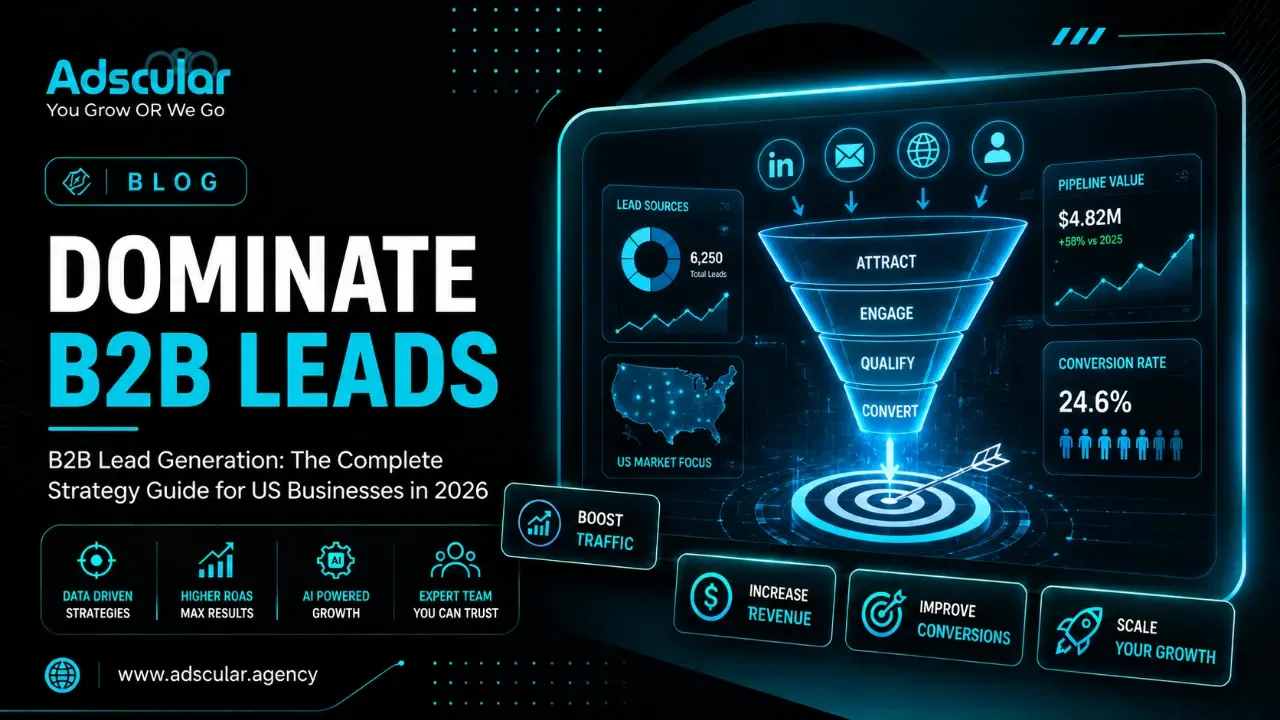
Why Most B2B Lead Generation Systems Fail — And the 7-Step Fix That Fills Your Pipeline
Written by the Adscular Agency growth team | June 23, 2026 | 8 min read
Introduction:
Quick Answer: The most effective B2B lead generation strategies in 2026 combine high-intent paid search, ICP-targeted LinkedIn outreach, and conversion-optimized landing pages — then tie them together with a qualification system that separates sales-ready buyers from time-wasters. Most B2B teams generate plenty of leads. The problem is 79% of those leads never convert into sales because the channels, the targeting, and the handoff between marketing and sales are all misaligned. The fix isn't more volume — it's a tighter system.
At Adscular Agency, we build B2B demand generation systems for founders, sales directors, and marketing managers across SaaS, legal, healthcare, and professional services in the US. What we see consistently is that the teams with the most pipeline aren't the ones running the most campaigns. They're the ones who've defined their ICP precisely, built channels that reach that ICP at the moment of intent, and set up a qualification process that routes the right leads to sales immediately.
What Are the Best B2B Lead Generation Strategies?
The highest-ROI B2B lead generation strategies in 2026 are Google Ads for high-intent search capture, LinkedIn Ads and outreach for decision-maker targeting, and SEO-driven content for long-term inbound volume. Running all three in parallel — with a shared ICP definition and a conversion-optimized landing page for each — is what separates pipelines that scale from campaigns that stall. For a deeper foundation on how paid search fits into this system, read our guide on how Google Ads works for US businesses.
Why B2B Lead Generation Is Harder Than It Was Two Years Ago
B2B buyers have changed. Today's decision-makers complete nearly 70% of their research before ever speaking to a sales rep. They're reading comparison articles, watching LinkedIn content, and running their own searches — and by the time they fill out your form, they've already shortlisted you or ruled you out.
That shift makes the top of the funnel more competitive and the middle of the funnel more important. Just driving traffic is no longer enough. Your content, your ads, and your landing pages all need to do qualification work before a human ever picks up the phone.
The other reality: <strong>only 13% of MQLs convert to SQLs</strong> on average. That means 87% of the leads most B2B marketing teams are celebrating are noise. If your pipeline isn't converting, the answer isn't more leads — it's a tighter definition of what a lead actually means for your business.
The 6 B2B Lead Generation Channels That Actually Drive Pipeline
Which Channel Should You Prioritize First?
Not all B2B lead gen channels deliver the same outcome at the same cost. Before you spread the budget across every platform, understand where your buyers are and what the real cost per qualified lead looks like across channels.
|
Channel |
Best For |
Avg. Cost Per Lead (US B2B) |
Time to First Lead |
Lead Quality |
|
Google Ads (Search) |
High-intent buyers searching now |
$40–$200 |
Same day |
High |
|
LinkedIn Ads |
Decision-maker targeting by title/company |
$80–$300 |
3–7 days |
Very High |
|
LinkedIn Outreach (organic) |
SDR-led prospecting |
$10–$40 (SDR time) |
1–2 weeks |
High |
|
SEO / Content Marketing |
Long-term inbound at scale |
$20–$80 (at maturity) |
3–9 months |
Medium–High |
|
Email Outbound |
Re-engagement, warm list activation |
$15–$60 |
1–3 weeks |
Medium |
|
Webinars / Events |
Pipeline acceleration, late-funnel nurture |
$50–$150 |
2–4 weeks |
High |
The winning combination for most US B2B teams with a $5,000–$20,000/month marketing budget: Google Ads to capture existing demand, LinkedIn to create new demand, and SEO content to compound both over time. These three channels reinforce each other — Google captures buyers who already know they have a problem, LinkedIn builds awareness with decision-makers who don't yet know they need you, and SEO content brings both together organically.
To understand what strong performance looks like across these channels, read our breakdown of performance marketing KPIs you should actually be tracking.
Not Sure Which B2B Lead Gen Channel Is Right for Your Budget?
Most US B2B teams waste the first 60–90 days testing the wrong channel for their ICP. We'll tell you exactly which one to start with — based on your industry, deal size, and current monthly budget.
Get Your Free B2B Lead Gen Audit →
Google Ads: The Highest-Intent B2B Lead Gen Channel
Google Ads captures demand that already exists. When a VP of Operations searches "B2B SaaS CRM for manufacturing" or a CFO searches "outsourced accounting firms Chicago," those buyers are ready to engage. Google Ads puts your offer in front of them at that exact moment.
For B2B specifically, Search campaigns on high-intent, role-specific keywords consistently deliver the lowest time-to-lead and the highest close rates — because the buyer is already problem-aware and solution-seeking. The trap most B2B teams fall into is running broad match keywords with no negative keyword list, then wondering why their CPL is $400 and their sales team ignores the leads. Structure matters more than budget. Our paid ads lead generation service for US businesses is built specifically around fixing this problem.
LinkedIn: The Best Channel for Reaching Decision-Makers Directly
LinkedIn is where 89% of B2B marketers run lead generation campaigns — and for good reason. No other platform lets you target by job title, company size, industry, and seniority simultaneously. A well-structured LinkedIn campaign can put a case study in front of every Director of IT at US manufacturing companies with 200–1,000 employees. No other channel matches that precision.
LinkedIn works in two modes: paid (Sponsored Content, Lead Gen Forms) and organic (connection-based outreach via your sales team). Both work. Paid LinkedIn typically runs $80–$300 CPL but delivers decision-maker-level leads that convert at a higher rate downstream. Organic outreach, when done with a specific message and a clear ICP, can produce $10–$40 CPL — but requires consistent SDR time.
The mistake most teams make: using LinkedIn for brand awareness posts when their pipeline is empty. LinkedIn is a demand creation channel. Use it to share insight that proves expertise, then follow with a direct, specific outreach sequence.
What Is a B2B Lead Generation Funnel?
A B2B lead generation funnel is the structured path a potential buyer takes from first awareness of your business to becoming a qualified sales opportunity. Unlike B2C, where a purchase can happen in minutes, a B2B funnel typically involves 3–7 decision-makers, a sales cycle of 30–180 days, and multiple content touchpoints before any conversation occurs.
The three stages that matter for lead gen strategy:
- Top of Funnel (TOFU): Buyer identifies a problem. Channels: SEO content, Google Ads, LinkedIn Ads, social. Goal: generate awareness and capture contact info.
- Middle of Funnel (MOFU): Buyer evaluates solutions. Channels: email sequences, retargeting, case studies, webinars. Goal: establish credibility and move to SQL.
- Bottom of Funnel (BOFU): Buyer selects a vendor. Channels: direct outreach, demo, audit, proposal. Goal: convert SQL to closed deal.
Most B2B companies under-invest in MOFU. They generate TOFU leads and immediately hand them to sales — who ignore them because they're not ready. A 3–5 email nurture sequence between lead capture and sales call alone can double your MQL-to-SQL conversion rate. See our guide on what conversion rate optimization actually means for the mechanics of this.
A 7-Step B2B Lead Generation System That Scales
-
Define your ICP with precision.
Not "mid-market SaaS companies." Instead: "US-based SaaS companies with 50–250 employees, annual revenue $5M–$30M, currently using HubSpot, with a VP of Marketing or Head of Growth as the primary decision-maker." The tighter your ICP, the higher your conversion rate across every channel.
-
Map intent signals to channels.
High-intent signals (searching for your solution by name or category) → Google Ads. Low-awareness signals (right job title, right company, no active search) → LinkedIn. Existing traffic that didn't convert → Retargeting.
-
Build one conversion-optimized landing page per channel.
Not your homepage. A page with one headline, one CTA, social proof specific to the ICP, and a form with 3–5 fields maximum. Every additional form field drops conversion rate by 11%.
-
Set up conversion tracking before launching anything.
Google Ads, LinkedIn, and your CRM must all track the same events: form fills, calls, demo bookings. Without tracking, you're optimizing blind.
-
Create a lead scoring system.
Assign points for behaviors: visited pricing page (+15), opened 3 emails (+10), attended webinar (+20), job title matches ICP (+25). When a lead hits a threshold, route to sales automatically.
-
Build a 5-email nurture sequence for leads not yet sales-ready.
Email 1: deliver the lead magnet. Email 2: relevant case study. Email 3: common objection addressed. Email 4: social proof. Email 5: direct CTA to book a call. Space emails 3–5 days apart.
-
Define your MQL-to-SQL handoff SLA.
Sales must follow up with every SQL within 4 hours. Speed-to-lead is the single biggest variable in B2B conversion rates — leads contacted within 5 minutes are 100x more likely to qualify than leads contacted after 30 minutes.
Real-World Result: What a B2B Lead Gen System Looks Like When It Works
Trackflow, an Austin-based B2B SaaS company, came to Adscular Agency running Google Ads and LinkedIn campaigns separately with no unified ICP definition and no lead scoring. Their CRM had 340 leads from the previous quarter. Sales had contacted 60 of them. Cost per lead: $210. Closed deals from those leads: 2.
We rebuilt the system: unified the ICP definition across both channels, rebuilt their Google Ads campaign around high-intent keywords with tighter match types, restructured their LinkedIn campaigns to target VP-level roles at companies with 100–500 employees, built a dedicated landing page for each channel, and implemented a 5-email nurture sequence with a lead score threshold of 45 before routing to sales.
Result after 90 days: 112 leads at $94 CPL. Sales contacted 89 of them within 4 hours. Closed deals: 11. Same monthly budget. The difference was the system, not the spend.
This is what performance marketing built for B2B actually looks like — and why we approach every engagement as a revenue system, not a campaign.
Frequently Asked Questions
What is B2B lead generation?
B2B lead generation is the process of identifying business decision-makers who match your ideal customer profile, capturing their contact information, and moving them through a qualification process until they're ready for a sales conversation. B2B lead generation differs from B2C in that buying decisions involve multiple stakeholders, longer sales cycles (30–180 days), and higher contract values — which means lead quality matters far more than lead volume.
What are the most effective B2B lead generation strategies in 2026?
The highest-ROI B2B lead generation strategies in 2026 are Google Search Ads for intent-driven capture, LinkedIn Ads and outreach for decision-maker targeting, and SEO content for compounding inbound volume over time. For US B2B companies with budgets of $5,000–$20,000/month, combining Google Ads and LinkedIn in parallel — with a unified ICP and dedicated landing pages for each — consistently produces the best pipeline quality and conversion rates.
How much does B2B lead generation cost?
B2B lead generation cost varies significantly by channel. Google Ads typically runs $40–$200 CPL for B2B search campaigns. LinkedIn Ads run $80–$300 CPL. Organic outreach via LinkedIn SDRs runs $10–$40 CPL when measured against rep time. SEO content, once mature (9–18 months), can produce leads at $20–$80 CPL. Total monthly program costs for a full B2B lead gen system — paid ads, content, and outreach — typically range from $8,000–$25,000/month including agency fees and ad spend.
What is the difference between B2B demand generation and lead generation?
B2B demand generation creates awareness and interest in your category among buyers who aren't actively searching yet. B2B lead generation captures contact information from buyers who are already problem-aware and solution-seeking. In practice, demand generation feeds lead generation: LinkedIn content and thought leadership create demand, and Google Ads and landing pages capture it. Running lead generation without demand generation means you can only capture existing demand — which limits your TAM.
How do I qualify B2B leads effectively?
Effective B2B lead qualification uses a combination of firmographic fit (does the company match your ICP on size, industry, revenue?) and behavioral intent (have they visited your pricing page, opened 3+ emails, attended a webinar?). The BANT framework — Budget, Authority, Need, Timeline — is the standard starting point. Layer behavioral scoring on top of BANT criteria using a CRM like HubSpot or Salesforce, and set a minimum score threshold before routing leads to sales. If your MQL-to-SQL conversion rate is below 20%, your qualification definition is too loose.
Should I use inbound or outbound B2B lead generation?
Inbound and outbound B2B lead generation serve different purposes and work best in combination. Inbound (SEO, content, Google Ads) captures buyers who are already searching for a solution — these leads convert faster and close at higher rates. Outbound (LinkedIn outreach, cold email, SDR calls) creates new demand by reaching ICP-fit buyers before they're actively searching — these leads take longer to close but expand your addressable market. For most US B2B companies, the right balance is 60–70% inbound for pipeline efficiency and 30–40% outbound for pipeline expansion.
The Bottom Line
The best B2B lead generation strategy isn't the one with the most channels — it's the one with the tightest system. Define your ICP precisely, match your channels to buyer intent, build dedicated conversion paths for each, and implement a qualification process that protects your sales team's time. Volume is a vanity metric. Pipeline that converts is the only number that matters.
If you want Adscular Agency to audit your current B2B lead generation system — identify where your pipeline is leaking and what it would take to fix it — get your free B2B Lead Gen Audit. We'll pull your channel data, benchmark your CPL against US industry averages, and hand you a prioritized action plan — no fluff, no sales theater.
Want to build the paid search foundation first? Read our complete guide: How Google Ads Works — A Complete Guide for US Business Owners in 2026.
Author Bio
SEO Specialist, Adscular Agency Daniel Brooks leads search and content strategy at Adscular Agency, a US-based performance marketing agency that builds full-funnel revenue systems for B2B, SaaS, legal, and healthcare businesses across the US.
To discuss your b2b Lead Generation Strategies , visit https://www.adscular.agency/.