

How to Build Profitable Google Ads Campaigns: A Step-by-Step Guide
Running Google Ads can put your business in front of people who are actively searching for your products or services. But getting clicks is only the beginning. A campaign becomes valuable when it attracts the right prospects, converts them into customers, and generates enough revenue to justify the cost of acquiring them.
Many businesses focus on impressions, click-through rates, and even return on ad spend (ROAS) without understanding whether their advertising is contributing to actual profit. A campaign can generate plenty of traffic and still lose money if the keywords attract the wrong audience, the landing page fails to convert, or customer acquisition costs exceed profit margins.
Building profitable Google Ads campaigns requires a different approach: start with your business economics, target meaningful search intent, measure the entire conversion journey, and optimize decisions around commercial outcomes.
This guide explains how to plan, launch, measure, and improve Google Ads campaigns with a practical framework that businesses can adapt to their budgets and goals.
What Makes a Google Ads Campaign Profitable?
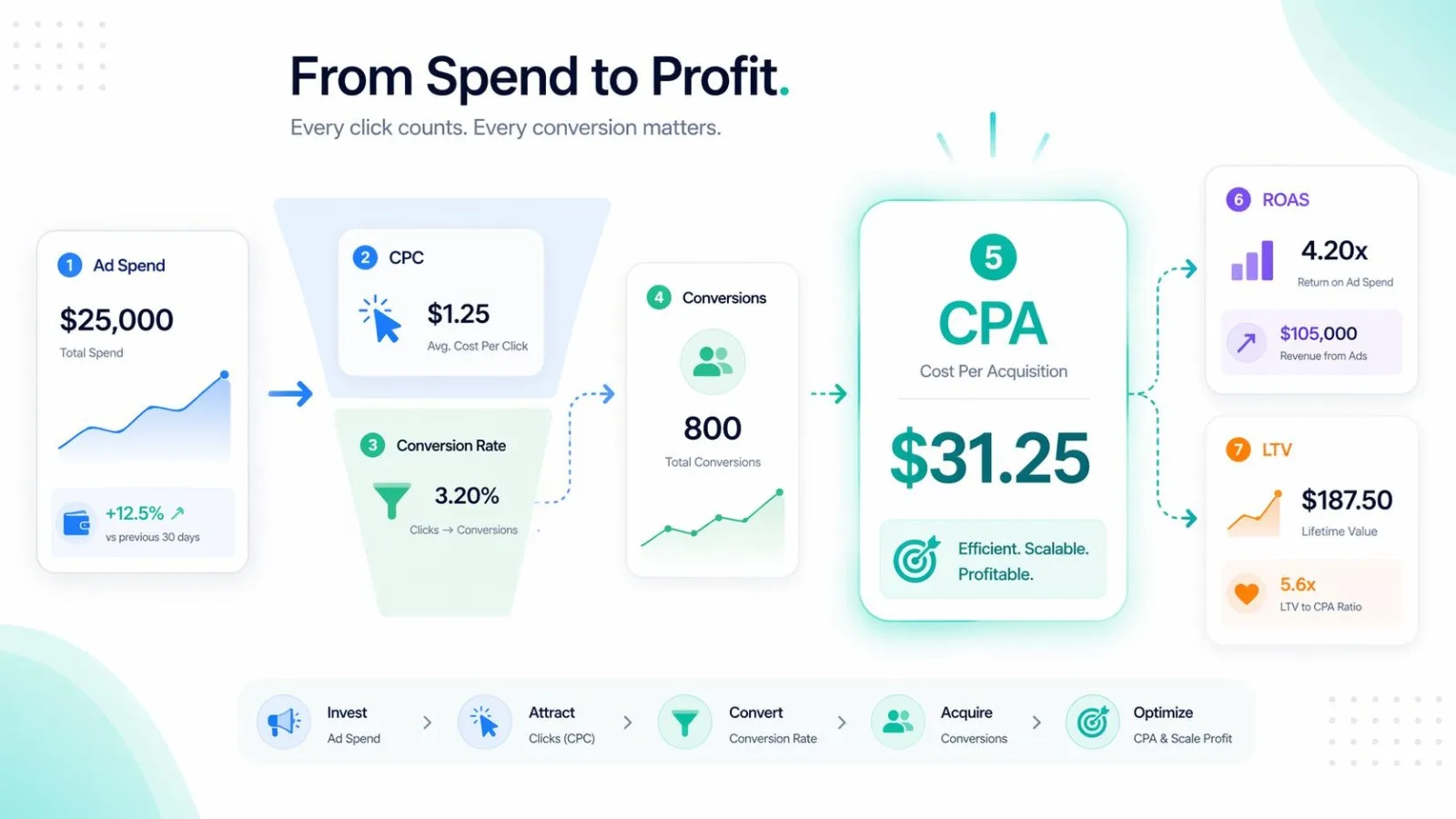 A profitable campaign generates enough contribution from the customers it acquires to cover advertising costs and the other relevant costs of serving those customers.
The exact calculation depends on your business model. An ecommerce company must account for product costs, shipping, returns, and payment fees. A service business needs to consider fulfillment costs, sales expenses, and the proportion of leads that become paying customers.
For that reason, revenue alone is not a reliable measure of profitability.
Consider a simplified ecommerce example:
- Advertising spend: $2,000
- Revenue attributed to advertising: $8,000
- ROAS: 4x
- Product and fulfillment costs: $4,800
- Advertising cost: $2,000
- Remaining contribution: $1,200
The remaining $1,200 is before any additional overhead or costs not included above. The campaign generates a 4x ROAS, but final net profit depends on the full cost structure.
A campaign with a lower ROAS could be more profitable if its margins are higher. Likewise, a high-ROAS campaign may underperform financially if the products or services have very low margins.
The first rule is simple: define what profitable means for your business before deciding which campaign metrics to optimize.
Step 1: Set a Clear Business Goal Before Spending
Start by deciding what the campaign must accomplish. Different goals require different campaign structures, conversion events, and performance evaluation methods.
For example:
- Ecommerce: Generate completed purchases while protecting contribution margins.
- B2B companies: Generate qualified opportunities that progress through the sales pipeline.
- Local service businesses: Generate relevant calls, quote requests, or booked appointments.
- SaaS companies: Acquire trial users or paying customers at an economically sustainable cost.
- Professional services: Attract prospective clients whose likely value justifies the cost of acquisition.
Avoid treating every form submission, phone call, or website visit as an equally valuable conversion.
For a B2B business, a form submission from an unqualified visitor is not equivalent to a sales-qualified opportunity. For a local contractor, a call from outside the service area may have little commercial value.
Choose a primary conversion that reflects a meaningful business outcome. Track secondary actions separately so that early engagement does not get confused with revenue generation.
Before launch, document three things:
- The outcome you want to generate.
- The maximum acquisition cost your economics can support.
- The measurement method you will use to determine whether the campaign is working.
These decisions establish the foundation for everything that follows.
Step 2: Calculate Your Break-Even ROAS and Acquisition Cost
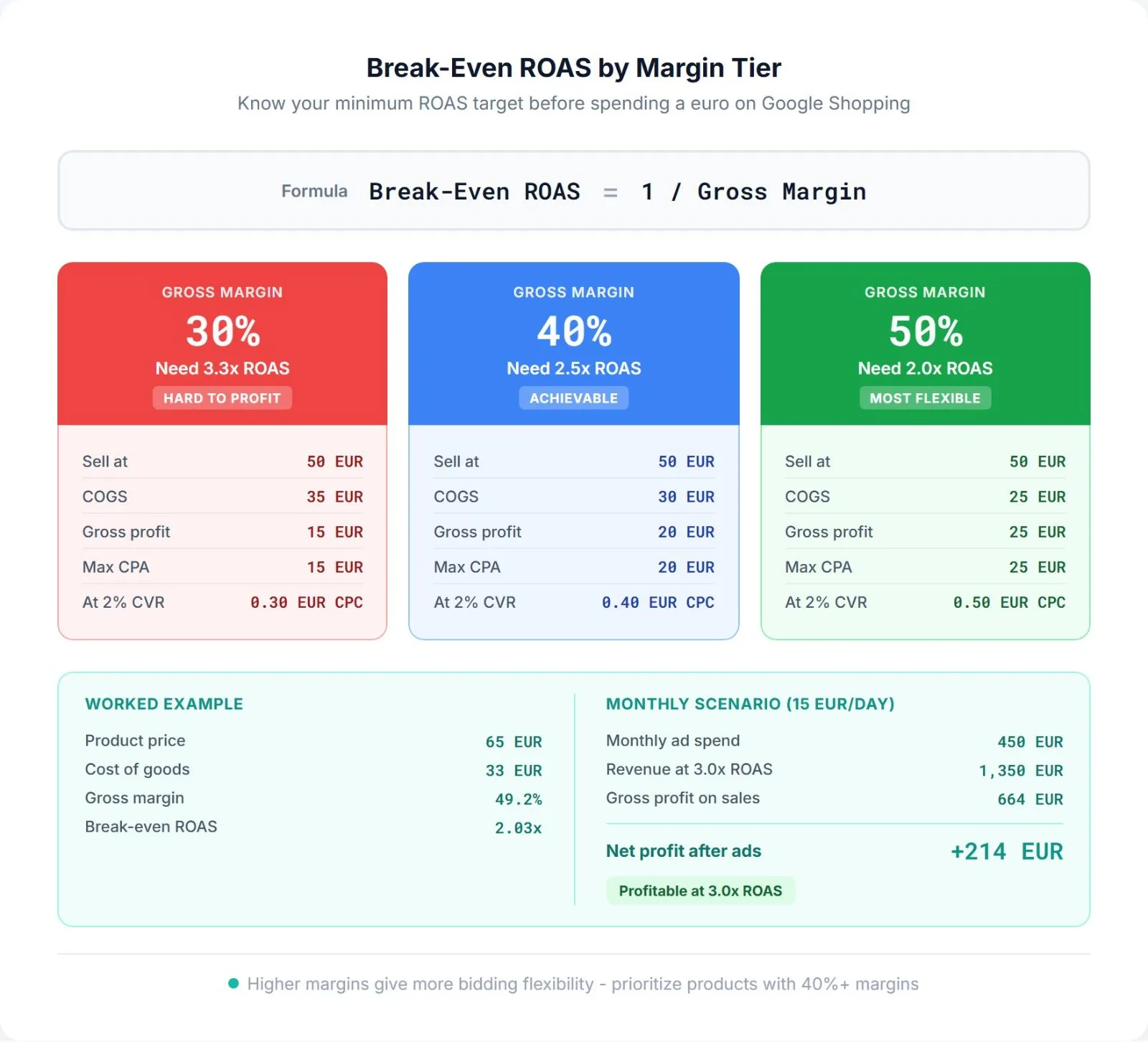
Your advertising targets should come from your margins and customer economics, not from a benchmark copied from another business.
How to calculate break-even ROAS
For a simplified e-commerce model, where the contribution margin is measured before advertising and includes the relevant variable costs:
Break-even ROAS = 1 ÷ Contribution margin ratio
If your contribution margin before advertising is 40%, the calculation is:
1 ÷ 0.40 = 2.5x
That means the campaign needs approximately $2.50 in attributed revenue for every $1 in ad spend to cover those included costs. It does not automatically mean the business has achieved net profitability, because overhead and other excluded expenses may still apply.
To set a target above break-even, account for the profit contribution your business wants to retain.
How to calculate allowable customer acquisition cost
For lead-generation businesses, start with customer value and the costs of delivering the service.
Suppose a service business earns $3,000 in revenue from a new customer and estimates that $1,800 remains as contribution before acquisition costs.
If the business wants to retain $1,000 of that contribution after acquisition, its allowable acquisition cost would be $800, assuming the estimates include all relevant variable costs.
The lead-generation calculation requires another step: not every lead becomes a customer.
If 10% of qualified leads become customers and the allowable acquisition cost is $800, the theoretical allowable cost per qualified lead is:
$800 × 10% = $80
This is an illustrative calculation, not an industry benchmark. Your actual target must reflect your sales conversion rate, lead quality, sales costs, and customer economics.
For more context on interpreting advertising returns, see Adscular's guide to Google Ads ROAS benchmarks.
Step 3: Research Keywords Around Buying Intent
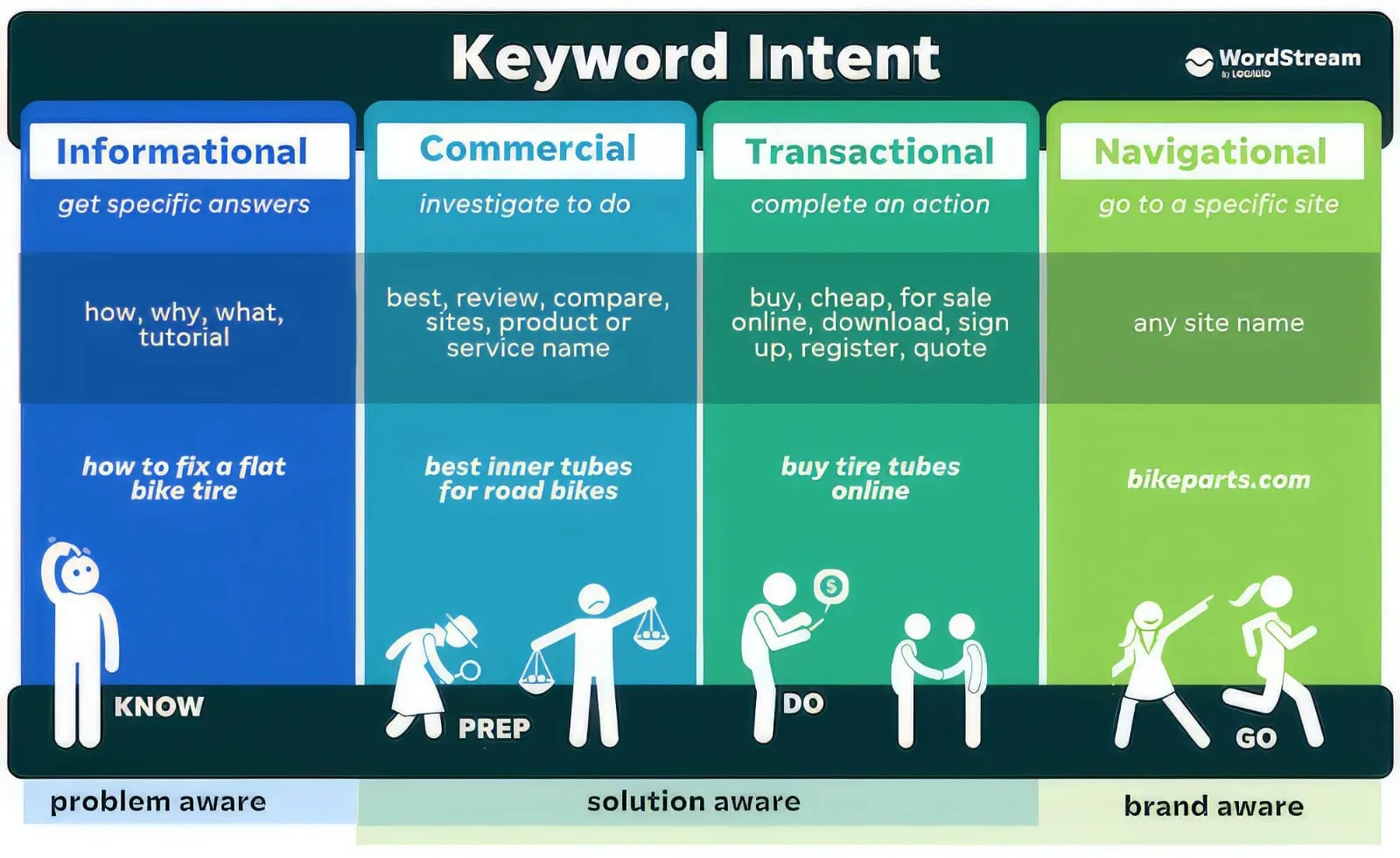
Keyword research determines which searches can trigger your ads. The goal isn't to attract the largest possible audience; it is to reach people whose needs match your offer.
A useful starting point is to organize keywords into intent groups.
High commercial intent
These searches often indicate that someone is evaluating a provider or preparing to take action.
Examples include:
- Google Ads management services
- Google Ads agency for small businesses
- Hire a Google Ads consultant
- Google Ads management pricing
The commercial value of each term depends on your offer, audience, competition, and ability to serve the prospect.
Problem-aware searches
These users understand the problem but may still be researching solutions.
Examples include:
- Why are my Google Ads not converting?
- How to reduce Google Ads cost per lead
- How to improve Google Ads profitability
These searches can support educational content and, where appropriate, campaigns designed to reach people who are researching solutions.
Informational searches
These users may be learning the basics rather than looking to hire a provider.
Examples include:
- What is Google Ads?
- What does ROAS mean?
- How does keyword bidding work?
Informational traffic can be valuable for education and remarketing where permitted, but it should not automatically receive the same budget priority as high-intent acquisition terms.
Build a negative keyword list.
Negative keywords help prevent ads from appearing for searches that are irrelevant to your offer.
Depending on your business, you may need to exclude searches related to jobs, salaries, free courses, tutorials, or unrelated products. Review actual search-term data before applying exclusions because a term that is irrelevant to one advertiser may be valuable to another.
Do not exclude words blindly. Evaluate the meaning of the search, the match type, and the campaign's purpose.
For a broader explanation of campaign mechanics and targeting, read how Google Ads works.
Step 4: Structure Campaigns Around Distinct Business Needs
A campaign structure should make it easier to manage budgets, interpret performance, and connect advertising costs to meaningful outcomes.
For many advertisers, a practical starting structure separates major product categories, service lines, or clearly different customer intentions.
For example, a home services company might separate emergency plumbing searches from planned bathroom renovation searches. Urgency, average order value, the conversion process, and messaging can differ substantially.
Within each campaign, group closely related keywords so the ads and landing pages can address the same underlying need.
Avoid putting every keyword into one large ad group. Equally, avoid creating dozens of tiny campaigns before you have enough data to manage them effectively.
Consider the following principles:
- Separate business objectives when their budgets or conversion goals differ.
- Group keywords by closely related intent.
- Match ad messaging to the searcher's needs.
- Direct visitors to the most relevant destination.
- Keep budgets and reporting understandable.
- Avoid fragmenting conversion data without a clear reason.
Start with a structure you can maintain consistently, then refine it as reliable performance data becomes available.
Step 5: Write Ads That Set the Right Expectations
An ad should explain why your offer matters and what visitors can expect after clicking.
Strong ad copy is specific, credible, and consistent with the landing page. It avoids exaggerated promises or unsupported performance claims.
For example, a Google Ads management provider could emphasize:
- Campaign strategy tailored to business goals
- Conversion tracking and performance reporting
- Search intent and keyword optimization
- Landing page alignment
- A clear next step for prospective clients
Use relevant search language naturally in headlines and descriptions. Where appropriate, explain what differentiates the service, such as a clear process, transparent reporting, or experience with a particular business model.
Use available Google Ads assets to provide useful additional information, such as service details, relevant landing pages, or contact options.
Avoid promising guaranteed rankings, guaranteed ROAS, or a fixed number of leads unless the promise is genuinely supportable and its terms are clearly defined.
The ad's job is to attract the right click, not simply the largest number of clicks.
Step 6: Build a Landing Page That Converts the Right Visitors
Even well-targeted ads can underperform if the landing page doesn't meet visitors' needs.
The page should continue the conversation started by the search query and the ad.
A strong landing page generally answers five questions quickly:
- What does the business offer?
- Who is the service for?
- What problem does it solve?
- Why should the visitor trust the provider?
- What should the visitor do next?
Improve message match
If someone searches for Google Ads management, send them to a page explaining that service rather than a generic homepage that discusses every marketing offering.
The page headline, supporting copy, service details, and call to action should reinforce the same promise made in the ad.
Reduce conversion friction
Review the page on mobile and desktop. Check whether the primary CTA is easy to find, forms request only necessary information, and contact options work correctly.
Use genuine proof, such as verified testimonials, relevant work samples, transparent processes, or substantiated case studies. Do not invent client results or present illustrative calculations as actual campaign outcomes.
Test improvements methodically
Test meaningful changes, such as a clearer headline, a shorter form, a more relevant CTA, or a better explanation of the offer.
Evaluate the quality of leads as well as the number of conversions. A page that produces more submissions but fewer qualified opportunities may not be the better option.
If landing-page performance is a bottleneck, Adscular's conversion rate optimization service is a relevant next step.
Step 7: Set Up Accurate Conversion Tracking
Campaign optimization depends on the quality of the data being measured. If conversion tracking is incorrect, you can make decisions based on misleading performance reports.
Before launch, verify that important actions are recorded correctly.
For ecommerce, this may include completed purchases and accurate transaction values. For lead generation, this may include completed forms, qualified leads, booked appointments, and closed sales you can measure.
A practical tracking checklist includes:
- Verify the conversion action fires when the intended event occurs.
- Check that duplicate events are not inflating conversions.
- Confirm revenue values and currencies are recorded correctly.
- Test forms, phone calls, and booking flows.
- Use Google Analytics 4 and Google Tag Manager where appropriate.
- Connect CRM or sales data when feasible and permitted.
- Review consent, privacy, and applicable data-protection requirements.
A lead-generation campaign should ideally distinguish between a raw lead and a qualified lead. If a business can reliably connect qualified opportunities and closed revenue to advertising interactions, those downstream outcomes can improve decision-making.
Do not assign arbitrary values to conversions and interpret the resulting ROAS as actual revenue. Clearly distinguish modeled or estimated values from verified sales.
Step 8: Choose a Bidding Strategy That Fits Your Data
Google Ads offers different bidding strategies for different objectives. The appropriate option depends on the campaign goal, available conversion data, budget, and the quality of the measurement setup.
For example, conversion-focused strategies may be useful when the account can measure meaningful conversions reliably. Value-based strategies may be appropriate when conversion values reflect real differences in business value and sufficient data is available.
The important principle is to align bidding with the outcome you want.
If a campaign optimizes for low-value actions, the platform may find more of those actions without producing the business results you need.
Before changing bidding strategies, check:
- Whether primary conversions are recorded accurately
- Whether the campaign has enough relevant data
- Whether the conversion action reflects business value
- Whether budgets and targets are realistic
- Whether recent changes have affected performance
Avoid switching strategies repeatedly in response to short-term fluctuations. Make changes for a clear reason and allow an appropriate period to evaluate their effects.
There is no universal number of conversions or fixed waiting period that guarantees a bidding strategy will work. Account conditions and conversion volume matter.
Step 9: Review Search Terms and Optimize for Quality
Once a campaign is running, review what people actually searched for before clicking your ads.
The Search Terms report can reveal irrelevant queries, new commercial opportunities, and differences between the traffic you expected and the traffic you received.
Use these insights to:
- Add appropriate negative keywords.
- Identify relevant search themes worth testing.
- Improve ad messaging when it doesn't match intent.
- Separate materially different customer needs when useful.
- Investigate expensive queries that are not producing meaningful results.
Do not pause every keyword that has not converted immediately. Some conversions take time, and low-volume campaigns may need a larger observation window. Consider spend, click volume, conversion lag, business value, and the probability that a term will eventually convert.
Likewise, do not scale a keyword simply because it generated one conversion. Assess whether performance is repeatable and whether the resulting customers are commercially valuable.
Step 10: Optimize Beyond Clicks and ROAS
A useful optimization process considers the complete path from search to customer.
Important metrics include:
|
Metric |
What it helps you understand |
|
Click-through rate |
How often impressions generate clicks |
|
Cost per click |
How much traffic costs |
|
Conversion rate |
How effectively clicks produce the measured action |
|
Cost per lead |
How much each lead costs |
|
Qualified lead rate |
How many leads meet your criteria |
|
Customer acquisition cost |
How much it costs to acquire a customer |
|
ROAS |
Revenue attributed to ads relative to advertising spend |
|
Contribution after advertising |
How much remains after the included variable costs and advertising |
|
Close rate |
How effectively sales opportunities become customers |
No single metric tells the whole story.
For example, reducing cost per lead is not necessarily an improvement if the new leads are much less likely to buy. Similarly, a lower ROAS may still accompany higher total contribution if the business can profitably reach more customers.
For additional context, see Adscular's guide to performance marketing KPIs.
The goal is to connect campaign activity to meaningful business outcomes rather than optimize isolated dashboard numbers.
Step 11: Scale Only When the Economics Support It
Increasing the budget can amplify a campaign's results, but it can also amplify inefficiencies.
Before scaling, check that:
- Conversion tracking is trustworthy.
- Lead or customer quality is acceptable.
- Results are reasonably consistent over a relevant period.
- Acquisition costs fit your business model.
- The business can fulfill additional demand.
- The landing page and sales process can handle more volume.
Increase budgets in a controlled way and monitor how the additional spend performs. Marginal performance may differ from the results achieved at the original budget.
For lead generation, review whether additional leads are still within your target geography, service category, and customer profile. For ecommerce, monitor contribution margins, average order value, returns, and other relevant costs.
Scaling should be based on evidence that additional spend can create additional business value—not simply on the fact that a campaign has performed well in the past.
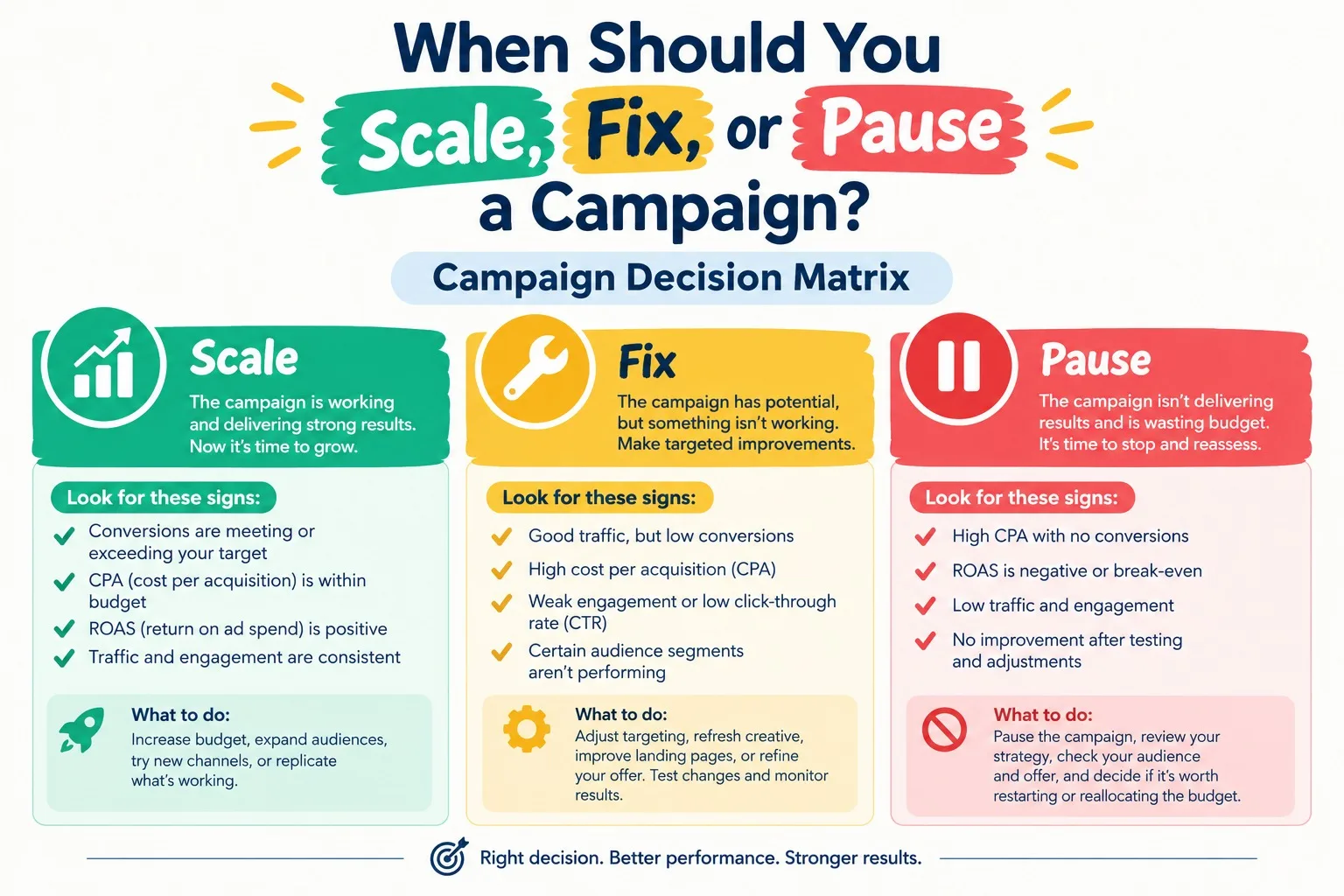
A Practical Google Ads Optimization Schedule
A repeatable process helps prevent random changes and makes it easier to learn from campaign data.
Before launch
- Define the business objective and allowable acquisition cost.
- Research keywords and prepare negative keyword themes.
- Build relevant ads and landing pages.
- Verify conversion tracking.
- Check budgets, locations, targeting, and campaign settings.
During the initial monitoring period
- Confirm ads are serving as expected.
- Check search terms for clearly irrelevant traffic.
- Test conversion actions and lead delivery.
- Investigate technical problems promptly.
- Avoid unnecessary changes based on tiny data samples.
During regular optimization
- Review search-term quality and conversion performance.
- Assess lead quality and sales outcomes.
- Compare results against business economics.
- Test meaningful improvements to ads and landing pages.
- Document changes and their observed effects.
During scaling decisions
- Verify that results are sustainable enough to justify expansion.
- Increase budgets cautiously.
- Track marginal acquisition costs and customer quality.
- Reassess targets when market conditions or business margins change.
The schedule should adapt to spending levels, conversion volume, and sales cycles. A high-volume ecommerce account may generate useful signals faster than a business that receives only a few qualified leads each month.
Common Mistakes That Undermine Google Ads Profitability
Optimizing for clicks instead of business outcomes
More traffic is not necessarily more revenue. Focus on the intent and value of the visitors you attract.
Ignoring negative keywords
Irrelevant searches can consume budget. Use search-term data to identify exclusions without blocking valuable queries indiscriminately.
Sending every visitor to the homepage
A generic destination can create a mismatch between the search, the ad, and the offer. Use relevant landing pages where appropriate.
Trusting inaccurate conversion data
Duplicate conversions, incorrect values, or unqualified actions can make performance appear better than it is. Validate tracking regularly.
Increasing spend before understanding performance
Higher budgets do not automatically fix weak targeting or poor conversion rates. Diagnose the underlying problem before expanding.
Treating benchmark ROAS as a universal target
A benchmark cannot account for every business's margins, sales cycle, customer lifetime value, and operating costs. Calculate your own thresholds.
Making too many changes at once
When keywords, budgets, ads, landing pages, and bidding strategies change at once, it becomes hard to know what drove the outcome. Make changes with a clear hypothesis and evaluate them systematically.
How a Google Ads Management Partner Can Help
Managing Google Ads profitably requires more than launching campaigns. It involves aligning keyword intent, campaign structure, conversion tracking, landing pages, reporting, and business economics.
An experienced management partner can identify wasted spend, build a measurement framework, prioritize improvements, and connect ad performance to the sales process.
Before choosing an agency, ask how it measures qualified leads, handles conversion tracking, reports on performance, and decides when to scale or reduce spend. Ask for relevant evidence of previous work and ensure any reported results can be substantiated.
For businesses that need support with strategy, campaign management, and performance measurement, explore Adscular Agency's Google Ads management services.
The right approach should be transparent about objectives, limitations, costs, and how success will be measured. No agency can guarantee a particular ROAS or profit level for every business.
Frequently Asked Questions
What is a profitable Google Ads campaign?
A profitable campaign generates enough contribution from acquired customers to cover advertising costs and the other relevant costs of serving those customers. Profitability depends on margins, customer value, conversion rates, and acquisition costs.
How much should a business spend on Google Ads?
There is no universal budget. Start with a budget your business can afford to test, estimate the economics of acquiring customers, and use actual campaign data to determine whether additional spending is justified.
What is a good ROAS for Google Ads?
A good ROAS depends on your business model and contribution margins. Ecommerce, SaaS, B2B, and local service businesses can have very different profitability thresholds. Calculate break-even ROAS before choosing a target.
How long does it take to make Google Ads profitable?
The timeline varies according to competition, conversion volume, tracking quality, the sales cycle, and the offer. Some campaigns need substantial setup improvements before you can evaluate them reliably. Do not assume that every campaign will become profitable within a fixed number of days.
Should I use broad match keywords?
Broad match can help you discover relevant searches, but it requires proper bidding, conversion tracking, and monitoring of search terms. Whether it is suitable depends on your campaign goals, data, and ability to control irrelevant traffic.
Why are my Google Ads getting clicks but no leads?
Possible causes include low-intent keywords, a mismatch between ads and landing pages, weak offers, technical problems, or incorrect conversion tracking. Review the search terms, test the conversion journey, and verify that leads are being recorded correctly.
Is ROAS the same as profit?
No. ROAS compares attributed revenue with advertising spend. Profitability also depends on product costs, service delivery, fulfillment, overhead, and other relevant expenses.
When should I increase my Google Ads budget?
Consider increasing the budget when tracking is accurate, customer quality is acceptable, acquisition costs fit your business economics, and the business can handle more demand. Scale cautiously and monitor whether additional spend remains worthwhile.
Final Thoughts
Building profitable Google Ads campaigns starts with understanding your business economics and continues through every part of the customer journey.
Set realistic acquisition targets, research the right keywords, create relevant ads, build landing pages that match user intent, and verify conversion tracking before relying on performance reports. Then use search-term data, lead quality, contribution margins, and customer acquisition costs to guide ongoing optimization.
The objective is not simply to get more clicks or report a higher ROAS. It is to acquire the right customers at a cost your business can sustain and to make informed decisions about future growth.
If your campaigns are generating traffic but not enough qualified leads or profitable sales, review your targeting, tracking, landing pages, and customer economics before increasing spend.
Need help improving your Google Ads performance?
Explore Adscular Agency's Google Ads management services to learn how a structured, measurement-focused approach can support your business goals.