How Does Google Ads Work? A Complete Guide for Business Owners in 2026
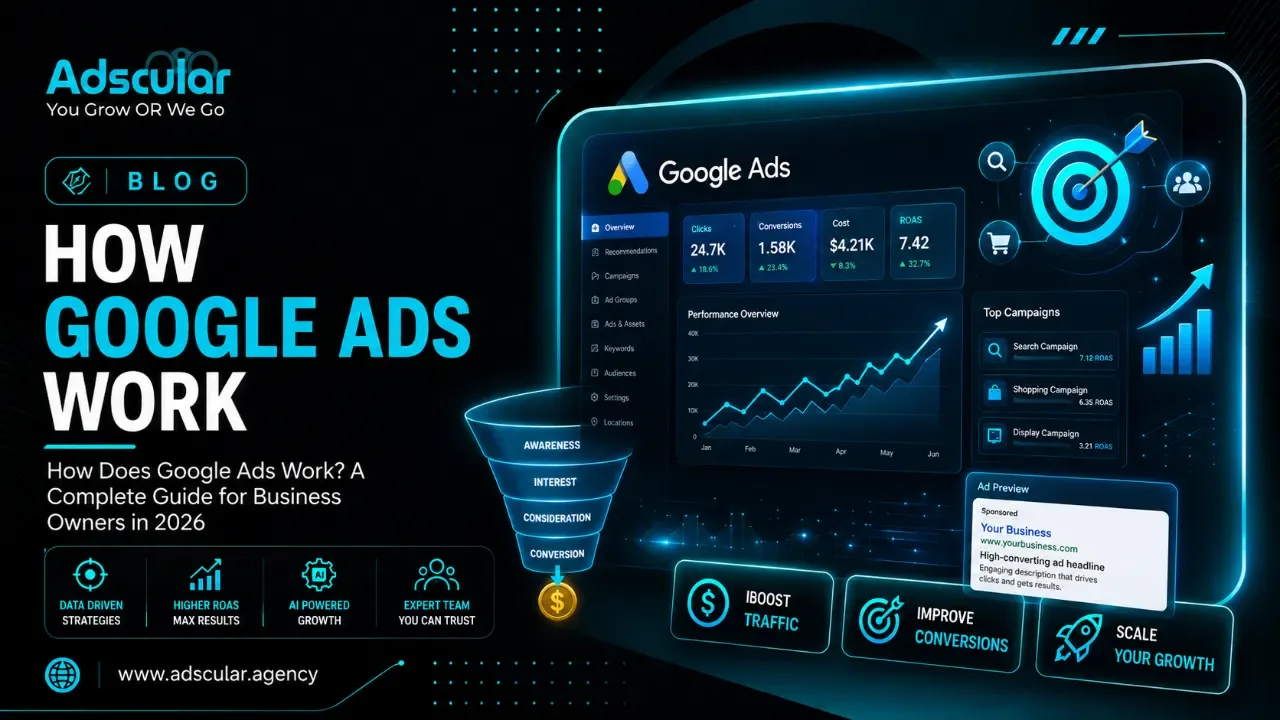
The Paid Search System Most US Business Owners Get Wrong — And How to Get It Right
Written by the Adscular Agency growth team | June 22, 2026 | 8 min read
Introduction:
Quick Answer: Google Ads is a pay-per-click advertising platform where your ad appears when someone searches a term you're targeting — and you only pay when they click. Every search triggers a real-time auction that factors in your bid, your ad's relevance, and your landing page quality to decide who shows up and where. Done right, it's the fastest way for a US business to put an offer in front of someone who's actively looking to buy.
At Adscular Agency, we build and manage Google Ads systems for businesses across healthcare, legal, SaaS, home services, and e-commerce — and what we see consistently is that the businesses who struggle aren't spending too little. They're running ads without understanding how the auction actually works. That's what this guide fixes.
How Does Google Ads Work?
You create an ad, set a maximum bid on a keyword, and Google runs a lightning-fast auction every time someone searches that term. Your position in the results is determined not just by who bids the most, but by a formula called Ad Rank — which combines your bid, your Quality Score, and the expected impact of your ad assets. The winner gets the click. The loser pays nothing.
Why Google Ads Matters for US Business Owners Right Now
Google processes roughly 8.5 billion searches per day. A meaningful slice of those searches are high-intent buyers — people searching "emergency plumber near me," "best dental implant cost," or "hire a DUI attorney in Dallas." These aren't casual browsers. They're ready to call, book, or buy.
Organic SEO can eventually capture that traffic, but SEO takes 3–6 months minimum to show results. Google Ads puts you in front of that same audience today — if you understand the system. If you don't, you'll burn the budget on clicks that never convert.
That's the core tension. Google Ads is one of the highest-ROI channels in performance marketing — and one of the easiest ways to waste $3,000 a month with nothing to show for it.
How the Google Ads Auction Actually Works
Step 1: You Choose Keywords and Set a Bid
When you set up a Google Ads campaign, you select the keywords you want to target — the exact phrases you believe your potential customers are typing into Google. For each keyword, you set a maximum CPC (cost-per-click) bid: the highest amount you're willing to pay if someone clicks your ad.
This is not what you'll actually pay. It's just your ceiling.
Step 2: Google Runs a Real-Time Auction
Every single time someone types a search into Google, an auction fires in milliseconds. Every advertiser targeting that keyword enters the auction automatically. Google then calculates each advertiser's Ad Rank to decide who shows, and in what order.
Ad Rank Formula:
Ad Rank = Bid × Quality Score × Expected Impact of Ad Extensions
You don't see this number directly. But it controls everything — your position, whether you show at all, and what you actually pay per click.
Step 3: Quality Score Determines Your Real Cost
Quality Score is Google's 1–10 rating of how relevant your ad and landing page are to the keyword someone searched. It has three components:
- Expected Click-Through Rate (CTR): Does Google predict people will click your ad?
- Ad Relevance: Does your ad copy match the searcher's intent?
- Landing Page Experience: Does your page deliver what the ad promised?
A high Quality Score means you can outrank competitors who bid more — while paying less per click. A low Quality Score means you overpay for worse positions. This is where most first-time advertisers bleed money.
Example: If Advertiser A bids $5 with a Quality Score of 8, and Advertiser B bids $8 with a Quality Score of 4 — Advertiser A wins the higher position at a lower cost. That's the system.
Step 4: You Only Pay When Someone Clicks
Google Ads runs on a CPC model: you pay only when someone clicks your ad. The actual amount you pay is typically less than your maximum bid — Google charges just enough to beat the next advertiser's Ad Rank. The formula is:
Your Actual CPC = (Competitor's Ad Rank ÷ Your Quality Score) + $0.01
The practical implication: improving your Quality Score from 4 to 8 can cut your cost per click in half — without changing your bid.
Google Ads Campaign Types: Which One Do You Actually Need?
Not all Google Ads campaigns work the same way. Choosing the wrong type is one of the most common mistakes US SMBs make when starting out.
|
Campaign Type |
Where Ads Show |
Best For |
Risk Level |
|
Search |
Google search results (text ads) |
High-intent buyers searching for your service |
Low — high intent |
|
Display |
Websites across Google's network (banner ads) |
Brand awareness, retargeting |
Medium — lower intent |
|
Shopping |
Google Shopping tab + search results |
E-commerce product sales |
Low for e-commerce |
|
Performance Max |
All Google properties (automated) |
Scaling after Search is profitable |
High if launched cold |
|
Video |
YouTube pre-roll and in-stream |
Awareness and remarketing |
Medium |
For most US service businesses — legal, dental, home services, SaaS — start with Search campaigns. You're capturing demand that already exists. Display and PMax should come after you've proven your offer converts.
What Determines Where Your Ad Shows Up?
Your Bid Is Only One Factor
Beginners assume the biggest spender always wins the top spot. That's wrong. Google ranks ads using Ad Rank, not just budget. A well-built $3,000/month campaign from a small business can outperform a $30,000/month campaign with poor structure and weak landing pages.
Ad Extensions Add Real Estate (and Lift Quality Score)
Ad extensions — now called "assets" by Google — let you add phone numbers, site links, callouts, and location information directly to your ad. These expand your ad's footprint on the results page and signal relevance to Google. Adding relevant extensions improves your Ad Rank without increasing your bid.
A law firm running Google Ads without call extensions and location assets is leaving both clicks and Ad Rank points on the table.
Match Types Control Who Triggers Your Ad
Keywords in Google Ads come with match types that determine how closely a search must match your keyword before your ad fires:
- Broad Match: Ad can show for loosely related searches (highest reach, lowest control)
- Phrase Match: Ad shows when the search contains your keyword phrase in order
- Exact Match: Ad shows only when the search closely matches your exact keyword (most control, lowest volume)
Most campaigns that burn budget are running Broad Match on competitive keywords with no negative keyword list. One of the first things we do at Adscular when auditing a new client's account is pull their search term report — it's rarely pretty. For a deeper look at how this compares to other channels, see our breakdown of SEO vs Google Ads for lead generation.
How to Run a Google Ads Campaign: Step-by-Step
-
Define your goal.
Pick one: leads, calls, purchases, or form fills. Don't run an ad without a conversion action set up in Google Ads and Google Analytics 4.
-
Research your keywords.
Use Google's Keyword Planner to find terms your buyers actually search. Focus on high-intent, specific terms ("emergency HVAC repair Austin") over broad terms ("HVAC").
-
Set your campaign structure.
One campaign per service or product category. One ad group per tight keyword theme. Do not dump 50 keywords into one ad group.
-
Write 3 ads per ad group.
Use Responsive Search Ads (RSAs) with at least 8–10 headlines and 4 descriptions. Rotate and let Google optimize.
-
Build a dedicated landing page.
Your homepage is not a landing page. Each campaign needs a page that matches the ad's promise, loads in under 3 seconds, and has one clear CTA above the fold.
-
Set a daily budget and bid strategy.
Start with Manual CPC or Maximize Clicks while you gather data. Move to Target CPA only after you have 30+ conversions in the account.
-
Add negative keywords from day one.
Block irrelevant traffic immediately. Common negatives for service businesses: "free," "DIY," "jobs," "salary," "course."
-
Monitor and optimize weekly.
Pull your Search Terms report. Pause underperforming keywords. Raise bids on converting terms. Improve ad copy based on CTR data.
To understand what strong performance looks like — and what metrics actually matter — read our guide on what a good ROAS looks like in Google Ads and how to improve ROAS in Google Ads.
Real-World Result: What Google Ads Looks Like When It's Built Right
Crestview Dental Group in Chicago came to Adscular running a Google Ads campaign that was spending $4,200/month and generating 9 new patient leads. Cost per lead: $467. Most of their budget was burning on broad-match keywords triggering searches like "dental school near me" and "free teeth cleaning."
We rebuilt the account from scratch: tightened keyword match types, built service-specific landing pages with a 4-second load time, added call extensions and location assets, and shifted budget to high-intent terms like "dental implants Chicago cost" and "emergency dentist Chicago same day."
Ninety days later: 38 new patient leads at $68 cost per lead on the same $4,200/month budget. Same spend. 4x the output. The difference wasn't the budget — it was the structure.
This is what performance marketing done right actually looks like.
Frequently Asked Questions
How much does Google Ads cost for a small business?
Google Ads has no minimum spend. Most US small businesses start with $1,000–$3,000/month in ad spend. Your actual cost per click varies by industry — legal and insurance keywords can run $30–$80 per click, while home services typically run $5–$20. Budget is less important than structure: a well-built $2,000/month campaign will outperform a poorly built $10,000/month campaign.
How long does it take for Google Ads to show results?
Google Ads can generate clicks and leads within hours of launching. However, it typically takes 30–60 days of data collection before your campaigns are fully optimized. Smart bidding strategies like Target CPA require at least 30 conversions before they perform reliably. Plan for a 60–90 day ramp period before judging performance.
What is a Quality Score in Google Ads and why does it matter?
Quality Score is Google's 1–10 rating of how relevant your keyword, ad, and landing page are to the person searching. A higher Quality Score means lower costs per click and better ad positions. Advertisers with Quality Scores of 8–10 can outrank competitors bidding twice as much. It's the single biggest lever for reducing your customer acquisition cost.
What is Ad Rank in Google Ads?
Ad Rank is the score Google assigns to every ad in every auction to determine whether your ad shows and in what position. It's calculated from your bid, Quality Score, and the expected impact of your ad extensions. A higher Ad Rank wins better placements — and the advertiser with the higher Ad Rank typically pays less per click than their maximum bid.
Is Google Ads better than Meta Ads for lead generation?
It depends on the intent. Google Ads targets active demand — people searching right now for what you sell. Meta Ads targets audiences based on demographics and interests — they're not searching, you're interrupting them. For high-ticket services like legal, medical, or B2B SaaS, Google Ads typically produces higher-quality leads. For products with visual appeal or impulse purchases, Meta can outperform.
Can I run Google Ads myself, or do I need an agency?
You can run Google Ads yourself, but the learning curve is steep and mistakes are expensive. Google's interface is designed to encourage spending, not efficiency. If your monthly ad budget is under $1,500, self-managing with a good course or resource makes sense. Above $2,500/month, poor campaign structure typically costs more than agency fees.
The Bottom Line
Google Ads works by running a real-time auction on every search — and your position is determined by your bid, your Quality Score, and the relevance of your entire ad experience. The businesses that win aren't always the ones spending the most. They're the ones with the tightest structure, the most relevant ads, and landing pages that convert.
If you want to know exactly how your current Google Ads account stacks up — or what it would take to build one that actually drives revenue — get your free Google Ads audit from Adscular Agency. We'll pull your account data, identify where your spend is leaking, and show you the specific fixes that would change your numbers.
Want to go deeper first? Read our full guide on performance marketing KPIs to understand which metrics you should actually be tracking — and which ones are just noise.
Author Bio
Written by Daniel Brooks, SEO Specialist at Adscular Agency — a US-based performance marketing agency that builds full-funnel revenue systems for businesses in healthcare, legal, SaaS, home services, and e-commerce. He specializes in technical SEO, content strategy, and search visibility — helping US businesses turn organic traffic into measurable revenue. When he's not auditing sites or writing content that ranks, he's building systems that make lead generation more predictable.
To discuss your project, visit https://www.adscular.agency/.