
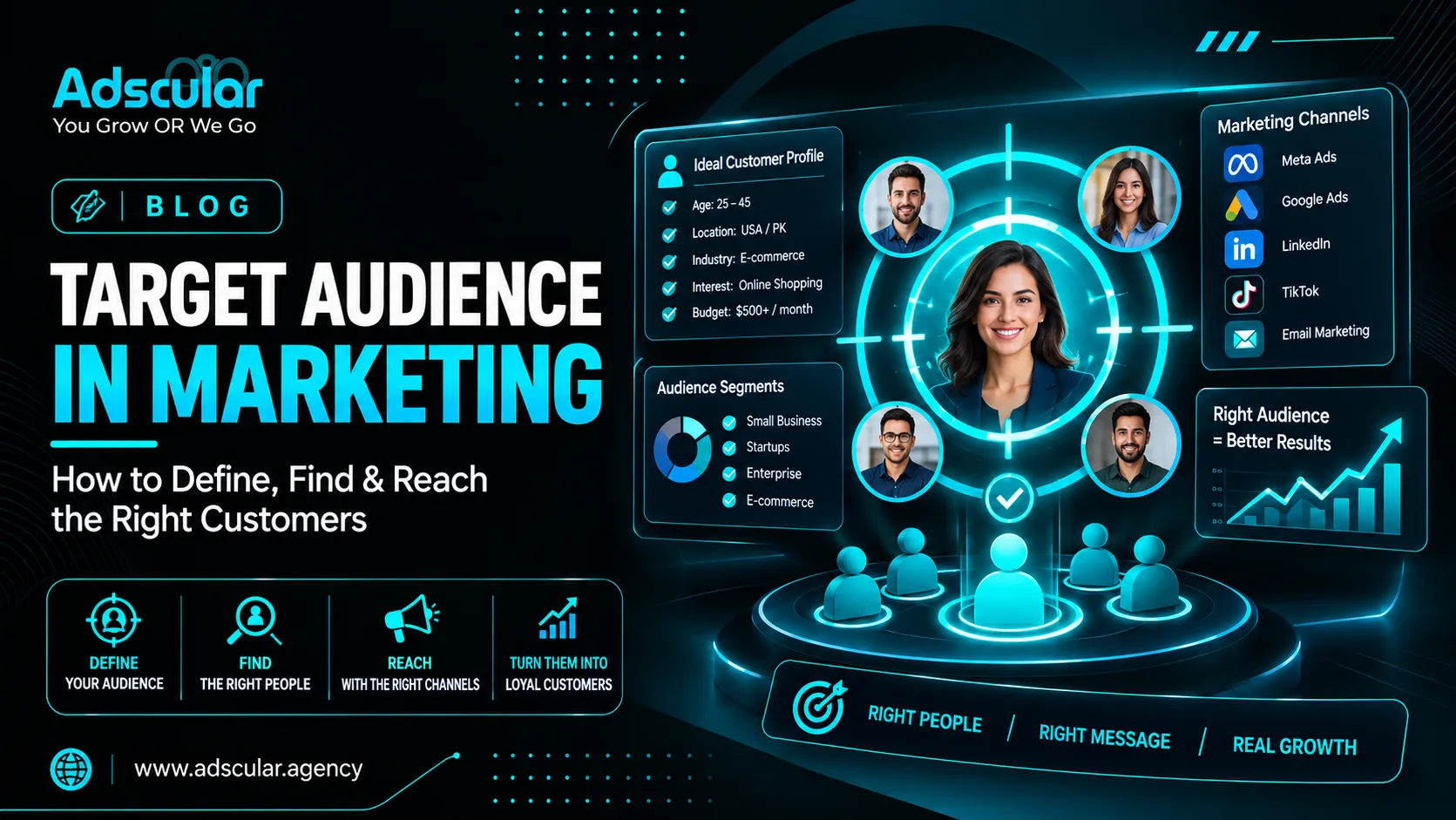
Target Audience in Marketing: How to Define, Find & Reach the Right Customers
Introduction:
Getting more people to see your marketing does not automatically mean getting more customers.
A campaign can generate thousands of impressions and still produce poor results if it reaches people who don't need the product, cannot afford it, or aren't ready to buy.
That is why understanding your target audience matters in marketing.
Your target audience is the specific group of people most likely to have a problem your business can solve and take action on your offer.
When you understand that audience, you can make better decisions about your messaging, content, SEO, advertising, landing pages, offers, and sales process.
This guide explains what a target audience is, how to identify yours, how to segment it, and how to turn audience research into a practical marketing strategy.
What Is a Target Audience?
A target audience is a defined group of people a business wants to reach with its marketing because they are likely to be interested in its products, services, or offer.
A target audience can be defined by factors such as:
-
Age
-
Location
-
Industry
-
Job role
-
Income or purchasing power
-
Interests
-
Problems and needs
-
Buying behavior
-
Business size
-
Purchase intent
-
Preferred channels
-
Stage in the buying journey
For example, a marketing agency could technically advertise to "business owners."
But that audience is too broad to build a precise campaign around.
A more useful audience might be:
U.S. service businesses with established websites that already invest in marketing but need more qualified leads and better customer acquisition efficiency.
That definition immediately gives the marketing team more direction.
The website messaging can become more specific. SEO topics can become more relevant. Paid campaigns can be better aligned with customer intent.
The goal isn't to reach everyone. It's to become highly relevant to the people most likely to become customers.
Target Audience vs. Target Market: What's the Difference?
The terms target audience and target market are closely related, but they are not the same.
Target Market
Your target market is the broader group of potential customers your business serves.
Target Audience
Your target audience is the specific group within that market you are trying to reach with a particular marketing message or campaign.
For example:
Target market:
Small and mid-sized U.S. businesses.
Target audience:
U.S. healthcare businesses looking for more qualified patient leads through Google Ads and SEO.
Another campaign might target:
Target market:
E-commerce businesses.
Target audience:
U.S. e-commerce brands generating consistent sales that want to improve paid acquisition and conversion rates.
The distinction becomes especially important when running multiple campaigns.
One business can have several target audiences depending on the product, service, location, or marketing objective.
Why Is a Target Audience Important in Marketing?
Without a clear audience, marketing often becomes generic.
You end up with messages such as:
"We help businesses grow online."
The statement may be true, but it doesn't tell a specific customer why the offer is relevant to them.
A defined audience lets you make your marketing more specific.
1. Better Marketing Messages
When you understand your customer's problems, you can write messaging around those problems.
Instead of:
"Grow your business with digital marketing."
You might say:
"Generate more qualified leads from Google without increasing wasted ad spend."
The second message addresses a much clearer business problem.
2. More Relevant Content
Your audience determines what questions your content should answer.
A SaaS company may need content about:
-
Customer acquisition cost
-
Product-led growth
-
SaaS SEO
-
Lead generation
-
Conversion optimization
A local service business may need:
-
Local SEO
-
Google Business Profile optimization
-
Local search
-
Lead generation
-
Service-area marketing
The better you understand the audience, the easier it becomes to create useful content.
3. More Efficient Advertising
Advertising platforms give businesses many ways to define who should see an advertisement.
But better targeting isn't simply about adding hundreds of interests or demographic filters.
The important question is:
Who is actually likely to need and value this offer?
That starts with customer research, not the advertising dashboard.
4. Better Conversion Rates
A visitor is more likely to take action when the page immediately answers:
-
Is this for me?
-
Does this business understand my problem?
-
Can it solve my problem?
-
Why should I trust it?
-
What should I do next?
Audience understanding helps answer all five.
How to Identify Your Target Audience
You don't need to guess.
You can build a practical target audience analysis from five types of information.
1. Start With Your Existing Customers
Your existing customers can tell you more than assumptions can.
Look for patterns such as:
-
Which industries buy most often?
-
Which services generate the highest-value customers?
-
Which locations generate the most business?
-
Which problems cause customers to contact you?
-
How did customers find you?
-
What objections did they have before buying?
-
Why did they choose your business?
If several of your best customers share similar characteristics, that pattern may reveal an important audience segment.
2. Identify the Problem They Are Trying to Solve
People usually don't buy a service just because it exists.
They buy because they want an outcome.
For example:
A business may not actually want "SEO."
It may want:
-
More qualified organic traffic
-
More phone calls
-
More consultation requests
-
Better visibility in Google
-
Lower customer acquisition costs
-
More revenue from existing traffic
That distinction matters.
Your marketing should connect your service to the problem or outcome customers actually care about.
3. Analyze Customer Behavior
Demographics tell you who your audience is.
Behavior helps explain what they do.
Look at:
-
Pages they visit
-
Search queries
-
Products or services they view
-
Previous purchases
-
Email engagement
-
Form submissions
-
Ad interactions
-
Content engagement
-
Repeat purchases
-
Search intent
For example, someone who repeatedly visits your pricing page has a different level of intent than someone reading an introductory blog post.
That difference should influence how you market to them.
4. Understand Their Motivations
Two customers can have the same demographic profile but completely different reasons for buying.
Imagine two business owners looking for SEO.
One wants:
More leads from Google.
Another wants:
To reduce dependence on paid advertising.
The service may be similar.
The marketing message doesn't have to be identical.
Ask:
What does this customer want to achieve?
Then ask:
Why does that outcome matter to them?
That second question often reveals the strongest marketing insight.
5. Study What Customers Search For
Search behavior can reveal audience intent before someone ever contacts your business.
Look for searches related to:
-
Problems
-
Services
-
Comparisons
-
Pricing
-
Solutions
-
Alternatives
-
Locations
-
Reviews
-
Buying decisions
For example:
Informational:
what is local SEO
Commercial investigation:
best local SEO agency
Transactional:
local SEO agency USA
These searches represent different stages of the customer journey.
Your content and landing pages should match the intent behind each one.
7 Types of Target Audience Segmentation
Once you understand your customers, you can divide them into meaningful groups.
This is called audience segmentation.
1. Demographic Segmentation
Based on characteristics such as:
-
Age
-
Gender
-
Income
-
Education
-
Occupation
-
Family status
This is useful when demographic differences genuinely affect buying behavior.
2. Geographic Segmentation
Based on location.
Examples:
-
Country
-
State
-
City
-
Region
-
Service area
Geographic segmentation is especially important for local businesses.
For example:
A business serving Dallas should not necessarily use the same marketing approach as a business serving Miami.
Local demand, competition, customers, and search behavior can differ.
3. Firmographic Segmentation
This is particularly useful for B2B marketing.
You can segment companies by:
-
Industry
-
Company size
-
Revenue
-
Location
-
Number of employees
-
Business model
-
Growth stage
For example:
B2B SaaS companies with 20–200 employees
is much more actionable than:
Businesses.
4. Behavioral Segmentation
This focuses on what customers actually do.
Examples include:
-
Previous purchases
-
Website behavior
-
Product usage
-
Email engagement
-
Ad interactions
-
Content consumption
-
Purchase frequency
Behavior often provides stronger marketing signals than basic demographics alone.
5. Psychographic Segmentation
This looks at:
-
Interests
-
Values
-
Lifestyle
-
Preferences
-
Attitudes
-
Motivations
Psychographic information can help businesses understand why people make certain decisions.
6. Needs-Based Segmentation
Group customers according to the problem they need solved.
For example, an SEO agency might have:
Audience A:
Businesses that need more organic traffic.
Audience B:
Local businesses that need more calls.
Audience C:
E-commerce brands that need more profitable acquisition.
Audience D:
B2B companies that need qualified leads.
The same agency can serve all four groups, but each needs a different message.
7. Intent-Based Segmentation
Intent describes how close someone is to taking action.
For example:
Low intent:
"What is SEO?"
Research intent:
"How does SEO work for small businesses?"
Commercial intent:
"Best SEO agency for small business"
Transactional intent:
"SEO agency USA"
This segmentation is extremely useful for SEO and paid advertising because it helps match the right message and landing page to the customer's stage.
Target Audience Examples
Here are a few practical examples.
Local Dental Practice
Target market:
People looking for dental services.
Target audience:
Adults in the practice's service area searching for specific dental treatments.
Problems:
Finding a trustworthy provider, availability, pricing, convenience.
Marketing channels:
Local SEO, Google Search, Google Business Profile, reviews, educational content.
B2B SaaS Company
Target market:
Businesses that could use the software.
Target audience:
Operations or marketing leaders at growing companies experiencing a specific workflow problem.
Problems:
Manual processes, inefficiency, lack of visibility, scaling challenges.
Marketing channels:
SEO, search advertising, LinkedIn, content marketing, webinars, email.
E-commerce Brand
Target market:
Consumers interested in the product category.
Target audience:
A specific group with a strong need for the product, buying behavior, and relevant purchase intent.
Problems:
Product discovery, price, quality, convenience, trust.
Marketing channels:
Google Shopping, SEO, Meta Ads, retargeting, email, content.
How to Find Your Target Audience Online
If you are starting from zero, use this simple process.
Step 1: Review Your Existing Data
Look at:
-
Google Analytics
-
Google Search Console
-
CRM records
-
Customer lists
-
Sales conversations
-
Ad data
-
Website behavior
Find patterns before making assumptions.
Step 2: Research Search Demand
Look for:
-
High-intent keywords
-
Questions
-
Problems
-
Service searches
-
Comparison searches
-
Location searches
Don't focus only on search volume.
Search intent matters.
A lower-volume keyword can be more valuable if the searcher is much closer to becoming a customer.
Step 3: Read Customer Language
Look at:
-
Reviews
-
Sales calls
-
Support questions
-
Reddit discussions
-
Industry communities
-
Customer surveys
-
Comments
Pay attention to the words customers use to describe their problems.
Those words can improve your website copy, ads, content, and offers.
Step 4: Analyze Competitors
Study:
-
Who they speak to
-
What problems they emphasize
-
What services they promote
-
What content they publish
-
What offers they use
-
What objections they address
Don't copy their messaging.
Use the research to identify gaps and opportunities.
How to Use Your Target Audience in Digital Marketing
Knowing your audience is only useful if it changes what you do.
SEO
Build content around the questions, problems, and commercial searches your audience actually has.
A useful SEO structure might look like:
Problem → Educational Content → Solution → Service Page → Conversion
For example:
"Why isn't my website generating leads?"
Can lead to educational content about conversion problems and eventually to a relevant CRO service.
For businesses targeting local customers, a strong Local SEO strategy can connect geographic search intent with relevant service pages and conversion paths. Local SEO & Google Business Profile Optimization
Google Ads
Google Ads works particularly well when you understand search intent.
Instead of targeting every possible keyword, organize campaigns around relevant commercial demand.
Your ad, keyword, landing page, and offer should tell the same story.
For businesses capturing high-intent searches, Google Ads management can be connected to conversion tracking and landing-page optimization rather than measuring success only through clicks.
Meta Ads
Meta advertising can help you reach audiences based on customer characteristics, interests, behavior, creative response, and past interactions.
But audience targeting is only one part of the equation.
The creative, offer, landing page, and follow-up process also matter.
Content Marketing
Your audience should determine what you publish.
Instead of asking:
"What keyword can I write about?"
ask:
"What problem does my potential customer need solved?"
That shift can produce more useful, commercially relevant content.
Create an Ideal Customer Profile
For businesses selling higher-value services, an Ideal Customer Profile (ICP) can make audience targeting much more practical.
Use this simple framework:
|
ICP Element |
Example |
|
Industry |
Healthcare |
|
Location |
United States |
|
Company Size |
10–100 employees |
|
Main Problem |
Inconsistent lead flow |
|
Current Marketing |
Google Ads + SEO |
|
Pain Point |
High CAC |
|
Desired Outcome |
More qualified leads |
|
Buying Trigger |
Falling lead volume |
|
Decision Maker |
Owner / Marketing Director |
|
Main Objection |
Cost and proof |
|
Preferred Action |
Growth audit / consultation |
You don't need a complicated 50-field persona.
You need enough information to understand who you serve, what they need, and why they would buy.
Common Target Audience Mistakes
Trying to Reach Everyone
If your audience is "everyone," your messaging usually becomes generic.
Targeting Demographics Without Intent
Knowing someone's age doesn't necessarily tell you whether they need your product.
Ignoring Existing Customers
Your best audience may already exist inside your customer data.
Confusing Traffic With Demand
High traffic numbers don't automatically mean commercial value.
Creating One Message for Every Segment
Different customers can have different problems, motivations, and buying triggers.
Focusing Only on Keyword Volume
A high-volume keyword can bring visitors who never become customers.
Forgetting the Customer Journey
Someone learning about a problem needs different content from someone ready to buy.
A Simple Target Audience Framework You Can Use Today
If you need to define your audience quickly, answer these seven questions:
1. Who are we trying to reach?
Define the person or business.
2. What problem do they have?
Identify the specific pain point.
3. What outcome do they want?
Define the desired result.
4. What triggers them to search for a solution?
Identify the buying trigger.
5. What prevents them from buying?
List common objections.
6. Where do they look for information?
Identify Google, social media, communities, referrals, email, or other channels.
7. What would make them trust us?
Consider proof, expertise, reviews, case studies, transparency, and relevant experience.
If you can answer those questions clearly, you have the foundation for a much stronger marketing strategy.
How Target Audience Research Improves Your Marketing Funnel
Your audience research should influence every stage of the funnel.
Awareness
Help people understand their problem.
Consideration
Show them possible solutions and explain how to evaluate them.
Decision
Give them evidence, clarity, trust, and a reason to act.
Conversion
Make the next step simple.
Retention
Continue delivering value after the purchase.
The important point is that audience research isn't only an advertising exercise.
It influences your:
SEO → Content → Ads → Website → Landing Pages → CRO → Sales → Retention
That is why audience research can have a much larger impact than simply improving an ad audience.
Conclusion
A strong target audience in marketing is not simply a demographic profile.
It is a practical understanding of:
Who your customer is → what problem they have → what they want → what they search for → what influences their decision → and what action they are ready to take.
Once you understand those elements, your marketing becomes easier to align.
Your SEO can target better search intent.
Your advertising can become more relevant.
Your content can answer real customer questions.
Your landing pages can address actual objections.
And your sales team can spend more time talking to people who are genuinely a fit.
For businesses that need to connect audience research with acquisition, conversion, and measurable growth, Adscular combines SEO, paid acquisition, CRO, lead generation, and revenue-focused marketing systems for U.S. businesses. Adscular's performance marketing approach
The objective isn't to reach the largest possible audience.
It's to reach the right people with the right message at the right moment.
Frequently Asked Questions
What is a target audience in marketing?
A target audience is the specific group of people or businesses most likely to be interested in and take action on a company's product, service, or offer.
How do I identify my target audience?
Start with existing customers and analyze their characteristics, problems, behavior, buying motivations, search patterns, and why they chose your business. Then use customer and market research to identify common patterns.
What is the difference between a target audience and a target market?
A target market is the broader group a business serves. A target audience is the specific segment of that market a particular marketing campaign or message is designed to reach.
What are examples of target audiences?
Examples include U.S. B2B SaaS companies with 20–200 employees, homeowners searching for local home services, or e-commerce customers interested in a specific product category.
Why is target audience important in digital marketing?
It helps businesses create more relevant content, messaging, advertising, landing pages, and offers instead of communicating with a broad audience that may have little interest in the product or service.
How does target audience research help SEO?
Audience research helps identify the problems, questions, commercial searches, and search intent that should guide keyword targeting and content creation.
Can a business have more than one target audience?
Yes. A business can serve multiple audience segments. However, each important segment may need different messaging, content, offers, or campaigns.
If your business is already investing in marketing but sales performance isn't where it should be, the next step may not be spending more.
It may be fixing the system behind the traffic.
Get a Free Revenue Growth Audit from Adscular Agency