
← The Adscular BlogPerformance Marketing
How to Improve Sales Performance: 15 Proven Strategies to Increase Sales
Adscular TeamSeptember 30, 202627 min read
Introduction:
Improving sales performance is not simply about making more calls, sending more emails, or increasing your advertising budget.
A business can generate thousands of website visitors and hundreds of leads and still struggle to increase revenue.
Why?
Because sales performance depends on what happens across the entire customer journey.
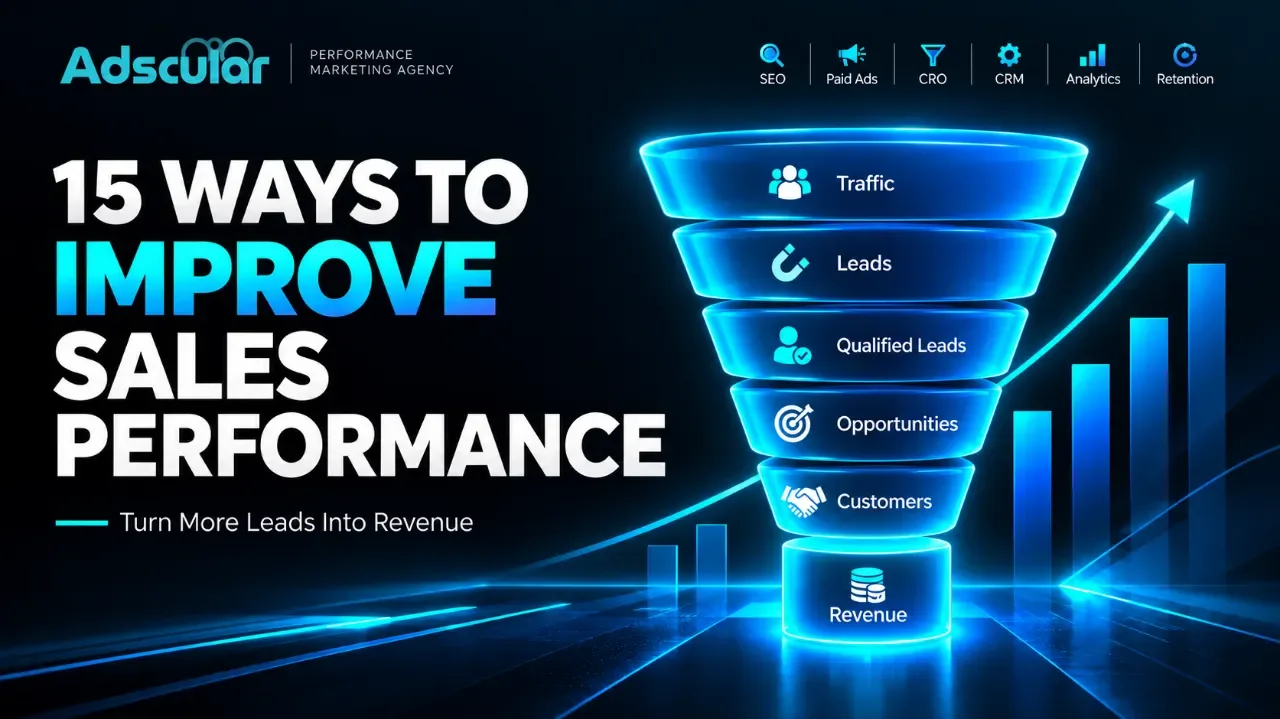
Traffic → Lead → Qualified Lead → Sales Opportunity → Customer → Revenue
If the right prospects are not entering the funnel, your sales team has less to work with. If your website doesn't convert, you waste valuable traffic. If you don't follow up on leads quickly, opportunities disappear. And if your marketing and CRM data are disconnected, it becomes difficult to know which activities are actually generating customers.
The good news is that you can improve sales performance systematically.
This guide explains how to improve sales performance using practical strategies across lead generation, SEO, paid advertising, conversion rate optimization, sales funnels, follow-up, CRM, analytics, and customer retention.
How Can You Improve Sales Performance Without Simply Spending More?
The fastest way to improve sales performance is usually not to increase your marketing budget immediately.
Instead, identify the stage of your customer acquisition funnel where you're losing the most.
For example:
More traffic but few leads?
You may have a conversion problem.
You may have a conversion problem.
Lots of leads but few qualified opportunities?
You may have a targeting or lead-quality problem.
You may have a targeting or lead-quality problem.
Many opportunities but few customers?
Your sales process, offer, pricing, trust signals, or follow-up may need improvement.
Your sales process, offer, pricing, trust signals, or follow-up may need improvement.
Good sales but poor profitability?
Your customer acquisition cost or customer lifetime value may need attention.
Your customer acquisition cost or customer lifetime value may need attention.
The objective is simple:
Generate more qualified opportunities and turn a larger percentage of them into profitable customers.
What Is Sales Performance?
Sales performance measures how effectively a business turns potential customer activity into sales and revenue.
Depending on the business model, it can include:
- Revenue generated
- Number of customers acquired
- Qualified leads
- Sales opportunities
- Conversion rate
- Win rate
- Average deal value
- Sales cycle length
- Customer acquisition cost
- Pipeline value
- Customer lifetime value
- Revenue per lead
A business should not judge sales performance using only one metric.
For example, generating 1,000 leads may look impressive, but if only 20 are qualified, the business may still have a serious growth problem.
Fewer high-intent leads can be far more valuable if they produce more customers and revenue.
That is why modern sales performance should be measured across the complete funnel, not by lead volume alone.
15 Ways to Improve Sales Performance
1. Define Your Ideal Customer
Before trying to generate more sales, make sure you know exactly who you want to sell to.
A broad target audience can create problems throughout your marketing and sales process.
Your advertising becomes less precise.
Your website messaging becomes generic.
Your sales team spends more time speaking with poor-fit prospects.
Start by defining your ideal customer based on:
- Industry
- Company size
- Location
- Revenue
- Job role
- Business problem
- Buying intent
- Budget
- Current solution
- Purchase motivation
For B2B companies, also identify the decision-makers involved in the buying process.
A clear ideal customer profile allows you to build better campaigns, landing pages, offers, and sales conversations.
Example
Weak positioning:
We provide digital marketing services.
Stronger positioning:
We help U.S. businesses generate qualified leads and improve customer acquisition through SEO, paid advertising, conversion optimization, and revenue-focused marketing systems.
The second message immediately tells the prospect who the service is for and what business problem it addresses.
2. Set Sales Goals That Connect to Revenue
“Get more sales” is not a measurable strategy.
Break your revenue target into the numbers required to achieve it.
For example:
Revenue target
↓
Customers required
↓
Sales opportunities required
↓
Qualified leads required
↓
Marketing leads required
↓
Website traffic required
Suppose your business wants 20 new customers per month.
If 20% of qualified opportunities become customers, you need approximately 100 qualified opportunities.
If 30% of qualified leads become opportunities, you need approximately 334 qualified leads.
This type of reverse calculation makes the growth target much easier to understand.
Instead of saying:
“We need more leads.”
You can determine exactly which stage needs improvement.
3. Improve Lead Quality Instead of Chasing Lead Volume
More leads do not automatically mean more sales.
Consider this example:
| Metric | Campaign A | Campaign B |
|---|---|---|
| Leads | 500 | 200 |
| Qualified leads | 50 | 80 |
| Opportunities | 20 | 40 |
| Customers | 5 | 12 |
Campaign B generated fewer leads but produced more than twice the number of customers.
This is why businesses should track:
Lead → Qualified Lead → Opportunity → Customer
rather than stopping at the first conversion.
A 30% lead-to-opportunity conversion rate can be a useful example or benchmark in some B2B funnels, but it is not a universal standard. Actual conversion rates vary significantly by industry, offer, traffic source, qualification criteria, and sales process.
Your most valuable benchmark is your own historical performance.
4. Match Your Marketing to Buyer Intent
Not every website visitor has the same level of buying intent.
Someone searching:
“What is SEO?”
is at a different stage from someone searching:
“SEO agency for small business USA.”
The second search has significantly stronger commercial intent.
A strong marketing strategy should address different stages of the buyer journey.
Informational intent
The prospect is learning.
Examples:
- What is SEO?
- How does Google Ads work?
- What is conversion rate optimization?
Commercial investigation
The prospect is comparing solutions.
Examples:
- Best SEO agency
- SEO vs Google Ads
- Google Ads agency for small business
Transactional intent
The prospect is ready to take action.
Examples:
- Hire SEO agency
- Google Ads management
- Performance marketing agency USA
Matching content and offers to intent helps prevent businesses from selling too aggressively to people who are still researching.
5. Improve Your Website Conversion Rate
If your website gets traffic but doesn't generate enough inquiries, buying more traffic may not be the first solution.
You may have a conversion problem.
Review your website and ask:
- Is the offer clear immediately?
- Does the headline communicate a specific benefit?
- Is the CTA obvious?
- Does the page answer common objections?
- Are there trust signals?
- Is the form easy to complete?
- Does the page work properly on mobile?
- Does the landing page match the advertisement?
- Is the next step obvious?
Conversion Rate Optimization focuses on increasing the percentage of relevant visitors who take a desired action.
That action could be:
- Booking a call
- Requesting a quote
- Submitting a form
- Calling the business
- Requesting a demo
- Making a purchase
For a deeper explanation, read Conversion Rate Optimization and how it can improve revenue without simply increasing traffic.
6. Create Landing Pages for Specific Offers
Your homepage should not have to sell every service to every visitor.
If someone clicks an advertisement for Google Ads management, a dedicated Google Ads page is usually more relevant than sending them to a generic homepage.
A stronger customer journey looks like:
Search → Advertisement → Relevant Landing Page → Offer → CTA
For example:
“Google Ads agency USA”
should lead to a page that immediately explains:
- Google Ads services
- Who the service is for
- Campaign approach
- Conversion tracking
- Benefits
- CTA
The same principle applies to SEO, Meta Ads, lead generation, CRO, and other services.
The closer the relationship between the search query, advertisement, landing page, and offer, the easier it is for the visitor to understand what to do next.
7. Strengthen Your Value Proposition
A potential customer should quickly understand:
What do you do?
Who do you help?
What problem do you solve?
Why should they choose you?
Avoid vague marketing language.
For example:
“We provide innovative digital solutions.”
Doesn’t tell the prospect much.
A stronger statement might be:
“We build full-funnel marketing systems that help U.S. businesses generate qualified leads, improve conversion rates, and scale customer acquisition.”
Your value proposition should focus on the customer’s problem and desired outcome, not just your list of services.
8. Find and Fix the Biggest Leak in Your Sales Funnel
A sales funnel shows how prospects move from first interaction to customer.
A simple funnel is:
Awareness
↓
Interest
↓
Website Visit
↓
Lead
↓
Qualified Lead
↓
Opportunity
↓
Customer
↓
Repeat Customer
Now look for the largest drop-off.
Example 1
10,000 visitors
→ 100 leads
→ 100 leads
Your website may have a conversion problem.
Example 2
100 leads
→ 10 qualified opportunities
→ 10 qualified opportunities
Your targeting or qualification may be weak.
Example 3
10 opportunities
→ 1 customer
→ 1 customer
Your offer, sales process, pricing, trust, objection handling, or follow-up may need attention.
Don’t try to optimize everything simultaneously.
Find the biggest leak first.
9. Improve Lead Follow-Up Speed and Consistency
Generating a lead is only the beginning.
What happens after someone:
- Fills out your form
- Books a consultation
- Requests a quote
- Calls your business
- Sends a message
- Requests a demo
can have a major effect on the final sales result.
Create a defined follow-up process:
- Who receives the lead?
- How quickly is the lead contacted?
- How is the lead qualified?
- What happens if the prospect doesn’t respond?
- When is the next follow-up?
- When does the lead enter the sales pipeline?
- When is the outcome recorded?
A business can spend heavily on lead generation and still lose revenue because the follow-up process is inconsistent.
10. Connect Your CRM With Marketing and Sales Data
A CRM becomes much more useful when it connects marketing activity with actual sales outcomes.
Instead of knowing:
Google Ads → 100 leads
you want to know:
Google Ads → 100 leads → 35 qualified → 12 opportunities → 4 customers → $X revenue
That information allows you to make better decisions.
You can identify:
- Which campaigns generate qualified leads
- Which sources produce customers
- Which industries convert best
- Which landing pages perform better
- Where prospects drop out
- How long leads take to close
- Which channels produce profitable customers
Automation can also support:
- Lead routing
- Lead scoring
- Follow-up reminders
- Appointment notifications
- Email sequences
- Pipeline updates
- Reporting
The objective isn’t to remove humans from sales.
It’s to remove unnecessary manual work and make sure valuable opportunities don’t disappear.
11. Use SEO to Capture High-Intent Search Demand
SEO can become a long-term customer acquisition channel when it targets the searches your potential customers actually make.
A revenue-focused SEO strategy can target:
- Service keywords
- Commercial keywords
- Industry keywords
- Location keywords
- Problem-based searches
- Comparison searches
- Pricing searches
- Informational topics
But ranking is not the final objective.
The actual journey is:
Search Visibility → Relevant Traffic → Conversion → Qualified Lead → Customer
That is why SEO should connect to landing pages, conversion optimization, lead tracking, and sales outcomes.
For businesses targeting the U.S. market, Adscular’s SEO services focus on high-intent organic visibility and sustainable customer acquisition.
12. Use Paid Advertising to Capture and Create Demand
Paid advertising can help businesses reach potential customers faster.
Google Ads is particularly useful for capturing existing search demand.
Meta Ads can help create demand, reach new audiences, and retarget people who have already interacted with your business.
The important thing is to connect the campaign to the rest of the funnel:
Ad → Landing Page → Lead → Qualification → Sales → Customer
A campaign with a low cost per lead isn’t automatically successful.
If most of those leads are unqualified, the actual customer acquisition cost may be much higher.
For businesses targeting bottom-funnel search demand, evaluate Google Ads management against qualified leads, opportunities, customers, and revenue—not clicks alone.
For demand creation and retargeting, Meta Ads can play a complementary role.
13. Track Cost Per Result at Every Stage
“Cost per result” means different things depending on where you measure it.
Cost Per Click
Ad Spend ÷ Clicks
Cost Per Lead
Ad Spend ÷ Leads
Cost Per Qualified Lead
Ad Spend ÷ Qualified Leads
Cost Per Opportunity
Ad Spend ÷ Sales Opportunities
Customer Acquisition Cost
Total Marketing + Sales Cost ÷ New Customers
The further down the funnel you measure, the more useful the number becomes for revenue decisions.
For example:
A $20 cost per lead may look excellent.
But if none of those leads become customers, the business has not necessarily improved.
A $75 qualified lead that produces a profitable customer can be far more valuable.
For a complete breakdown of the metrics that connect marketing performance with revenue, see Performance Marketing KPIs.
14. Improve Sales Performance for High-Ticket Services
High-ticket businesses need to think differently about lead costs.
Suppose a service has an average value of:
1,000$
and the business converts:
30% of qualified opportunities into customers.
If the business generates 10 qualified opportunities:
10 × 30% = 3 customers
Potential revenue:
3 × 1,000$ = 3,000$
This is only an illustrative example, not a universal industry benchmark.
The important principle is that the acceptable cost of acquiring a lead depends on:
- Average deal value
- Profit margin
- Close rate
- Customer lifetime value
- Sales cycle
- Retention
- Delivery costs
A $100 lead can be expensive for one business and extremely profitable for another.
That’s why high-ticket businesses should focus on cost per qualified opportunity and customer acquisition cost, not simply the cheapest possible lead.
If reducing acquisition cost is one of your goals, How to Lower Customer Acquisition Cost provides a deeper framework around conversion, SEO, targeting, response speed, retention, and acquisition efficiency.
15. Increase Customer Lifetime Value After the First Sale
Sales performance doesn’t end after the first purchase.
Existing customers can create additional revenue through:
- Upsells
- Cross-sells
- Renewals
- Retainers
- Additional services
- Repeat purchases
- Referrals
For example, a customer might initially purchase website development and later need SEO, paid advertising, CRO, or marketing automation.
The objective should not be to sell unnecessary services.
The objective is to continue solving genuine customer problems.
Increasing customer lifetime value can make customer acquisition more profitable because the business can generate more revenue from the same customer relationship.
How SEO, Paid Media and CRO Work Together to Improve Sales
Modern sales performance is increasingly connected to marketing performance.
Think about the system as four layers.
1. Demand Acquisition
SEO and paid media bring potential customers into the funnel.
2. Conversion Architecture
Landing pages, offers, forms, and CRO turn relevant visitors into leads.
3. Revenue Intelligence
CRM, CAC, ROAS, attribution, and lead-quality data show what is actually working.
4. Scale Optimization
The business invests more in channels and campaigns that generate profitable customers.
This creates a connected system:
SEO + Paid Media + CRO + CRM + Analytics + Sales
rather than six disconnected marketing activities.
This is also the core philosophy behind Adscular’s performance marketing approach: measure growth by business outcomes, not traffic or vanity metrics.
Sales Performance Metrics You Should Track
You don’t need hundreds of numbers.
Focus on the metrics that help you make decisions.
| Metric | What it tells you |
|---|---|
| Website Traffic | How many people reach your site |
| Conversion Rate | How efficiently visitors become leads |
| CPL | Cost to generate a lead |
| Qualified Lead Rate | Quality of generated leads |
| Opportunity Rate | How many leads become opportunities |
| Win Rate | How many opportunities become customers |
| CAC | Cost to acquire a customer |
| Average Deal Value | Revenue per customer |
| Sales Cycle | Time required to close |
| Pipeline Value | Potential future revenue |
| LTV | Long-term customer value |
| ROAS | Revenue generated from advertising |
Don't try to make every metric look good.
Find the metric that is limiting profitable growth.
For example, if traffic is increasing but qualified leads are flat, more traffic may not be the answer.
If qualified leads are increasing but sales aren’t, the problem may be further down the funnel.
What Is a Good Sales Conversion Rate?
There is no single conversion rate that is “good” for every business.
A 30% conversion rate may be strong for one stage of a high-intent funnel and unrealistic for another.
Conversion rates depend on:
- Industry
- Offer
- Price
- Traffic source
- Audience
- Qualification criteria
- Sales process
- Sales cycle
- Geographic market
Instead of asking:
“What conversion rate should I have?”
ask:
“Where are prospects dropping out, and what can we improve?”
That question leads to a much more useful optimization strategy.
How to Improve Sales Performance When Sales Are Declining
If sales suddenly decline, don’t immediately increase your advertising budget.
Investigate the funnel first.
Check traffic
Has qualified traffic decreased?
Check leads
Are you generating fewer inquiries?
Check lead quality
Are the new leads different from previous leads?
Check conversion rate
Has the website or landing-page conversion rate changed?
Check response time
Are leads being contacted quickly?
Check close rate
Are more sales opportunities being lost?
Check pricing and offer.
Has your value proposition become less competitive?
Check tracking
Could a tracking or attribution issue make performance look worse than it is?
The goal is to find the root cause before increasing spend.
How AI Can Help Improve Sales Performance
AI can support sales and marketing teams with tasks such as:
- Lead scoring
- Customer segmentation
- Sales forecasting
- Follow-up assistance
- Content personalization
- Conversation analysis
- Data analysis
- Reporting
- Workflow automation
- Customer research
But AI is not a replacement for a weak sales process.
If your targeting is wrong, AI won’t automatically create qualified customers.
If your offer is unclear, automation won’t fix your positioning.
If your landing page doesn’t convert, sending more prospects through the same funnel won’t solve the problem.
The strongest approach is to use AI to make a well-designed, measurable process faster and more consistent.
Inbound vs. Outbound Sales: Which Is Better?
Both can work.
Inbound sales
Customers find your business through:
- SEO
- Content
- Paid search
- Social media
- Referrals
- Your website
Outbound sales
Your business proactively reaches prospects through:
- Cold email
- Cold calling
- LinkedIn outreach
- Partnerships
- Account-based prospecting
Inbound is useful when potential customers are actively searching for solutions.
Outbound can be valuable when your ideal customers are not actively searching or when you want to create demand in a specific market.
Many businesses can benefit from a combination of both.
How Storytelling Can Improve Sales Conversations
Customers don’t always remember a list of features.
They remember problems, outcomes, and experiences.
Instead of saying:
“Our platform has advanced automation.”
Explain the business problem:
“A company was losing leads because inquiries were being handled manually. Automating lead routing allowed the team to respond faster and spend more time on qualified opportunities.”
The second approach gives the buyer context.
A strong sales story should explain:
Problem → Consequence → Solution → Process → Outcome
Always use genuine examples and avoid inventing customer results.
How to Improve Sales Performance in 30 Days
You don’t need to rebuild your entire business in one month.
Start with the biggest bottleneck.
Week 1: Audit the Funnel
Review:
- Traffic
- Leads
- Qualified leads
- Opportunities
- Customers
- Conversion rates
- Cost per lead
- CAC
- Sales cycle
Find the largest drop-off.
Week 2: Fix the Conversion Point
Improve:
- Messaging
- Landing pages
- Offer
- CTA
- Forms
- Trust signals
- Qualification
Week 3: Improve Follow-Up
Build:
- Lead routing
- CRM stages
- Follow-up sequences
- Qualification rules
- Sales notifications
- Appointment reminders
Week 4: Measure Again
Compare the new numbers with your original baseline.
Then identify the next bottleneck.
The process is:
Measure → Identify → Fix → Test → Measure Again
That’s how sales performance becomes an ongoing improvement process.
Sales Performance Improvement Checklist
Before increasing your marketing budget, ask:
- Do we know exactly who our ideal customer is?
- Are we attracting high-intent prospects?
- Are our leads properly qualified?
- Does our website clearly communicate the offer?
- Are our landing pages built around specific customer intent?
- Do we know our conversion rate?
- Do we know our cost per qualified lead?
- Are leads followed up quickly?
- Is our sales process documented?
- Is our CRM being used properly?
- Can we connect marketing campaigns to customers?
- Do we know our customer acquisition cost?
- Do we know our average deal value?
- Are we measuring revenue instead of vanity metrics?
- Are we fixing the biggest bottleneck first?
If several answers are “no,” you may have significant room to improve sales performance before increasing your marketing budget.
When Should You Hire a Digital Marketing Agency to Improve Sales?
An agency can help when your business has a viable product or service but needs help with acquisition, conversion, tracking, or scalability.
You may benefit from outside expertise if:
- Traffic is increasing, but sales aren’t
- Advertising costs are rising.
- Lead quality is inconsistent.
- Your website isn’t converting enough visitors.
- You don’t know which channels generate customers.
- Customer acquisition cost is too high.
- Marketing and sales data are disconnected.
- You lack specialist SEO or paid-media expertise.
- You want to scale without simply increasing wasted spend.
The right agency should not focus only on impressions, clicks, or traffic.
It should help answer:
How much does it cost to acquire a customer, where are potential buyers being lost, and what can be improved to generate more profitable revenue?
For businesses looking for a revenue-focused acquisition system, Adscular Agency combines SEO, paid media, CRO, lead generation, analytics, and revenue-focused optimization.
Frequently Asked Questions
What is the best way to improve sales performance?
Start by identifying the biggest bottleneck in your sales funnel. It may be lead quality, website conversion, follow-up, qualification, close rate, pricing, or customer acquisition cost. Fixing the largest bottleneck first is usually more effective than changing everything at once.
How can I improve sales without increasing my marketing budget?
Improve lead quality, conversion rates, follow-up, sales qualification, customer retention, and average customer value. Increasing efficiency can help you generate more customers from the same marketing investment.
What are the most important sales performance metrics?
Important metrics include conversion rate, qualified lead rate, opportunity rate, win rate, customer acquisition cost, average deal value, sales cycle, pipeline value, revenue, ROAS, and customer lifetime value.
Is a 30% conversion rate good?
It depends on the funnel stage and the type of business. A 30% rate may be strong for one qualified-lead stage but weak or unrealistic for another. Always compare conversion rates against your own funnel, industry, traffic source, and historical performance.
How does SEO improve sales performance?
SEO can bring relevant visitors to your website when they are actively searching for a problem, product, or service. The commercial value comes when that traffic becomes qualified leads and customers.
Can Google Ads improve sales performance?
Yes. Google Ads can capture high-intent search demand, but performance depends on keyword targeting, ad relevance, landing-page experience, conversion tracking, lead quality, and sales follow-up.
How does CRO improve sales?
CRO improves the percentage of relevant visitors who take a desired action, such as submitting a form, booking a call, requesting a quote, or making a purchase.
How does CRM improve sales performance?
A CRM helps businesses track leads, qualification, follow-up, opportunities, sales stages, and customer outcomes. When connected with marketing data, it can also show which acquisition channels generate actual customers.
Should I focus on more leads or better leads?
For most businesses, qualified leads are more valuable than simply increasing lead volume. The ultimate objective is profitable customers, not the largest possible number of inquiries.
How long does it take to improve sales performance?
The timeline depends on the problem. You can often implement conversion and follow-up improvements faster than SEO or long sales-cycle improvements. The first step is identifying the specific bottleneck.
Final Takeaway
Improving sales performance is not about finding one magic sales technique.
It is about improving the entire customer journey.
Right Audience
↓
Right Traffic
↓
Better Conversion
↓
Better Lead Quality
↓
Faster Follow-Up
↓
More Sales Opportunities
↓
More Customers
↓
Higher Revenue
If your business is generating traffic but not enough revenue, don’t automatically assume you need more traffic.
You may need:
- Better targeting
- Better lead quality
- Better landing pages
- Better follow-up
- Better sales qualification
- Better tracking
- Better conversion rates
- Better customer economics
The strongest growth systems connect SEO, paid advertising, CRO, lead generation, CRM, analytics, and sales instead of treating each channel as a separate activity.
If your business is already investing in marketing but sales performance isn’t where it should be, the next step may not be spending more.
It may be fixing the system behind the traffic.
Lead Generationperformance marketingSales PerformanceSales Growthdigital marketing serviceshow to improve sales performanceConversion Rate OptimizationSales Funnel