
What Is Conversion Rate Optimization? (And Why Most Businesses Ignore It)
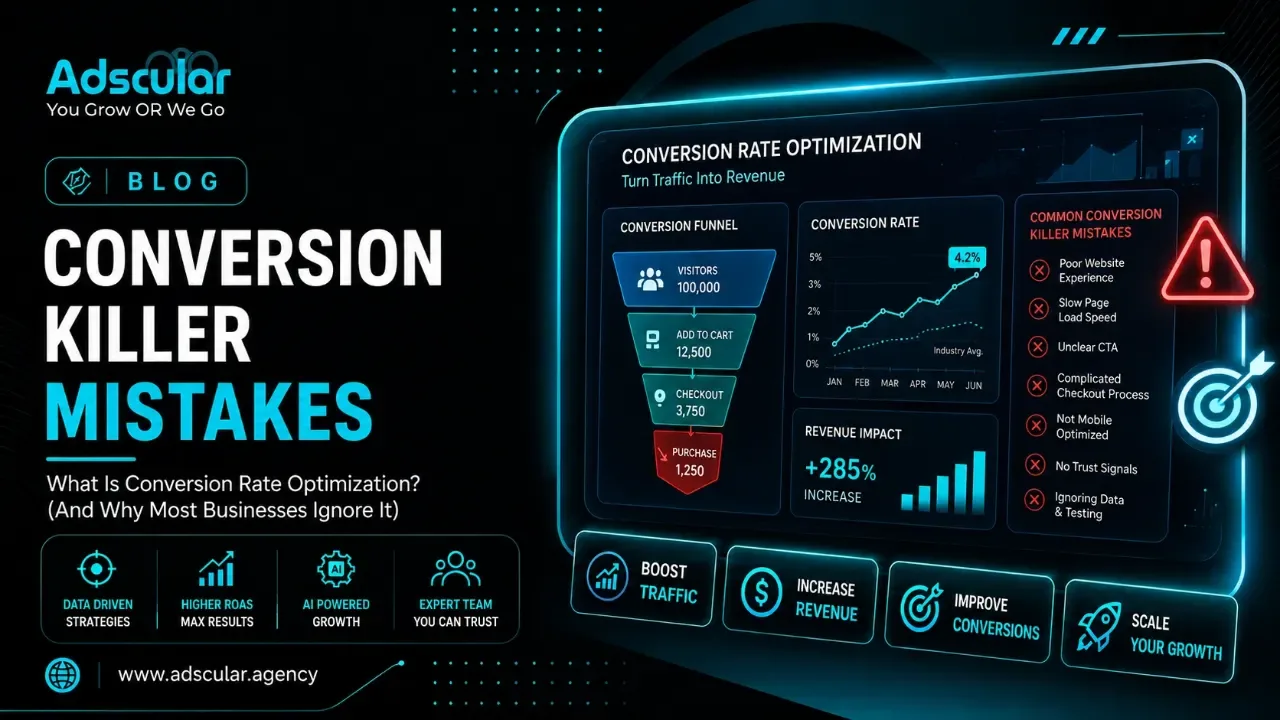
How Conversion Rate Optimization Helps Businesses Grow Faster
By the Adscular Agency Team | Updated June 19, 2026 | 8 min read
Introduction:
Quick Answer: Conversion Rate Optimization (CRO) is the process of increasing the percentage of website visitors who become leads, customers, or buyers. CRO often produces larger revenue gains than increasing traffic because improving conversion rates turns existing visitors into more revenue without increasing advertising costs.
Many businesses spend thousands of dollars on Google Ads, SEO, and social media campaigns while ignoring the pages where visitors actually decide whether to buy. That mistake creates a traffic problem that is really a conversion problem.
At Adscular Agency, we've worked with businesses across healthcare, legal, SaaS, real estate, home services, and B2B markets. The highest-performing campaigns are rarely the campaigns with the most traffic. The highest-performing campaigns are usually the campaigns with the best conversion systems.
If you're investing in paid traffic, CRO is not optional. CRO determines whether advertising becomes profitable.
For businesses investing in Conversion Rate Optimization USA services, the goal is simple: generate more revenue from the traffic you already have.
What Is Conversion Rate Optimization?
Conversion Rate Optimization is the systematic process of improving webpages, landing pages, offers, forms, messaging, and user experience to increase the percentage of visitors who take a desired action.
The conversion rate formula is straightforward:
Conversion Rate = Conversions ÷ Visitors × 100
Example:
-
1,000 visitors
-
50 leads
Conversion Rate = 5%
If CRO improvements increase conversions from 50 to 80 leads without increasing traffic, revenue grows while advertising costs remain the same.
That is why CRO frequently produces higher ROI than increasing traffic.
Why Does Conversion Rate Optimization Matter for US Businesses?
Most businesses focus on traffic because traffic is visible.
Traffic reports look impressive.
Click volume looks impressive.
Impressions look impressive.
Revenue does not come from traffic. Revenue comes from conversions.
Consider two businesses:
Metric |
Business A |
Business B |
|
Monthly Visitors |
10,000 |
10,000 |
|
Conversion Rate |
1% |
4% |
|
Leads Generated |
100 |
400 |
|
Traffic Cost |
$10,000 |
$10,000 |
Business B generates four times more leads without spending another dollar on advertising.
That difference comes from CRO.
This is why CRO has become one of the most important disciplines in digital marketing.
Google Ads campaigns, SEO campaigns, Facebook Ads campaigns, and LinkedIn campaigns all become more profitable when conversion rates improve.
A business that doubles conversion rates effectively doubles the value of every marketing channel.
Why Most Businesses Ignore CRO
Most businesses treat conversion problems as traffic problems.
When leads decline, the response is usually:
-
Increase ad spend
-
Publish more content
-
Launch another campaign
-
Buy more clicks
Very few businesses ask:
"Why are visitors not converting?"
That question often uncovers the real bottleneck.
Poor messaging.
Weak landing pages.
Slow page speed.
Confusing offers.
Broken forms.
Missing trust signals.
Every one of those problems destroys revenue before traffic can become a customer.
CRO Is Often More Profitable Than Buying More Traffic
A business spending $15,000 per month on Google Ads has two choices:
Option 1:
Increase ad spend by 50%.
Option 2:
Increase conversion rate by 50%.
The second option usually delivers better economics because advertising costs remain fixed.
That principle explains why sophisticated advertisers invest heavily in landing page optimization and user experience testing.
Traffic acquisition gets attention.
Conversion optimization gets profit.
How Does Conversion Rate Optimization Actually Work?
Conversion Rate Optimization works by identifying where visitors drop off, understanding why visitors leave, and systematically testing improvements that increase conversions.
Most businesses guess.
High-performing businesses test.
The CRO process is built around data, not opinions.
Step 1 — Measure Visitor Behavior
Before making changes, you need to understand how visitors interact with your website.
Key tools include:
-
Google Analytics 4
-
Microsoft Clarity
-
Hotjar
-
Google Tag Manager
-
Google Search Console
These tools reveal:
-
Bounce rate
-
Scroll depth
-
Form abandonment
-
Click behavior
-
User journeys
A CRO strategy starts with evidence.
A CRO strategy never starts with design preferences.
H3: Step 2 — Remove Friction
Every obstacle between a visitor and a conversion reduces revenue.
Common friction points include:
-
Slow loading pages
-
Long forms
-
Weak headlines
-
Poor mobile experience
-
Confusing navigation
-
Unclear offers
The best landing pages feel effortless.
The visitor should immediately understand:
-
What you offer
-
Why it matters
-
What action to take next
Every unnecessary click lowers conversion rates.
CRO vs SEO vs Google Ads: Which Matters Most?
SEO generates traffic. Google Ads buys traffic. CRO turns traffic into revenue.
Many business owners compare SEO and Google Ads while completely ignoring CRO.
That is a mistake.
Without conversion optimization, both channels become less profitable.
Factor |
SEO |
Google Ads |
CRO |
|
Primary Goal |
Traffic |
Traffic |
Conversions |
|
Time to Results |
3–12 months |
Immediate |
Often weeks |
|
Cost Structure |
Ongoing investment |
Pay-per-click |
One-time + testing |
|
Revenue Impact |
Indirect |
Direct |
Direct |
|
Improves Existing Traffic |
No |
No |
Yes |
|
Increases Marketing ROI |
Partially |
Partially |
Significantly |
The strongest growth strategy combines all three.
At the Adscular Agency, CRO acts as the multiplier.
More traffic matters.
Better conversion rates matter more.
What Happens Without CRO?
Imagine:
-
SEO increases traffic by 50%
-
Google Ads budget increases by 50%
But conversion rates stay flat.
Revenue grows slowly.
Now imagine:
-
Traffic remains the same
-
Conversion rate doubles
Revenue often grows faster.
More traffic amplifies results. Better conversion rates create results.
When Should You Prioritize CRO?
CRO should become a priority when:
-
You're already generating traffic
-
You're running paid ads
-
Leads are expensive
-
Conversion rates are below industry averages
-
Customer acquisition costs are rising
For most businesses spending more than $2,000 per month on advertising, CRO usually produces a faster ROI than additional ad spend.
What Are the Biggest Conversion Rate Optimization Mistakes?
Most businesses lose conversions because of a few recurring mistakes.
Mistake 1 — Sending Paid Traffic to Homepage
Homepages serve many purposes.
Landing pages serve one purpose.
A Google Ads visitor should land on a page designed specifically for the search intent behind the click.
Generic homepages usually convert poorly.
Mistake 2 — Weak Value Propositions
Visitors decide quickly.
Most websites fail to communicate:
-
What they do
-
Who they help
-
Why they are different
A strong headline often improves conversion rates immediately.
Bad messaging destroys conversion potential before visitors read anything else.
Mistake 3 — Asking for Too Much Information
Long forms reduce conversions.
Every extra field creates friction.
Ask only for information required to start the sales conversation.
For most lead-generation businesses:
-
Name
-
Email
-
Phone
is enough.
Mistake 4 — Ignoring Mobile Users
More than half of website traffic comes from mobile devices.
Yet many websites are still designed primarily for desktop visitors.
Mobile CRO requires:
-
Fast load speed
-
Large buttons
-
Clear CTAs
-
Simplified layouts
Mistake#5 — Never Testing
Many businesses redesign websites every few years.
High-performing businesses run tests every month.
Small improvements compound.
A headline improvement of 15%.
A form improvement of 10%.
A CTA improvement of 20%.
Together those improvements can double conversion rates.
Getting traffic but not enough leads?
A conversion problem can quietly waste thousands in ad spend. Get a free CRO audit and discover exactly where visitors are dropping off and how much revenue you're leaving on the table.
What Should You Optimize First?
Many business owners attempt to optimize everything simultaneously.
That creates confusion.
Instead, follow this framework:
The CRO Priority Framework
Level 1: Traffic Quality
Before improving pages, verify traffic quality.
Questions:
-
Are visitors qualified?
-
Does ad messaging match landing page messaging?
-
Does search intent align with the offer?
Poor traffic cannot be fixed with CRO.
Level 2: Landing Page Experience
Evaluate:
-
Headline
-
Offer
-
CTA
-
Social proof
-
Trust signals
-
Design clarity
Most conversion improvements occur here.
Level 3: Forms and Lead Capture
Review:
-
Form length
-
Button copy
-
Mobile usability
-
Confirmation experience
Small changes often produce meaningful gains.
Level 4: Follow-Up Process
Many businesses optimize lead generation but ignore lead management.
Fast follow-up increases conversion rates dramatically.
A lead contacted within minutes often converts better than a lead contacted hours later.
Businesses rarely have a traffic problem. Businesses usually have a conversion problem disguised as a traffic problem.
The fastest way to improve marketing ROI is often improving what happens after the click.
Real-World CRO Results: What Happens When You Optimize Conversions Instead of Buying More Traffic?
Most businesses try to scale traffic before fixing conversion problems.
That approach increases costs.
The better approach is improving conversion efficiency first.
At Adscular Agency, we've seen businesses increase lead volume without increasing advertising budgets simply by improving landing page performance.
Example Revenue Comparison
Metric |
Before CRO |
After CRO |
|
Monthly Visitors |
12,000 |
12,000 |
|
Conversion Rate |
1.8% |
4.2% |
|
Leads Generated |
216 |
504 |
|
Cost Per Lead |
$92 |
$39 |
|
Monthly Revenue |
$38,000 |
$87,000 |
Traffic stayed the same.
Revenue more than doubled.
That is the power of conversion optimization.
The fastest revenue growth often comes from improving conversion rates, not increasing traffic.
If you want to see how this strategy can apply to your business, explore our Conversion Rate Optimization Services USA:
Conversion Rate Optimization Checklist
Use this framework to identify the biggest opportunities on your website.
Step 1: Audit Traffic Quality
-
Review traffic sources
-
Analyze search intent
-
Match ads to landing pages
-
Remove low-quality traffic
Step 2: Improve Landing Pages
-
Clear headline
-
Strong offer
-
Visible CTA
-
Mobile-friendly design
-
Fast loading speed
-
Trust signals
-
Customer testimonials
-
Social proof
Step 3: Optimize Lead Capture
-
Reduce form fields
-
Improve CTA buttons
-
Test form layouts
-
Add click-to-call options
-
Improve mobile usability
Step 4: Test and Measure
-
Install Google Analytics 4
-
Configure Google Tag Manager
-
Monitor conversion paths
-
Run A/B tests
-
Measure revenue impact
Step 5: Improve Sales Follow-Up
-
Speed-to-lead optimization
-
Automated responses
-
CRM integration
-
Lead qualification process
-
Follow-up sequences
Frequently Asked Questions
What is conversion rate optimization in simple terms?
Conversion Rate Optimization is the process of increasing the percentage of website visitors who take a desired action. Those actions can include purchasing a product, submitting a form, booking a consultation, or requesting a quote. CRO helps businesses generate more revenue from existing traffic.
What does CRO mean in digital marketing?
CRO stands for Conversion Rate Optimization. In digital marketing, CRO focuses on improving landing pages, user experience, messaging, forms, and offers to increase conversions and maximize marketing ROI.
How do you calculate conversion rate?
The conversion rate formula is:
Conversion Rate = Conversions ÷ Total Visitors × 100
For example, if 100 visitors generate 5 leads:
5 ÷ 100 × 100 = 5%
The conversion rate is 5%.
Why is CRO important for Google Ads?
Google Ads becomes more profitable when conversion rates increase.
If two businesses spend the same amount on advertising, the business with the higher conversion rate generates more leads and lower acquisition costs.
CRO improves the return from every advertising dollar.
What is a good conversion rate?
A good conversion rate depends on the industry, traffic source, and offer.
Typical benchmarks:
-
Lead Generation: 2–5%
-
SaaS: 3–8%
-
E-commerce: 2–4%
-
Legal Services: 5–15%
-
Healthcare: 3–10%
The most important benchmark is improving your current conversion rate.
Do I need CRO if I already have SEO?
Yes.
SEO drives visitors.
CRO turns visitors into customers.
Without CRO, businesses often leave significant revenue on the table because traffic does not automatically generate conversions.
The Bottom Line
Conversion Rate Optimization is one of the highest-leverage growth strategies available to modern businesses. CRO increases revenue, improves advertising efficiency, lowers acquisition costs, and helps you generate more leads without increasing traffic.
At Adscular Agency, we build full-funnel revenue systems that combine Google Ads, SEO, landing page optimization, and CRO to help businesses across the USA grow profitably.
If you want a performance marketing system that actually generates leads — not just rankings — get your free revenue growth audit.
We'll show you:
-
Where visitors are dropping off
-
Which pages are leaking revenue
-
How much growth opportunity exists
-
What changes will generate the biggest ROI