
E-commerce Store
Do Meta Ads (Facebook and Instagram ads) work for an online store? Yes. In this case study, Adscular ran 11 sales campaigns on Meta for an online store. Together they spent $1,467.76 and drove 422 website purchases worth $9,789.34. That is a 6.67x return on ad spend (ROAS) at an average of $3.48 per purchase.
What was broken.
What we built.
The proof
Quick Answer
Do Meta Ads (Facebook and Instagram ads) work for an online store? Yes. In this case study, Adscular ran 11 sales campaigns on Meta for an online store. Together they spent $1,467.76 and drove 422 website purchases worth $9,789.34. That is a 6.67x return on ad spend (ROAS) at an average of $3.48 per purchase.
The Client
An online store that sells products directly on its website. The owner wanted steady sales from Facebook and Instagram, without wasting budget on people who only click and never buy.
Main goal: get more website purchases at a cost that leaves room for profit.
The Problem
Many stores run Meta Ads and get likes, clicks and messages, but very few sales. The usual reasons:
- Campaigns are set up for traffic or engagement, not purchases.
- Purchase tracking is missing or wrong, so Meta cannot learn who buys.
- One ad or one product is tested, then the whole channel is judged on it.
- Nobody checks cost per purchase and ROAS often enough.
The client needed a clear, sales-focused setup that could show which products and audiences actually make money.
What We Did
We kept the goal simple: purchases, measured by real sales value.
- Purchase tracking first. We made sure every website purchase and its value is sent back to Meta. This helps Meta find people likely to buy.
- Sales-focused campaigns. Every campaign was built to get website purchases, not clicks or views.
- Testing more than one campaign. We tested 11 campaigns, so we could see which ones brought the best return.
- Regular checks. We watched cost per purchase and ROAS and kept an eye on the campaigns that returned the most.
The Results
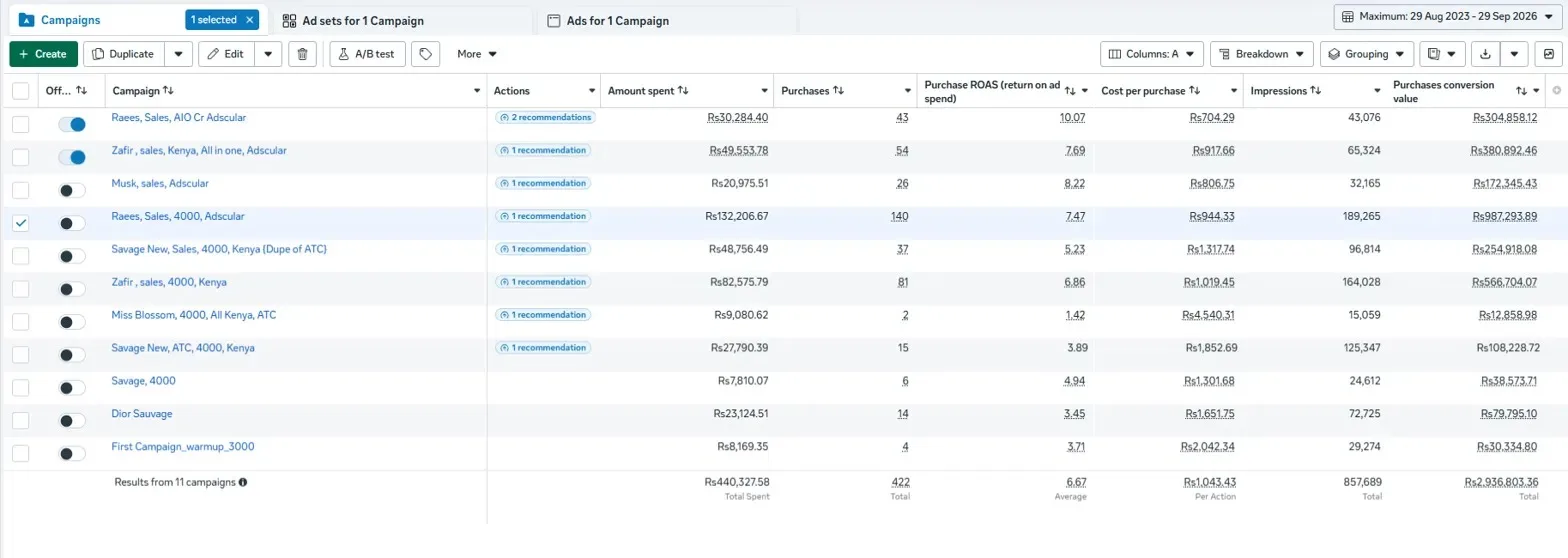
All 11 campaigns together
- Spend: $1,467.76
- Purchases: 422
- Cost per purchase: $3.48
- ROAS: 6.67x
- Purchase conversion value: $9,789.34
- Impressions: 857,689 Meta Ads Manager, all campaigns, as of Sep 29, 2026 Best-performing campaigns Six of the 11 campaigns returned more than 5x ROAS. These four stood out:
Campaign Spend Purchases Cost per purchase ROAS Purchase value Highest ROAS $100.95 43 $2.35 10.07x $1,016.19 Second highest ROAS $69.92 26 $2.69 8.22x $574.48 Third highest ROAS $165.18 54 $3.06 7.69x $1,269.64 Most purchases $440.69 140 $3.15 7.47x $3,290.98 Not every campaign performed the same. Some tests returned less, which is normal when you test new products and audiences. The overall result stayed strong at 6.67x.
Results are taken from Meta Ads Manager. ROAS is calculated on purchase conversion value. Results vary by product, price, offer and market.
Why It Worked
- Clean purchase data. Meta could learn from real sales, not just clicks.
- Testing gave clear winners. Running 11 campaigns showed what worked and what did not.
- Sales goal from day one. Every campaign was built for purchases.
- Steady monitoring. Cost per purchase and ROAS were checked, not guessed.
Key Takeaways
- Set campaigns to optimize for purchases, not traffic.
- Make sure purchase value is tracked correctly.
- Test several products and audiences, then focus on the winners.
- Judge results by cost per purchase and ROAS, not by likes or clicks.
Frequently Asked Questions
How much do Meta Ads cost for an online store?
It depends on your product and market. In this case study, the store spent $1,467.76 in total and paid an average of $3.48 per purchase.
What is a good ROAS on Facebook and Instagram ads?
A good ROAS is one that leaves you profitable after product cost and other expenses. This account reached 6.67x ROAS overall, and its best campaign reached 10.07x.
Do Meta Ads work for e-commerce?
Yes, when purchase tracking is set up correctly and campaigns are built for sales. This account produced 422 website purchases across 11 campaigns.
How many campaigns do I need to start?
You can start with one or two sales-focused campaigns. In this case study, 11 campaigns were tested and 6 of them returned more than 5x ROAS.
Can Adscular run Meta Ads for my business?
Yes. Adscular is a performance marketing agency that runs Meta Ads, Google Ads and TikTok Ads for businesses in Pakistan and the USA. Contact us for a free review of your account.
More results
All case studies →Roofing Contractor
Contracting & Renovation Company
Private Chef Company
Restaurant
E-commerce Store
E-commerce Food Brand
Local Service Business
Stop buying random marketing. Start building a growth system.
Then you do not need more random marketing. You need a performance growth system.