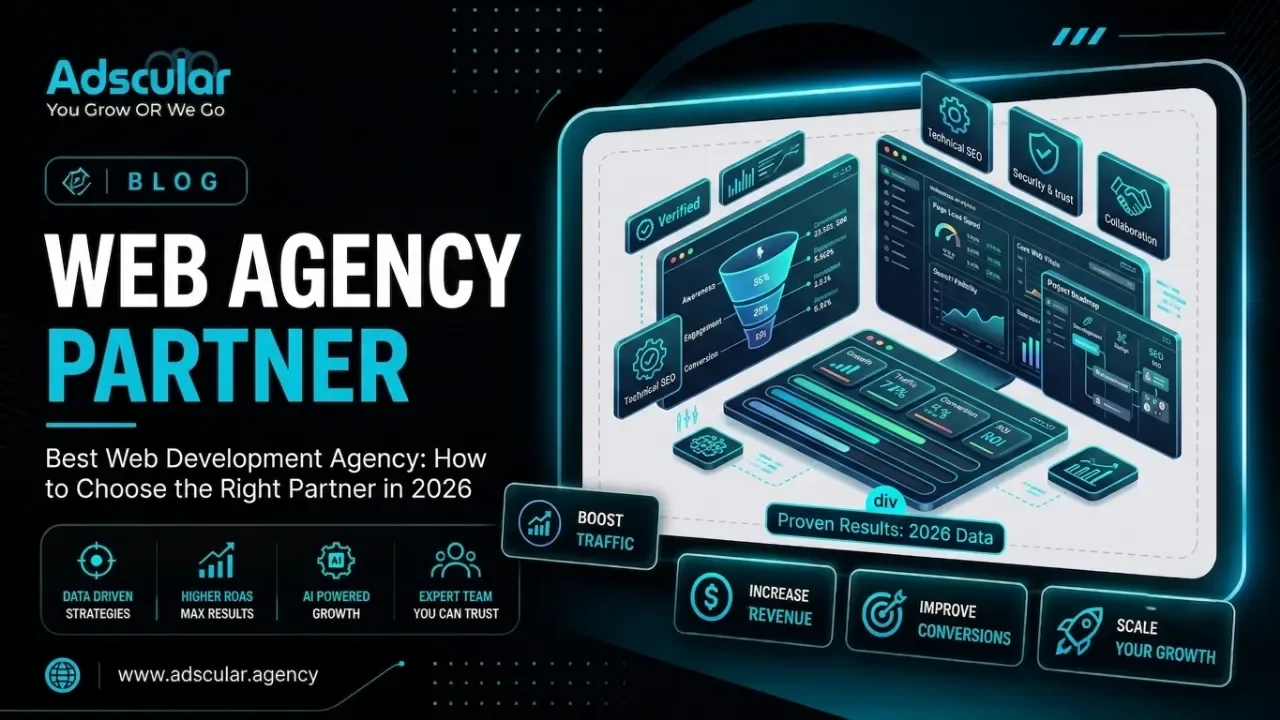
Best Web Development Agency: How to Choose the Right Partner in 2026
How to Choose a Web Development Agency Without Getting Burned
Written by the Adscular Agency growth team | Last updated July 7, 2026 | 8 min read
Introduction:
Quick Answer: The best web development agency for your business is the one that treats your website as a revenue system, not a design project. They audit your goals and your SEO architecture before a single wireframe gets drawn. They show you real work with real outcomes, not just screenshots. And they give you a price range up front instead of a vague "it depends" that turns into a change order three months in. Adscular Agency, a US-based performance marketing agency that builds and rebuilds websites specifically to generate leads and revenue rather than just look good, put this guide together from the pattern we see across dozens of agency-hire decisions.
The short answer: what actually separates a good web development agency from a bad one
A good web development agency asks about your business model before it asks about your color palette. It can show you a real conversion lift or traffic lift from past work, not just a portfolio of pretty homepages. And it tells you what your project will cost within a real range — not "let's hop on a call" three separate times before anyone says a number out loud.
Why the wrong web development agency costs you more than a bad website
Here's what most business owners don't realize until it's too late: a bad website isn't the worst outcome. A bad website that ranked well and generated leads for two years, then gets torn down and rebuilt by an agency that ignores your existing SEO equity — that's the expensive mistake. You lose backlinks, you lose indexed pages, you lose whatever rankings took years to build, and you find out three months after launch when traffic quietly drops 40%.
Most agencies won't tell you this part: the redesign itself is rarely the risk. The risk is hiring a team that treats SEO as an afterthought instead of a launch requirement. If your current agency conversation hasn't touched search architecture, redirects, or existing keyword rankings yet, that's worth flagging before you sign anything.
Custom development vs. CMS platforms: which does your business actually need?
This is the decision most guides skip entirely, and it's the one that actually determines your budget, your timeline, and how much control you'll have over your site five years from now.
Custom development means your site is built from the ground up on a framework like React or Node, with no platform license fees and no template constraints. It costs more up front and takes longer to launch, but it gives you full control over performance, integrations, and scale.
CMS platforms — WordPress, Shopify, Webflow, Framer — get you live faster and cost less initially, using pre-built themes and plugins you can manage yourself. The tradeoff shows up later: plugin bloat, slower page speed, and licensing or transaction fees that add up over time.
|
Approach |
Best for |
Typical cost range (US) |
Time to launch |
SEO control |
|
Custom development |
SaaS platforms, complex portals, high-traffic sites |
$15,000–$75,000+ |
8–16 weeks |
Full — no plugin or theme limitations |
|
WordPress |
Content-heavy sites, blogs, service businesses |
$5,000–$20,000 |
4–8 weeks |
Strong, with the right plugins and clean code |
|
Shopify |
E-commerce, product catalogs |
$6,000–$25,000 |
3–6 weeks |
Moderate — some technical SEO limits built into the platform |
|
Webflow / Framer |
Marketing sites, landing pages, small teams that want visual control |
$4,000–$15,000 |
2–5 weeks |
Good for on-page basics, weaker for large-scale content architecture |
If you're not sure which column you fall into, the honest answer is most SMBs overspend on custom development they don't actually need — a well-built WordPress or Webflow site handles 80% of business use cases just fine.
What a real web development agency price should look like
Most competitor guides either dodge this question or give you one number that means nothing without context. Here's a more useful breakdown by project type:
|
Project type |
Realistic US price range |
What's usually included |
|
Brochure site (5–10 pages) |
$3,000–$10,000 |
Design, copy integration, basic SEO setup, mobile responsiveness |
|
Lead-generation site |
$8,000–$25,000 |
Conversion-focused design, forms/CRM integration, on-page SEO, analytics setup |
|
E-commerce site |
$10,000–$40,000 |
Product catalog, payment integration, inventory sync, checkout optimization |
|
Enterprise / custom platform |
$40,000–$150,000+ |
Custom architecture, API integrations, scalable infrastructure, dedicated QA |
If a quote comes in dramatically below these ranges, ask what's being cut. It's almost always ongoing support, QA testing, or SEO setup — the three things that actually determine whether the site performs after launch.
7 questions to ask before you hire a web development agency
-
What does your discovery process look like before you start building?
A real discovery phase includes competitor research, user goals, and technical audit — not a single intake form.
-
Do I own the code and the domain after launch?
If the answer is unclear or "it depends," treat that as a serious warning sign.
-
What's your QA process before launch?
Ask specifically about cross-browser and mobile testing, not just "we test everything."
-
Will the site be built with SEO architecture in mind, or bolted on after?
Clean URL structure, proper heading hierarchy, and page speed should be part of the build, not a separate line item.
-
What happens after launch — is there a support plan?
Websites need maintenance. Ask what breaks first (usually plugins) and who fixes it.
-
Can I see a project from a client in a similar industry or budget range?
Not just any portfolio piece — one that matches your situation.
-
How do you communicate during the build?
Weekly check-ins, a shared project board, or radio silence until launch day — this tells you more about the relationship than almost anything else.
Red flags that mean you should walk away
- Guaranteed launch dates with no discovery phase. Nobody can promise a timeline before they understand the project.
- Vague budgets with large "to be determined" line items. That's where scope creep hides.
- Refusal to grant code or domain ownership. This should be a dealbreaker, not a negotiation point.
- No documented QA or testing process. If they can't describe how they catch bugs before launch, assume they don't.
- A portfolio with no recent work or no real client outcomes. Screenshots without results tell you nothing about whether the site actually worked.
If an agency gets defensive when you ask these questions directly, that's the answer. A partner worth hiring will welcome them.
Based in the US and evaluating a web development agency for your business? Get your free revenue growth audit from Adscular Agency — we'll show you exactly where your current site is leaking leads and what it would take to fix it.
How to evaluate a web development agency's past work
Don't just look at how a past project looks. Look at whether it worked.
What to look for in case studies: a stated business goal, a specific outcome tied to that goal (traffic, leads, conversion rate — not just "the client loved it"), and enough detail that you could roughly reproduce their logic for your own site.
Questions to ask their past clients, if you can reach one: Did the timeline hold? Did costs change mid-project? Would they hire the same team again for a second project? That last question tends to get the most honest answer of the three.
What a website rebuild should actually deliver
Based on rebuilds we've run across healthcare, legal, home services, and B2B SaaS clients in the US, a redesign done right typically improves three things at once: page load speed, organic search visibility, and on-site conversion rate — not just visual polish. Industry benchmarks for a well-executed SMB website rebuild generally show meaningful gains in each of these areas within 90 to 120 days of launch, provided the SEO architecture was preserved and the new design was built around a clear conversion path rather than aesthetics alone. Treat any specific percentage an agency quotes you before they've seen your site as a marketing claim, not a guarantee — ask instead for the methodology behind past results.
Frequently asked questions
How much does it cost to hire a web development agency?
Costs range from about $3,000 for a simple brochure site to $150,000+ for a custom enterprise platform. Most small and mid-size businesses land in the $8,000–$25,000 range for a conversion-focused, SEO-ready site.
Should I choose a custom website or a CMS?
Choose custom development only if you need complex functionality, heavy integrations, or scale beyond what a template can handle. Most businesses are better served — faster and cheaper — by a well-built WordPress, Shopify, or Webflow site.
How long does a website build usually take?
A brochure or lead-generation site typically takes 4 to 8 weeks. Custom platforms and enterprise builds usually run 8 to 16 weeks or longer, depending on integration complexity.
What's the difference between a web developer and a web designer?
A web designer focuses on layout, visual hierarchy, and user experience. A web developer writes the code that makes that design functional. Most agencies handle both, but it's worth asking who's doing which part of your project.
Can a new website actually improve my SEO and lead generation?
Yes, but only if SEO is part of the build itself — clean architecture, proper redirects from your old site, and a conversion path built into the design. A redesign that ignores SEO can just as easily hurt your rankings as help them.
The bottom line
The best web development agency isn't the one with the flashiest portfolio or the lowest quote — it's the one that can answer the pricing, ownership, and process questions above without hesitation. If you want a partner that builds websites as revenue systems rather than design exercises, get your free revenue growth audit from Adscular Agency. We'll show you exactly where your current site is leaking leads and what it would take to fix it. Want to go deeper on the platform side first? Read our full guide on web developer vs. web designer.