

Web Developer vs Web Designer: Which One Does Your Business Actually Need? (2026 Guide)
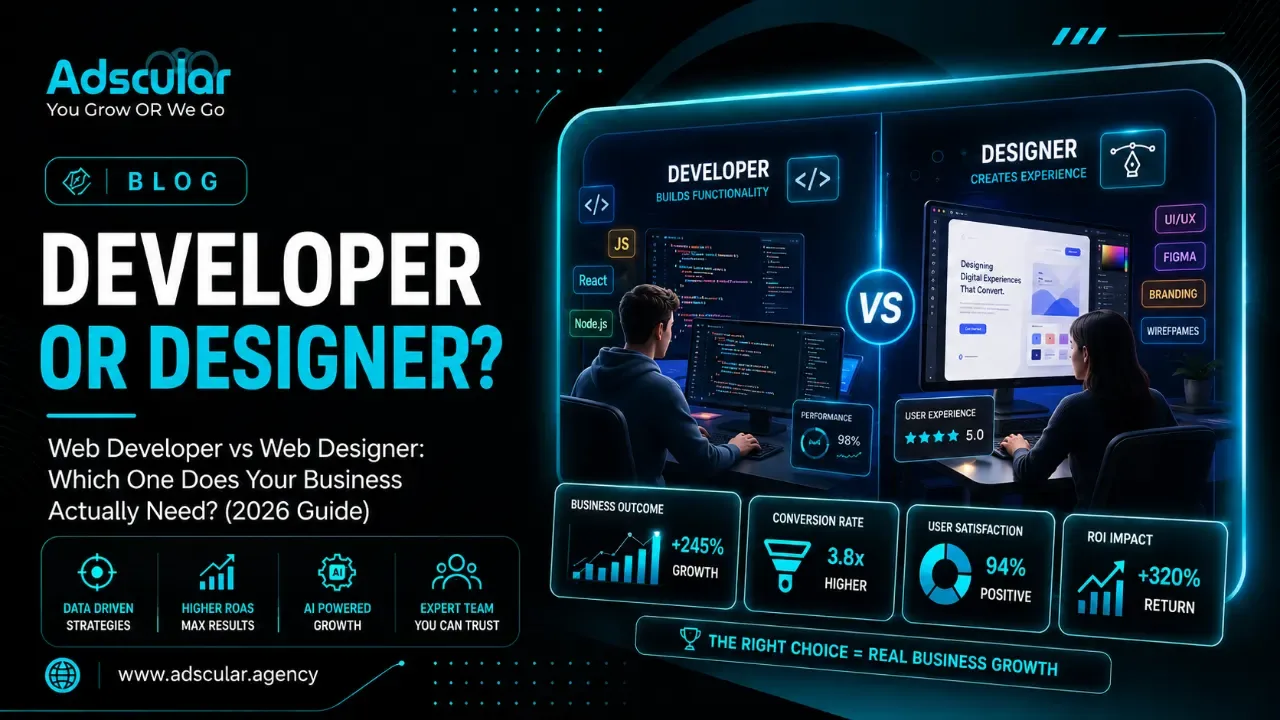
Web Developer vs Web Designer: Which Do You Need?
Written by the Adscular Agency growth team | June 25, 2026 | 8 min read
Introduction:
Quick Answer: A web designer controls how your website looks and feels. A web developer controls how it works. These are two distinct disciplines — different skill sets, different tools, different outcomes — and hiring the wrong one for your project costs you time, money, and conversions.
At Adscular Agency, we build performance-focused websites for service businesses, SaaS companies, and B2B firms across the US. The single most common mistake clients make before they reach us? Hiring one role when they needed both.
Web Developer vs Web Designer
A web designer creates the visual blueprint — layout, color scheme, typography, user experience. A web developer writes the code that turns that blueprint into a live, functional website. Most business websites need both to perform at the level that generates leads.
Why This Decision Directly Affects Your Revenue
Your website is either your best salesperson or your most expensive placeholder. Visitors form a visual first impression in approximately 50 milliseconds and roughly 46% judge your business's credibility based on design before they read a single word (Chetaru/Google research, 2026).
But design alone doesn't close deals. A website that looks polished but loads slowly, breaks on mobile, or buries its contact form loses leads before they convert. Sites loading in under one second convert at up to three times the rate of sites loading in five seconds (WordStream CRO Statistics, 2026). That's a developer's problem, not a designer's.
Both roles exist on the same revenue chain. Ignoring either one is where websites leak money.
For a deeper look at how your website fits into a full-funnel marketing system, read our guide on what is performance marketing.
What Does a Web Designer Actually Do?
A web designer is the architect of your user experience. Web designers work on everything a visitor sees, feels, and interacts with at a visual level — before a single line of code is written.
Core Responsibilities of a Web Designer
- Creating wireframes and prototypes in tools like Figma, Adobe XD, or Sketch
- Establishing color palettes, typography, and brand-consistent visual systems
- Designing page layouts with clear hierarchy and conversion psychology
- Planning user flows — the path a visitor takes from landing to contacting you
- Producing high-fidelity mockups that developers use to build the live site
Web designers specialize in UI (user interface) and UX (user experience) design. UI covers what elements look like — buttons, forms, menus, imagery. UX covers how those elements work together to move a visitor toward action. Both directly affect your conversion rate.
Tools a Web Designer Uses
|
Tool |
Purpose |
|
Figma |
UI design and prototyping (industry standard in 2026) |
|
Adobe XD |
Wireframing and interactive mockups |
|
Adobe Photoshop / Illustrator |
Graphics, image editing, brand assets |
|
InVision |
Client presentation and design feedback |
|
Canva (lite projects) |
Quick graphics and social assets |
A web designer does not typically write the code that makes your site go live. They hand finished design assets to a developer for implementation.
What Does a Web Developer Actually Do?
A web developer builds the functional structure behind what visitors see. Web developers take a designer's mockups and turn them into working websites using code — handling everything from page structure to database logic to server-side performance.
The Three Types of Web Developers
Understanding developer types prevents you from hiring the wrong specialist.
Front-end developers build the client-side layer — the HTML, CSS, and JavaScript that renders what users see in a browser. They take a designer's Figma file and make it a live, clickable, scrollable, responsive web page. Front-end developers work with frameworks like React, Vue, or Bootstrap to build faster and manage complex interactions.
Back-end developers handle the server-side infrastructure — databases, APIs, authentication systems, form processing, payment gateways. When someone fills out a contact form and it lands in your CRM, that's a back-end developer's work. Languages include PHP, Python, Node.js, Ruby, and Java.
Full-stack developers cover both front-end and back-end. A full-stack developer can take a project from design handoff to live deployment without needing additional technical support. For most small to mid-size business websites, a full-stack developer or a coordinated front-end/back-end pair is the most efficient path.
Tools a Web Developer Uses
|
Tool |
Purpose |
|
HTML / CSS / JavaScript |
Core front-end languages |
|
React / Vue / Angular |
Front-end frameworks for complex UIs |
|
PHP / Python / Node.js |
Back-end server-side languages |
|
WordPress / Webflow |
CMS platforms for managed site builds |
|
GitHub / Git |
Version control and code collaboration |
|
Google PageSpeed Insights |
Performance testing and Core Web Vitals |
Web Designer vs Web Developer: Side-by-Side Comparison
|
Factor |
Web Designer |
Web Developer |
|
Primary focus |
Visual aesthetics and user experience |
Code, functionality, and performance |
|
Output |
Mockups, wireframes, style guides |
Working, live website or application |
|
Tools |
Figma, Adobe XD, Photoshop, Illustrator |
HTML/CSS/JS, React, PHP, Python, WordPress |
|
Specialty |
UI/UX design, brand consistency, conversion layout |
Front-end, back-end, or full-stack builds |
|
Code fluency |
Limited to none (some understand HTML/CSS basics) |
Primary skill — the entire job is code |
|
US salary range (2026) |
$64,000–$117,000 median total pay (Glassdoor) |
$77,000–$132,000 median total pay (Glassdoor) |
|
When you need them |
Rebrand, new site visual concept, UX overhaul |
New site build, feature development, bug fixes, API integrations |
|
What they can't do alone |
Build a functional site |
Design a site that converts or feels on-brand |
The critical point in this table: neither role produces a revenue-generating website on its own. A beautiful design with poor code performance doesn't convert. Functional code without sound UX doesn't convert either.
Web Design vs Web Development: Which Comes First?
Design comes first. Always.
The correct sequence for any website project is:
- Strategy — Define business goals, target audience, conversion objectives, and site architecture
- Design — Create wireframes and high-fidelity mockups aligned to those goals
- Development — Build the approved design into a live, coded website
- QA and testing — Test performance, responsiveness, forms, and browser compatibility
- Launch — Deploy the site and configure analytics (Google Analytics 4, Google Search Console)
- Optimization — Monitor, test, and improve conversion rate post-launch
Skipping step one or two — going straight to development without design — is how businesses end up with technically functional websites that nobody converts on.
If your existing site has design and a CMS already in place but you're struggling to generate leads from it, the problem is usually conversion rate optimization, not more design or code. Read our full breakdown of what is conversion rate optimization is to understand where most sites leak revenue.
When Your Business Needs a Web Designer
Hire a web designer when the primary problem is visual or experiential:
- Your site looks outdated, inconsistent, or off-brand
- Visitors bounce quickly and your session duration is under 60 seconds
- Your brand identity is unclear or unestablished online
- You're redesigning a site from scratch and need a mockup to guide development
- Your UX is confusing — visitors can't find your service pages, contact form, or key offers
- You're preparing a new landing page for a campaign and need conversion-focused layout
A web designer cannot solve slow load times, broken forms, mobile rendering failures, or database problems. Those are code problems.
When Your Business Needs a Web Developer
Hire a web developer when the primary problem is functional or technical:
- Your site is slow — Largest Contentful Paint (LCP) above 2.5 seconds hurts both rankings and conversions
- Forms are broken, leads aren't reaching your CRM, or payment integrations aren't working
- You need custom functionality: booking systems, member portals, API connections, or dynamic content
- You want to install or configure a CMS like WordPress so your team can edit content without developer support
- Your site breaks on mobile or looks wrong in certain browsers
- You need to implement structured data (schema markup) for SEO performance
A web developer cannot make strategic decisions about your brand, UX flow, or visual hierarchy. Code can implement those decisions. It cannot originate from them.
When You Need Both — and What That Looks Like in Practice
Most business website projects require both roles working in sequence. Here's what that looks like for a realistic mid-market project:
Phase 1: Strategy (Days 1–7)
Define goals, audience, pages required, and conversion objectives. This is where Adscular Agency starts every web project — not with design preferences but with business outcomes.
Phase 2: Design (Weeks 2–4)
A designer creates wireframes and high-fidelity mockups for each key page: homepage, service pages, about, contact, and any landing pages. Client review and approval happens here.
Phase 3: Development (Weeks 4–10)
A front-end developer builds the approved design into a coded, responsive website. A back-end developer configures the CMS, integrates forms with your CRM, connects any APIs, and ensures the site meets Google's Core Web Vitals standards.
Phase 4: QA, Launch, and Optimization (Weeks 10–12)
Testing across devices and browsers. Speed optimization. Analytics configuration. Launch. The project doesn't end at launch — the first 30 days post-launch are when conversion data starts informing what to fix next.
A professional small-to-mid-size business website in 2026 typically costs between $2,000 and $8,000 for standard builds, with more complex builds — custom applications, e-commerce, advanced integrations — running $15,000 and above (WebFX / Chetaru, 2026). That range exists because the scope of design and development work is different for every project.
The "Full-Stack" Option: One Person for Both Roles?
Full-stack developers can handle both front-end and back-end development. They are the most efficient hire when a design is already finalized and the work is purely build-and-deploy.
What full-stack developers typically cannot do is replace a dedicated UX designer. They can implement design. They can translate a Figma file into code at a high level of fidelity. But making the strategic decisions about visual hierarchy, brand positioning, user flow psychology, and conversion layout — that's a designer's domain.
For very early-stage projects or simple brochure websites, a full-stack developer working from a quality template or existing brand guide is a practical cost-efficient option. For any project where conversion rate matters — and for any business running paid traffic to the site — a designer and a developer working together produces meaningfully better results.
Since your website is the landing destination for every paid ad you run, the performance of your development and design work directly multiplies or shrinks the ROI of your advertising spend. See how this connection works in our guide on how to lower customer acquisition cost.
Common Mistakes Business Owners Make When Hiring
Hiring a designer when they need a developer (or vice versa).
The most common version: a business hires a graphic designer to "make a website." The result is a beautiful PDF-style static site with no functional form, no CMS, no mobile optimization, and a load time that kills conversions.
Hiring a developer without a design brief.
Developers who build without a design system or conversion briefly default to templates and their own visual judgment. The technical execution is fine. The business outcomes are unpredictable.
Treating the website as a one-time cost.
A site built in 2023 and never updated doesn't meet 2026's Core Web Vitals standards, doesn't reflect your current positioning, and likely has broken integrations. The ongoing investment in web performance is where the ROI compounds.
Not pairing the website with a traffic strategy.
A well-designed, well-built website with zero traffic is an expensive brochure. The investment in design and development only pays off when paired with organic SEO, paid search, or both. Read our breakdown of SEO vs. Google Ads — which drives more leads to understand how to pair your site with the right traffic source.
Frequently Asked Questions
What is the main difference between a web developer vs web designer?
A web designer creates the visual layout and user experience of a website using tools like Figma and Adobe XD. A web developer writes the code that turns those designs into a live, functional website using languages like HTML, CSS, JavaScript, and PHP. Web designers focus on aesthetics and UX strategy. Web developers focus on technical implementation and functionality.
Can a web developer also be a web designer?
Some professionals have both skills — typically called UI developers or full-stack designers. They are uncommon at the specialist level. Most dedicated web developers have limited UX design training, and most dedicated designers have limited coding ability. For production-quality business websites where both conversion design and technical performance matter, hiring separately or through an agency that employs both is a stronger choice.
Is web design or web development harder to learn?
They're difficult in different ways. Web development requires fluency in programming languages and logic-based problem solving — a skill set that takes years to develop at a professional level. Web design requires mastery of visual principles, user psychology, and design tools — a creative discipline that blends intuition with data. Neither is easier. Both require significant professional investment to execute at a level that generates business results.
Do I need both a web designer and a web developer for my business website?
For most business websites where conversion matters, yes. A designer ensures visitors understand what you offer and are guided toward a clear action. A developer ensures the site loads fast, works on every device, and integrates with your business tools. Skipping either role produces a website that looks good but doesn't convert, or converts in theory but fails technically.
What does a full-stack developer do differently from a front-end developer?
A front-end developer builds only the client-side layer — what users see and interact with. A full-stack developer handles both front-end and back-end, meaning they can build the visible interface and the server-side logic (databases, APIs, form processing) that powers it. Full-stack developers are versatile but may not go as deep in either direction as a specialist would. For complex applications or high-traffic e-commerce builds, specialist front-end and back-end developers typically produce better outcomes.
How much does it cost to hire a web designer vs a web developer in 2026?
Web designers in the US earn a median total pay of $64,000–$117,000 per year, according to Glassdoor (March 2026). Web developers earn $77,000–$132,000 in the same range. Freelance project rates vary widely by scope and experience. For business website projects end-to-end, professional builds range from $2,000–$8,000 for standard sites, and $15,000+ for complex custom builds (WebFX 2026). Working with an agency that provides both design and development integration removes the coordination overhead of hiring separately.
The Bottom Line
A web designer and a web developer are not interchangeable. One creates the experience. The other builds the machine. Your business website needs both to turn traffic into revenue — and the sequence matters as much as the skills.
A website that looks right but performs poorly costs you leads. A website that performs technically but lacks UX strategy converts at a fraction of its potential. The highest-ROI web investment combines design and development with a shared conversion goal from day one.
At Adscular Agency, our website development services pair conversion-focused UX design with performance-grade development — built for the business outcomes you can measure, not just the aesthetics you can screenshot.
Ready to see what a revenue-focused website build looks like for your business? Book a free website strategy consultation →
We'll audit your current site, identify where it's leaking conversions, and show you exactly what design and development changes would move the needle — before you commit to anything.
Want to go deeper on site performance and conversion? Read our full guide on what is conversion rate optimization.