Full Service Marketing Agency: Services, Benefits, Costs, and How to Choose One in 2026
Introduction:
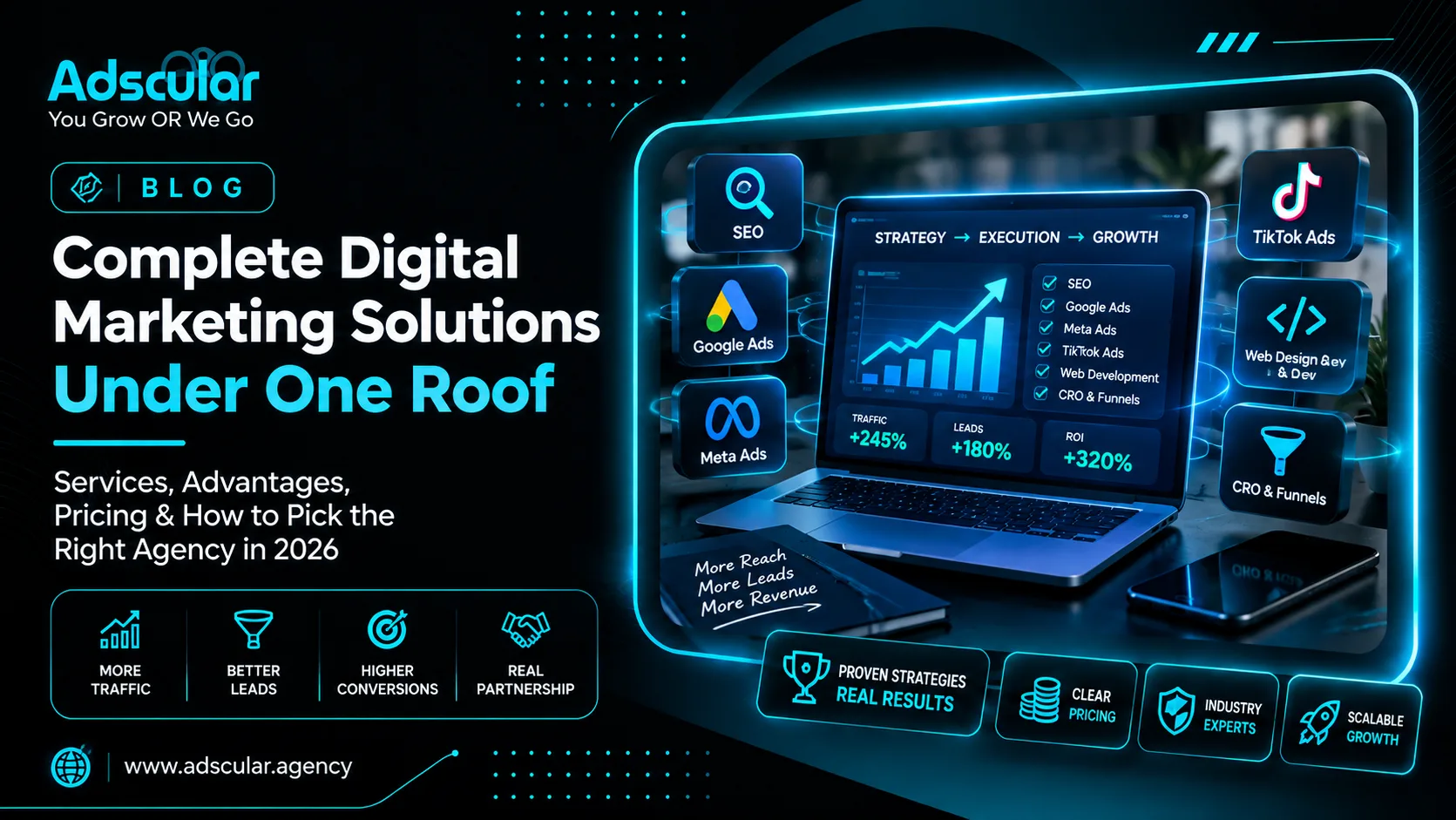
A full-service marketing agency helps businesses plan, execute, and measure multiple marketing activities through one coordinated team. Depending on the provider, services may include digital strategy, search engine optimization (SEO), paid advertising, social media marketing, content creation, website development, conversion rate optimization (CRO), and lead generation.
For businesses that need more than one marketing channel, working with a full-service marketing agency can simplify coordination and create a more consistent customer journey. However, the label “full service” does not automatically mean an agency is equally strong in every discipline or that every service is included in its standard package.
The right partner should understand your business goals, recommend appropriate channels, define responsibilities, and explain how its work will be measured.
This guide explains what a full-service marketing agency does, which services to look for, how the model compares with specialist agencies, and how to choose a partner for your business in 2026.
What Is a Full Service Marketing Agency?
A full-service marketing agency provides multiple marketing capabilities under one coordinated strategy. Instead of managing separate providers for SEO, advertising, website development, and content, a business can work with one agency to plan and coordinate these activities.
The goal is not simply to offer a long list of services. It is to connect marketing activities so that each contributes to a shared business objective, such as generating qualified leads, acquiring customers, increasing online sales, or improving customer retention.
For example, a B2B company might use SEO to attract buyers researching solutions, paid advertising to reach high-intent prospects, landing pages to convert visitors, and lead-nurturing campaigns to move qualified prospects toward a sales conversation.
When these activities share a clear strategy and measurement plan, the business can evaluate how its marketing works together instead of reviewing each channel in isolation.
What Services Does a Full-Service Marketing Agency Offer?
The exact scope varies by agency. Some focus primarily on digital marketing, while others also provide branding, public relations, traditional advertising, and broader creative services.
The following are common capabilities to consider when evaluating a full-service marketing agency.
1. Marketing Strategy and Planning
Marketing strategy establishes the direction for the rest of the work. It helps a business identify its target audience, market position, objectives, budget priorities, and most appropriate acquisition channels.
Typical activities include:
-
Audience and customer research
-
Competitor and market analysis
-
Positioning and messaging
-
Marketing channel selection
-
Campaign planning and budget allocation
-
KPI definition and performance measurement
A good strategy should explain why particular activities are recommended, what they are expected to achieve, and how the business will assess progress.
2. Search Engine Optimization (SEO)
SEO helps a business improve its visibility in unpaid search results when potential customers look for relevant products, services, or information.
A full-service marketing agency may provide technical SEO, on-page optimization, keyword research, content strategy, internal linking, local SEO, and relevant authority-building activities.
For example, a U.S. service business might need location-specific service pages and technical improvements, while an e-commerce business may need product and category page optimization.
Explore Adscular Agency’s SEO services to learn about SEO as part of a broader digital growth strategy.
3. Paid Advertising and Performance Marketing
Paid advertising can help businesses reach potential customers through platforms such as Google Ads and Meta Ads. Campaigns may focus on lead generation, online sales, remarketing, or brand awareness.
Common activities include:
-
Campaign planning and audience research
-
Search and paid social advertising
-
Ad creative and landing-page testing
-
Conversion tracking
-
Budget allocation and campaign optimization
-
Performance reporting
Paid advertising should be evaluated against the business objective. Clicks and impressions can indicate reach, but lead quality, customer acquisition cost, and revenue may be more relevant when the goal is profitable growth.
Businesses interested in search advertising can explore Adscular’s Google Ads services.
4. Social Media Marketing
Social media marketing helps a business build a presence, communicate with its audience, distribute content, and support customer acquisition.
Depending on the agreement, services may include content planning, creative production, publishing, community management, paid social campaigns, and analytics.
Organic social media and paid social advertising serve different purposes. Organic content can support ongoing engagement and brand communication, while paid campaigns can target defined audiences and test specific offers.
The right mix depends on the business, available creative resources, target audience, and campaign objectives.
5. Content Marketing and Creative Production
Content marketing gives potential customers useful information at different stages of their decision-making process.
An agency may create blog articles, landing-page copy, case studies, social content, email campaigns, video scripts, graphics, and other marketing assets.
Content should serve a defined purpose. An educational article might attract people researching a problem, while a case study may help a qualified buyer evaluate a provider.
Creative work should also maintain consistent messaging across channels so that customers receive a recognizable and coherent brand experience.
6. Website Design and Development
A website is more than a digital brochure. It often acts as the destination for organic traffic, paid campaigns, referrals, and social media visitors.
Website services may include:
-
Website design and development
-
Mobile-responsive layouts
-
Landing-page creation
-
Navigation and user experience improvements
-
Website performance improvements
-
Analytics implementation
-
Ongoing maintenance, where included
The scope matters. Some agencies build websites from the ground up, while others focus on landing pages, design updates, or conversion improvements.
Before signing an agreement, confirm whether development work, maintenance, hosting, and third-party software costs are included.
7. Conversion Rate Optimization (CRO)
Conversion rate optimization focuses on improving the proportion of visitors who complete a desired action, such as submitting a form, requesting a consultation, or purchasing a product.
CRO activities may include analyzing user behavior, reviewing forms and checkout flows, testing page layouts, improving calls to action, and identifying friction in the customer journey.
For example, if a landing page receives relevant paid traffic but generates few inquiries, the issue may involve the offer, page content, trust signals, form design, or audience alignment.
CRO should be guided by evidence rather than assumptions. Not every design change improves results, so testing and measurement are important when practical.
8. Lead Generation and Funnel Development
Lead generation helps businesses attract and capture potential customers. Funnel development connects the stages between initial discovery and a meaningful business outcome.
An agency may work on lead magnets, landing pages, forms, advertising campaigns, follow-up sequences, and qualification processes.
For B2B companies, this can include distinguishing between a raw inquiry and a qualified lead that matches the business’s target market.
The most useful reporting goes beyond counting form submissions. Where data is available, it should also consider lead quality, sales acceptance, pipeline contribution, and customer acquisition.
9. Email Marketing and Automation
Email marketing and automation help businesses communicate with prospects and customers after their initial interaction.
Services may include newsletter planning, segmentation, automated follow-up, abandoned-cart messages, lead nurturing, customer onboarding, and retention campaigns.
Automation should reflect actual customer needs and the business’s sales process. It also requires appropriate consent, data handling, and compliance with applicable laws.
Not every full-service marketing agency offers advanced CRM integration or automation implementation, so confirm the specific capabilities before choosing a provider.
10. Analytics and Performance Reporting
Analytics connects marketing activity with measurable outcomes. Without reliable measurement, a business may struggle to determine which channels are attracting valuable customers.
A reporting plan may include:
-
Organic search visibility and traffic
-
Paid campaign spending and conversions
-
Lead volume and qualification
-
Website conversion rates
-
Customer acquisition cost
-
Sales or revenue attribution, where measurable
-
Progress against agreed objectives
Reporting should define how each metric is calculated and acknowledge tracking limitations. Different advertising platforms may report conversions differently, so platform dashboards should not automatically be treated as a complete account of business performance.
Full Service Marketing Agency vs. Digital Marketing Agency
The terms are often used interchangeably, but they can describe different scopes.
A digital marketing agency generally focuses on online channels and activities. A full-service marketing agency may cover those channels as well as branding, offline advertising, public relations, and other marketing functions.
|
Area |
Digital marketing agency |
Full service marketing agency |
|
SEO and organic search |
Common |
Common, depending on scope |
|
Google and social advertising |
Common |
Often included |
|
Website and landing pages |
Frequently offered |
May be included |
|
Content and social media |
Frequently offered |
May be included |
|
Branding and creative |
Varies |
May include broader creative services |
|
Traditional advertising and PR |
Not always included |
May be included |
|
Integrated campaign planning |
Varies |
Often a central part of the offering |
These are general distinctions, not strict industry definitions. Some digital marketing agencies offer a very broad range of services, while some full-service agencies specialize in particular industries or campaign types.
When comparing providers, examine the actual scope of work rather than relying on the agency’s label.
What Are the Benefits of Hiring a Full Service Marketing Agency?
A full-service approach can be valuable when a business needs several marketing activities to work together.
One Coordinated Marketing Strategy
A shared strategy can help align advertising, content, SEO, website improvements, and lead follow-up around the same business objectives.
For example, keyword research may reveal what potential customers want to know, content can address those questions, and paid campaigns can test messaging or offers. Insights from these activities can inform future decisions.
Less Coordination Between Separate Vendors
When multiple providers work independently, someone inside the business must coordinate schedules, priorities, reporting, and handoffs.
A full-service agency may reduce this burden by managing several related activities under one agreement. The degree of coordination depends on how the agency structures its team and responsibilities.
More Consistent Brand Messaging
When the same strategy informs ads, landing pages, website content, and social media, customers can encounter more consistent messages throughout their journey.
Consistency does not mean using identical copy everywhere. Each channel should suit its audience and format while communicating the same core value proposition.
A More Connected View of Performance
An integrated team may be better positioned to investigate problems that cross channel boundaries.
For instance, a campaign may attract relevant visitors but produce few leads because the landing page is unclear. Another channel may generate many inquiries that rarely become customers. Reviewing these activities together can help identify where the process needs improvement.
Potentially Simpler Vendor Management
Working with one provider can reduce the number of contracts, meetings, and reporting relationships a business manages.
However, a single provider is not automatically cheaper. The overall cost depends on the scope, delivery model, team expertise, and work required.
What Are the Potential Drawbacks?
A full service model is not the best fit for every business.
Less depth in a specialist area: An agency may offer many services but have stronger expertise in some than others. Ask who will actually perform the work and what relevant experience they bring.
Higher cost for unnecessary services: If a business needs only one clearly defined service, paying for a broader engagement may be inefficient.
Dependence on one provider: Consolidating marketing can simplify coordination, but it also means the business should maintain access to its accounts, website, data, and marketing assets.
Unclear scope: The term “full service” does not guarantee that every service, deliverable, or implementation task is included. Get the scope in writing.
A successful partnership depends on fit, expertise, accountability, and the quality of execution—not the number of services listed on a website.
How Much Does a Full Service Marketing Agency Cost?
The cost of a full-service marketing agency depends on the breadth of work, the team’s seniority, the business’s needs, and whether the engagement involves ongoing management, one-time projects, or both.
Rather than relying on a generic industry average, compare proposals using the same scope.
|
Cost factor |
What to clarify |
|
Strategy and planning |
Is strategy included in the ongoing fee or billed separately? |
|
SEO and content |
How much research, optimization, and content production is included? |
|
Paid advertising |
Is campaign management separate from the advertising budget? |
|
Website work |
Are development, maintenance, and landing-page changes included? |
|
Creative production |
Are photography, video, design, and revisions included? |
|
Analytics |
Is tracking setup included, and which reports will be delivered? |
|
Additional tools |
Are software, CRM, and platform subscriptions extra? |
|
Contract terms |
What is the minimum commitment, and how can the engagement be changed or ended? |
A smaller business may need a focused combination of services, while a larger organization may require multiple specialists, ongoing creative production, complex analytics, and extensive campaign management.
Ask for a proposal that prioritizes the work you actually need. A transparent scope is more useful than a low headline price that excludes essential tasks.
How to Choose the Right Full Service Marketing Agency
Choosing an agency is a business decision. The objective is to find a team that understands your goals, has relevant capabilities, and can explain how the work will be delivered and evaluated.
1. Define Your Main Business Objective
Start with the outcome you want to improve. It could be qualified leads, e-commerce sales, organic visibility, customer acquisition cost, or a website that converts more effectively.
Clear objectives help agencies recommend appropriate activities instead of proposing every available service.
2. Confirm Relevant Experience
Ask whether the agency has worked with businesses of a similar size, industry, sales cycle, or business model.
Review case studies and references where available. Understand the baseline, timeframe, work performed, and metrics used. A result achieved for one business does not guarantee the same outcome for another.
3. Ask Who Will Do the Work
Find out who will manage the account and who will deliver SEO, advertising, creative, development, and analytics work.
If the agency uses external specialists or subcontractors, ask how their work is managed and who remains accountable for quality and deadlines.
4. Request a Clear Scope and Prioritized Plan
The proposal should identify deliverables, timelines, dependencies, approval processes, and exclusions.
It should also distinguish urgent tasks from longer-term opportunities. A credible agency should be able to explain why its proposed priorities suit your business.
5. Understand Reporting and Measurement
Ask which metrics will be tracked, how conversions will be defined, and how the agency will communicate progress.
For lead generation, consider lead quality and sales outcomes where data is available. For e-commerce, consider transactions, revenue, and margin-related measures alongside traffic.
6. Check Account and Data Ownership
Your business should understand who owns the website, advertising accounts, analytics properties, creative assets, and customer data.
Confirm that access, permissions, tracking configuration, and handover arrangements are documented before work begins.
7. Evaluate Communication and Accountability
Ask how frequently you will meet, who will answer questions, how approvals work, and how priorities can change.
Good communication makes it easier to understand progress, resolve problems, and keep marketing aligned with changing business needs.
8. Be Cautious About Guarantees
No agency can guarantee a specific Google ranking or a fixed amount of revenue from marketing without uncertainty.
Look for a clear process, realistic assumptions, transparent reporting, and a willingness to explain risks. Promises should not replace evidence or a documented plan.
Is a Full Service Marketing Agency Right for Your Business?
A full-service agency may be a good fit if your business needs several connected marketing activities and lacks the internal resources to coordinate them.
It may be especially useful when:
-
You need SEO, paid advertising, and website improvements to support one another.
-
Your business is growing, and marketing coordination is becoming difficult.
-
You need a consistent strategy across multiple customer touchpoints.
-
Your current providers report separate metrics without a shared view of performance.
-
You want one partner to coordinate defined marketing workstreams.
A specialist agency may be the better option if you have one specific problem, such as a technical SEO issue or a complex paid advertising account, and already have a capable team coordinating the rest.
A hybrid model can also work: an internal marketing leader manages the overall plan while specialists deliver specific services.
The best arrangement is the one that provides the right expertise and accountability for your needs.
Why Consider Adscular Agency?
Adscular Agency works across digital marketing services including SEO, Google Ads, Meta Ads, TikTok and Snapchat advertising, website development, conversion rate optimization, and lead generation.
These capabilities can support businesses looking to connect customer acquisition, website performance, and marketing measurement. The appropriate mix depends on the business’s goals, current marketing setup, and available resources.
If you are evaluating a marketing partner, start by identifying the main obstacle to growth and the work needed to address it. A clear diagnosis is more useful than choosing a provider simply because it advertises the largest service list.
You can explore Adscular Agency’s SEO services, review Google Ads management, or contact the team to discuss your business requirements.
Frequently Asked Questions
What does a full service marketing agency do?
A full-service marketing agency coordinates multiple marketing activities under one strategy. Depending on the provider, this may include SEO, paid advertising, social media, content, website development, branding, lead generation, and analytics.
What is included in full-service digital marketing?
Full-service digital marketing commonly includes online strategy, SEO, paid search and social advertising, content marketing, website and landing-page optimization, social media, and performance reporting. The exact deliverables vary by agency.
Is a full-service marketing agency worth it for a small business?
It can be worthwhile when a small business needs several connected marketing services and does not have the internal capacity to coordinate them. A focused specialist may offer better value when only one service is required.
What is the difference between a marketing agency and an advertising agency?
A marketing agency may cover strategy, research, positioning, SEO, content, customer acquisition, and measurement. An advertising agency generally emphasizes campaign creative, media planning, and advertising execution, although many providers offer overlapping services.
How do I compare full-service marketing agencies?
Compare relevant experience, service scope, delivery team, proposed priorities, reporting, contract terms, account ownership, and communication. Evaluate the evidence behind their claims and make sure the proposal addresses your actual business objectives.
Can one marketing agency manage all my marketing?
Some agencies can coordinate a broad range of marketing activities, but not every provider offers every discipline in-house. Confirm which services are available, who performs the work, and which activities require additional providers or fees.
How long does it take to see marketing results?
Timelines vary by channel, competition, website condition, implementation speed, and business model. Paid campaigns may generate early data once launched, while SEO and brand development often require longer-term work. No fixed timeframe guarantees a particular result.
Final Thoughts
A full-service marketing agency can help businesses coordinate multiple marketing activities through a shared strategy, consistent execution, and connected reporting. Its value depends on whether the team has the right capabilities, understands the business, and takes responsibility for the agreed work.
Before hiring an agency, define your goals, compare proposals on an equivalent scope, verify relevant experience, and agree on how success will be measured. Choose the partner that fits your actual needs—not simply the one that claims to do everything.