

← The Adscular BlogSEO / Digital Marketing
Digital Marketing Agency for Startups: A Practical 2026 Growth Guide
Adscular TeamOctober 7, 202622 min read
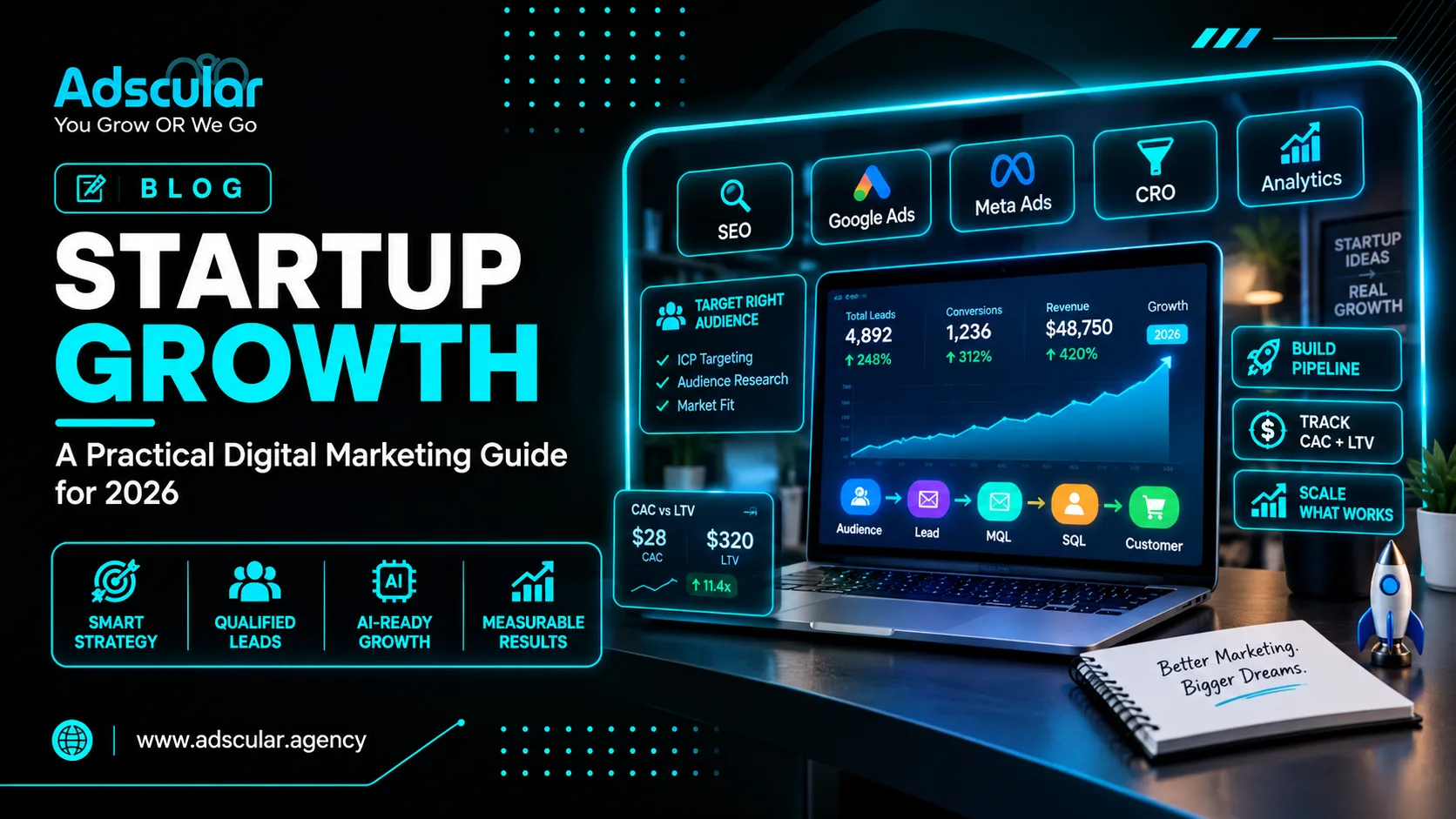
Startups rarely have unlimited time, budget, or room for inefficient marketing experiments.
A strong digital marketing strategy therefore needs to do more than create awareness. It should help a startup understand its market, reach the right buyers, test acquisition channels, convert interest into customers, and measure whether growth is economically sustainable.
A digital marketing agency for startups can support that process by combining strategy and execution across SEO, paid advertising, content, conversion optimization, social media, analytics, and marketing automation.
The right approach, however, depends heavily on the startup's stage.
A pre-seed company validating its offer should not necessarily use the same marketing system as a Series A SaaS company trying to scale predictable acquisition.
The most effective startup marketing strategy starts with the business model, customer, growth stage, and biggest constraint—not with a list of trendy marketing channels.
What Does a Digital Marketing Agency for Startups Actually Do?
A startup-focused digital marketing agency helps turn limited marketing resources into a structured customer acquisition system.
Depending on the business model and growth stage, that system can include:
- Go-to-market strategy
- Market and audience research
- Brand positioning
- SEO
- Content marketing
- Google Ads
- Meta Ads
- LinkedIn advertising
- Landing page development
- Conversion rate optimization
- Lead generation
- Email marketing
- Retargeting
- Marketing automation
- CRM integration
- Analytics and attribution
- AI search and GEO optimization
The important point is that these services should not operate as isolated campaigns.
For example, SEO may attract a potential buyer, content may answer the buyer's questions, a landing page may capture the lead, automation may nurture the prospect, and sales may eventually close the opportunity.
That creates a connected journey:
Discovery → Education → Conversion → Qualification → Sales → Customer
Adscular's current growth model follows a similar connected structure, combining demand acquisition, conversion architecture, revenue intelligence, and scale optimization rather than treating each marketing service as a separate activity.
Why Startups Need a Different Marketing Approach
Startups usually operate under constraints that established businesses may not face.
There may be:
- Limited brand recognition
- Small marketing teams
- Uncertain product-market fit
- Limited customer data
- Short financial runways
- Changing positioning
- Few established acquisition channels
- Pressure to demonstrate traction
That makes experimentation important.
But uncontrolled experimentation can become expensive.
A startup should know:
What is being tested?
Why is it being tested?
What does success look like?
What happens if the test fails?
This is where a structured startup growth strategy becomes more valuable than simply increasing marketing activity.
Marketing Priorities Change With Startup Stage
Not every startup needs the same marketing system.
Pre-Seed: Validate Before Scaling
At the pre-seed stage, the priority is usually learning.
Marketing can help answer questions such as:
- Who responds to the product?
- Which problem creates the strongest demand?
- Which message gets attention?
- Which audience converts?
- Which acquisition channel shows early promise?
At this stage, a complicated marketing stack can create unnecessary overhead.
A focused combination of positioning, customer research, landing-page testing, founder-led content, and small acquisition experiments can provide more useful information.
The goal is not to look bigger than the startup is.
The goal is to discover what the market actually responds to.
Seed Stage: Build Repeatable Acquisition
Once a startup has stronger evidence of product-market fit, the focus can shift toward repeatability.
This may involve:
- SEO foundations
- Content clusters
- Paid search
- Paid social
- Email nurture
- Lead-generation funnels
- Conversion optimization
- CRM integration
- Retargeting
- Performance reporting
The objective is no longer to discover whether someone wants the product.
It becomes:
Can the startup acquire customers repeatedly at an economically sensible cost?
Growth Stage: Scale What Has Been Proven
Growth-stage startups face a different challenge.
They may already know which channels work, but scaling them can introduce new problems.
Customer acquisition costs can rise.
Competition can increase.
Audiences can become saturated.
Paid media efficiency can decline.
Organic opportunities can become more competitive.
At this stage, marketing needs stronger experimentation, attribution, segmentation, automation, and channel diversification.
Scaling should come after you understand the underlying economics.
The Core Services a Startup Marketing Agency Should Provide
1. Go-to-Market Strategy
Marketing should begin with positioning and audience clarity.
A startup's go-to-market strategy should identify:
- Ideal customer profile
- Core problem
- Value proposition
- Competitive difference
- Pricing logic
- Distribution channels
- Acquisition model
- Conversion path
- Sales process
A startup looking to hire a digital marketing agency for a startup go-to-market strategy should therefore evaluate strategic capability before looking only at individual services.
A strong agency should explain why a particular channel fits the startup, rather than recommending every available platform.
2. SEO and Organic Growth
SEO can become a valuable long-term acquisition channel because useful content can continue attracting relevant search traffic after publication.
A startup SEO strategy can include:
- Technical SEO
- Keyword research
- Search-intent mapping
- Topic clusters
- Commercial landing pages
- Product-led content
- Comparison content
- Industry pages
- Internal linking
- Digital PR
- Structured data
- AI-search optimization
The objective should not be to create hundreds of pages simply because different keyword variations exist.
Each page should have a clear purpose and provide useful information to the audience.
For startups building an organic acquisition engine, Adscular's SEO and organic search growth offering focuses on technical SEO, high-intent keyword strategy, content, topical authority, and search visibility.
3. Paid Acquisition and Performance Marketing
Paid advertising can give startups faster market feedback than many organic channels.
Google Ads can capture existing search demand.
Meta Ads can create and nurture demand.
LinkedIn can help reach professional audiences.
Retargeting can reconnect with visitors who did not convert.
The strongest campaigns connect:
Audience → Offer → Creative → Landing Page → Conversion → Revenue
For a growth hacking and performance marketing agency for startups, experimentation should be structured, not random.
Useful tests may include:
- Different value propositions
- Landing-page headlines
- Offers
- Audiences
- Ad creative
- Calls to action
- Lead forms
- Search-intent segments
The goal is to learn which combinations produce qualified customers—not simply which advertisement receives the most clicks.
For startups relying on high-intent search, Adscular's Google Ads services for U.S. businesses focus on search intent, campaign architecture, conversion tracking, landing-page alignment, CAC, and ROAS.
4. Landing Pages and Conversion Rate Optimization
Traffic has limited value if the destination doesn't convert.
A startup landing page should quickly communicate:
- What the company offers
- Who it is for
- Which problem it solves
- Why the solution is credible
- What action the visitor should take
CRO can then improve the journey through structured testing.
Areas worth evaluating include:
- Headline clarity
- Page speed
- Mobile usability
- CTA placement
- Form length
- Trust signals
- Pricing presentation
- Product demonstrations
- Testimonials
- Objection handling
Adscular's conversion rate optimization guide explains the relationship between acquisition, conversion efficiency, and revenue, including why more traffic is not always the answer to a growth problem.
5. Content and Inbound Marketing
Content should support the buying process rather than exist solely for search engines.
Useful startup content can include:
- Educational guides
- Product comparisons
- Case studies
- Industry research
- Customer stories
- Implementation guides
- Pricing explanations
- Product tutorials
- Founder perspectives
- Expert commentary
For a b2b lead generation agency for enterprise tech startups, content may focus heavily on technical education, industry-specific problems, buying committees, case studies, and sales enablement.
For a consumer startup, the strategy may instead emphasize product discovery, creators, reviews, social distribution, and retention.
The audience determines the content architecture.
6. Founder-Led Content and Personal Branding
Early-stage companies often have something established brands cannot easily manufacture: direct access to the people building the product.
Founder-led content can communicate:
- Product insight
- Industry experience
- Customer problems
- Lessons from experimentation
- Market observations
- Company vision
It can be particularly useful on professional platforms where potential buyers can engage with useful expertise before becoming direct customers.
The goal isn't to turn every founder into a full-time influencer.
It is to create credible evidence that real people understand the problem the company is solving.
7. AI Search and GEO
Search behavior continues to evolve.
Potential customers increasingly use AI-powered search and conversational tools to research companies, products, and solutions.
Startups can prepare by making their information:
- Clear
- Specific
- Consistent
- Well structured
- Supported by evidence
- Easy to understand
- Connected to authoritative sources
This can include structured website content, strong entity information, expert contributions, original research, useful comparisons, and clear product documentation.
A digital marketing agency specializing in AI startups may place additional emphasis on explaining complex products clearly enough for both traditional search and AI-mediated discovery.
AI optimization should still begin with useful information rather than attempts to manipulate answer engines.
8. Customer Acquisition Cost and Lifetime Value
Traffic and leads do not automatically mean sustainable growth.
Two numbers become particularly important as startups mature:
Customer Acquisition Cost (CAC)
and
Customer Lifetime Value (LTV).
and
Customer Lifetime Value (LTV).
A digital marketing agency to lower customer acquisition cost for startups should therefore look beyond advertising CPC.
The agency may need to investigate:
- Conversion rate
- Lead quality
- Sales conversion
- Retention
- Pricing
- Average order value
- Customer lifetime
- Channel mix
Adscular's Performance Marketing KPIs guide covers CAC, ROAS, CPL, LTV, conversion rate, pipeline revenue, and other metrics that connect marketing activity to business outcomes.
9. Product-Led Growth
Some SaaS and technology startups can acquire customers through the product itself.
A digital marketing agency for product-led growth startups may therefore work on the journey from acquisition to product activation.
The funnel could look like:
Content → Website → Free Trial → Activation → Product Usage → Paid Conversion → Retention
Marketing and product teams need to work closely together in this model.
A campaign that produces thousands of free trials is not necessarily successful if very few users activate or become paying customers.
The key metric is the movement from attention to meaningful product usage and, eventually, revenue.
10. Fractional Marketing Leadership
Some startups need strategic leadership before they need a large marketing department.
A fractional CMO and digital marketing agency for seed-stage startups can combine strategic direction with outsourced execution.
This model can help establish:
- Marketing priorities
- Channel strategy
- KPIs
- Budget allocation
- Reporting
- Positioning
- Hiring requirements
- Agency/vendor management
The important consideration is whether the arrangement provides genuine strategic ownership rather than simply adding another layer of meetings.
Specialized Startup Marketing Needs
Not every startup fits a general marketing model.
AI Startups
AI products can be difficult to explain because the technology may be more complex than the customer's actual problem.
Positioning should translate technical capabilities into practical business outcomes.
Fintech Startups
Trust, compliance, security, and credibility can strongly influence acquisition.
A digital marketing agency for fintech startups should understand that conversion may depend on more than creative advertising.
Healthcare and MedTech
A digital marketing agency for healthcare and medtech startups needs to account for industry-specific trust, privacy, regulatory considerations, and buyer education.
SaaS
A b2b saas digital marketing agency for growth-stage startups may focus on pipeline generation, product positioning, SEO, paid acquisition, demos, free trials, and retention economics.
Direct-to-Consumer
A performance marketing agency for direct-to-consumer startups may place more emphasis on creative testing, paid social, product feeds, landing pages, email, retention, and customer acquisition economics.
Adscular's own broader performance marketing framework connects SEO, Google Ads, Meta Ads, CRO, lead generation, and revenue measurement rather than treating those channels as completely separate systems.
What About Bootstrapped Startups?
Bootstrapped companies usually need to be especially selective with marketing spend.
A digital marketing agency for bootstrapped startups with a low budget should not automatically recommend an expensive full-service package.
A more sensible approach may prioritize:
- Clear positioning
- One strong acquisition channel
- Conversion-ready website
- Useful organic content
- Basic analytics
- Retargeting where appropriate
- Gradual expansion
The right strategy depends on the startup's market, margins, sales cycle, and existing traction.
"Affordable" should not simply mean the lowest monthly fee.
It should mean that the marketing investment makes economic sense.
Programmatic SEO for Startups: When It Makes Sense
A startup with genuinely scalable data or distinct commercial pages may have an opportunity to use programmatic SEO.
Examples can include businesses with:
- Large product inventories
- Multiple legitimate use cases
- Distinct geographic markets
- Unique datasets
- Industry-specific landing pages
- Large collections of integrations
A programmatic seo and inbound marketing agency for startups should therefore focus on useful, differentiated pages rather than generating large numbers of near-identical URLs.
The question should always be:
Does each page give the user a reason to exist?
If the answer is no, creating more pages can add complexity without creating meaningful search value.
How Should a Startup Choose a Marketing Agency?
Choosing an agency should involve more than comparing service lists.
A startup should investigate five areas.
1. Startup Experience
Does the agency understand startup constraints?
A company selling enterprise software has different requirements from a consumer mobile application.
2. Strategic Thinking
Can the agency explain why a particular channel should be prioritized?
A strong partner should be comfortable saying no to unnecessary tactics.
3. Measurement
The agency should define meaningful KPIs before campaigns begin.
Metrics may include:
- CAC
- CPL
- Conversion rate
- Qualified leads
- Pipeline
- Revenue
- ROAS
- LTV
For a deeper evaluation framework, see How to Choose a Performance Marketing Agency. Adscular's own framework emphasizes attribution, stage fit, delivery capability, and whether an agency can connect marketing activity to measurable business outcomes.
4. Communication
Startup marketing changes quickly.
The agency should provide clear reporting and explain what was learned from both successful and unsuccessful experiments.
A useful reporting system should answer:
- What happened?
- Why did it happen?
- What was learned?
- What changes next?
- What business result did it influence?
5. Ability to Scale
The marketing system should evolve as the startup grows.
A company should not have to rebuild everything when it moves from seed stage to a larger growth phase.
The agency should be able to adapt its strategy as acquisition channels, customer segments, budgets, and economics change.
What Should Startup Marketing Cost?
There is no universal startup marketing price.
Costs vary according to:
- Startup stage
- Industry
- Geography
- Acquisition channel
- Sales cycle
- Competition
- Creative requirements
- Advertising budget
- Technical complexity
- Agency involvement
Common agency pricing structures include:
- Monthly retainers
- Project-based engagements
- Fixed packages
- Performance-based arrangements
- Hybrid models
The key is separating agency fees from media spend.
A startup should understand exactly how much it's paying for strategy and execution and how much it's investing in advertising platforms.
The cheapest provider is not necessarily the lowest-cost option if poor execution creates wasted spend.
A Practical 90-Day Startup Marketing Roadmap
A practical starting framework can be divided into three phases.
Days 1–30: Foundation
The focus is understanding the business.
Tasks can include:
- ICP research
- Positioning
- Competitor analysis
- Analytics setup
- Conversion tracking
- Website audit
- Search-intent research
- Landing-page review
- Channel prioritization
Days 31–60: Testing
The next phase introduces controlled experiments.
Potential activities include:
- SEO content
- Google Ads
- Meta Ads
- LinkedIn campaigns
- Founder content
- Landing-page tests
- Retargeting
- Lead nurturing
Each experiment should have a defined hypothesis and measurement framework.
Days 61–90: Optimization
The final phase focuses on identifying what deserves additional investment.
The team can evaluate:
- Qualified lead volume
- CAC
- Conversion rate
- Sales quality
- Pipeline
- Revenue contribution
- Channel efficiency
Reduce underperforming activities while giving stronger opportunities more attention.
Google Ads vs. Meta Ads for Startups
The correct platform depends on how customers discover the product.
Google Ads is generally strongest when you can capture existing demand through relevant search queries.
Meta can be more useful when visual creative, audience discovery, demand creation, or retargeting plays a major role.
The difference is essentially:
Google captures existing intent.
Meta can create and nurture demand.
Adscular's Google Ads vs. Meta Ads comparison explains this distinction. It provides a framework for deciding how the channels can work together rather than treating them as an either-or decision.
Why Audience Definition Comes Before Campaign Launch
A startup cannot build an efficient acquisition strategy without understanding who it wants to reach.
A broad description such as:
"B2B companies"
is rarely enough.
A stronger customer definition might specify:
- Industry
- Company size
- Revenue
- Geography
- Job role
- Problem
- Buying trigger
- Budget
- Existing solution
Adscular's Target Audience in Marketing guide covers the connection between audience definition, SEO, Google Ads, Meta Ads, content, and conversion paths.
The principle is simple:
Better audience definition → better messaging → better targeting → better conversion opportunities.
What Should Startup Marketing Actually Measure?
A dashboard with dozens of metrics doesn't automatically lead to better decisions.
A startup should begin with metrics connected to its business model.
| Metric | What it reveals |
|---|---|
| Traffic | Whether the business is attracting attention |
| Conversion rate | How efficiently visitors take action |
| CPL | Cost to generate a lead |
| CAC | Cost to acquire a customer |
| MQLs | Marketing-qualified demand |
| SQLs | Sales-qualified opportunities |
| Pipeline | Potential revenue entering sales |
| ROAS | Revenue relative to advertising spend |
| LTV | Long-term customer value |
| Revenue | Commercial outcome |
Adscular's performance marketing content similarly emphasizes CAC, ROAS, CPL, LTV, conversion rate, pipeline revenue, and attribution rather than relying only on traffic or impressions.
The Right Agency Is Not Always the One Offering the Most Services
A startup may encounter agencies offering dozens of services.
That can look attractive.
But a long service list does not necessarily indicate strategic quality.
The better question is:
Can the agency identify which two or three activities should matter most right now?
For example, a startup preparing for launch may need positioning, a conversion-ready website, and targeted acquisition testing.
Another startup may already have strong demand but poor conversion.
A SaaS company may need SEO and product-led acquisition.
A DTC startup may need creative testing and paid social.
Marketing should follow the bottleneck.
A Practical Startup Growth Model
A useful framework is:
1. Position
Clarify who the startup serves and why the product matters.
2. Attract
Use SEO, paid media, content, partnerships, and social channels to reach relevant audiences.
3. Convert
Build landing pages, offers, demos, trials, and lead forms that make the next step clear.
4. Nurture
Use email, retargeting, automation, and useful content to continue the relationship.
5. Measure
Track the metrics that connect marketing activity to customers and revenue.
6. Scale
Increase investment only after the underlying economics and conversion path make sense.
This approach creates a marketing system instead of a collection of disconnected campaigns.
How Marketing Connects to Sales
Marketing should not stop when someone fills out a form.
The actual journey may look like:
Visitor → Lead → Qualified Lead → Opportunity → Customer
Every stage can lose potential revenue.
That is why marketing and sales should share visibility into:
- Lead source
- Campaign
- Landing page
- Customer problem
- Lead quality
- Follow-up
- Sales outcome
For businesses working to strengthen the connection between acquisition and sales execution, Adscular's How to Improve Sales Performance provides a complementary framework around lead quality, conversion, follow-up, funnels, and revenue growth.
Final Takeaway
A startup does not need the biggest marketing operation.
It needs a marketing system that matches its stage, audience, economics, and growth objective.
A strong partner can help establish the foundation through positioning and go-to-market strategy, build acquisition through SEO and paid media, improve conversion through CRO, develop trust through useful content, and connect everything through measurement and automation.
The most important question is therefore not simply:
Which agency offers the most services?
It is:
Which partner can identify the startup's biggest growth constraint, test the right solution, measure the outcome, and build on what actually works?
That is the role a modern digital marketing agency for startups should play.
DTC startup marketingstartup marketing automationB2B startup marketingstartup marketing strategySaaS startup marketingstartup growth strategystartup paid advertisingdigital marketing for startupsstartup digital marketing agencystartup content marketingstartup performance marketingstartup marketing agencystartup lead generationstartup growth marketing